How we place Ohio University nursing students, step by step
You tell us your Ohio University program, the NRSE course that needs a preceptor, your city and the semester it runs. We search close to home for a clinician who suits that course, confirm them, prepare what faculty review for approval and the clinical packet, and watch hospital-system windows. Then we stay on call until your final hour is logged.
Start with your course
Program, city and clinical start are enough for your placement advisor to begin.
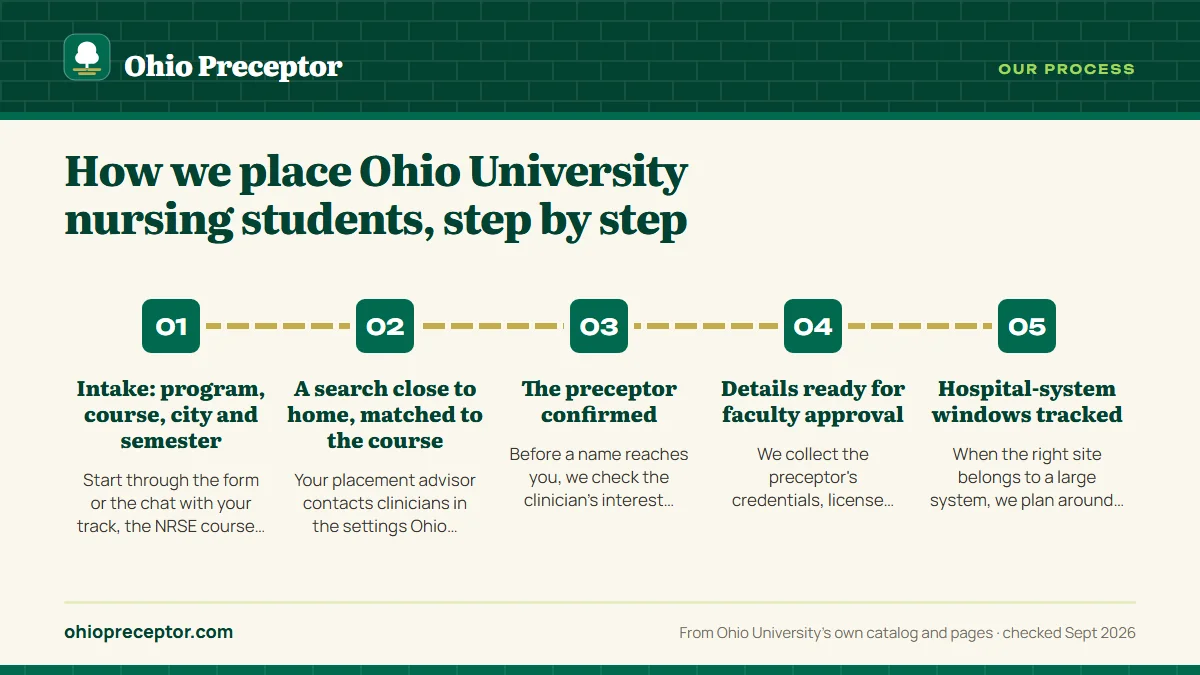
The six steps
Every Ohio University placement we run follows the same order, because the university's own process runs in that order: a preceptor you identify, faculty approval, then a clinical packet due weeks before the term.
- Intake: program, course, city and semesterStart through the form or the chat with your track, the NRSE course that needs a preceptor, where you will train and which term it runs. A course number such as
NRSE 6841tells us more than a program name, because each practicum asks for a different kind of clinical day. - A search close to home, matched to the courseYour placement advisor contacts clinicians in the settings Ohio University names for your track, starting near where you live and widening only as far as you are willing to drive.
- The preceptor confirmedBefore a name reaches you, we check the clinician's interest, the days they can offer and whether their site runs its own student application or asks for an affiliation agreement. You then talk with them yourself, and the decision is yours.
- Details ready for faculty approvalWe collect the preceptor's credentials, license information and site details in the order your clinical packet asks for them. Ohio University faculty make the approval decision; our part is a file that arrives complete.
- Hospital-system windows trackedWhen the right site belongs to a large system, we plan around that system's own application date, which Ohio University lists separately from the packet deadline.
- On call all semesterOnce clinicals begin, your placement advisor stays reachable. If a preceptor steps away mid-course, the replacement search starts that week.
What to send us at intake
Your first message needs only a handful of facts, and each one shapes where we look. Send what you know; your placement advisor fills any gaps with you by email, chat or WhatsApp.
- Your program as Ohio University names it, for example MSN Psychiatric Mental Health NP or the Post-Master's AG-ACNP Certificate.
- The course that needs a preceptor, such as
NRSE 6840,NRSE 6843,NRSE 6846orNRSE 8920. - The term it runs: fall, spring or summer.
- Your city and state, plus a realistic driving radius for clinical days.
- Any clinician or site you have already approached, so nobody is asked twice about the same student.
- Your employer, if you work for a hospital system: some systems' own pages give their employees priority for student rotations.
Leave medical records and compliance documents out of that first message. We ask for a specific item only when a site needs it.
How we match the search to your course
Ohio University's NP practicums build on one another, so the course number decides which sites make sense. In the FNP sequence, NRSE 6840 covers comprehensive primary care across the lifespan, NRSE 6841 moves to patients with complex conditions, and NRSE 6842 frames you as an entry-level clinician handling acute, chronic and well visits. A clinician who suits the first course may be a poor match for the third, so we search against the course description as well as the track.
Each MSN NP practicum carries 250 hours in a 15-week course, and we ask every candidate whether their schedule can carry that load. Settings follow Ohio University's own wording: primary-care offices and hospital or community-based clinics for FNP; critical care units, hospital-based medicine and emergency units for AG-ACNP, where the catalog describes supervision by acute-care physicians and advanced practice providers; and community mental health agencies, correctional facilities, school-based health centers or substance-abuse treatment programs for PMHNP. The clinical hours page sets out every program's courses.
What faculty receive, and when
Ohio University lets graduate students identify their own preceptor, subject to faculty approval, and faculty see that preceptor and site through the clinical packet. The packet has a fixed date each term; the spring 2027 packet, for example, is due 11/09/2026. Every date for the year is on the packet deadlines page.
Packet contents are not public. The School of Nursing keeps current forms behind a university login and sends the clinical overview sheets and preceptor packet on request to graduatenursing@ohio.edu. We work from the version you receive, so what we prepare lines up with the form faculty use. Documents for clinical placements go into Typhon as the School of Nursing instructs; the Typhon guide explains that system.
The costly mistake is treating the first day of class as your deadline. The clinical packet is due seven to nine weeks earlier, and some hospital applications close well before the packet.
Hospital systems keep their own calendar
Ohio University's MSN FAQ warns that big hospital systems may insist students use their own central process for assigning preceptors, with requests often due well in advance. The Nursing Knowledge Center's Important Dates page lists facility application deadlines for four Ohio systems: Cleveland Clinic, Holzer, Mount Carmel and OhioHealth. Holzer's comes first each term, about four and a half months before classes start, and the page marks every date as subject to change at the facility's discretion.
When a system site is the best fit, we confirm the current window with the system, build your plan around it and keep a community practice or health center in view as a second option. Each system's published terms are on the hospital system applications page.
After the match: on call to the last hour
Your placement advisor stays available for schedule changes, site questions and anything that puts your hours at risk. If a preceptor leaves a practice, changes roles or cuts back their clinic days, we start looking for a replacement that week and prepare the new clinician's details for faculty the same way as the first. What to tell faculty first is on the preceptor dropped out page.
Ohio University's FNP and PMHNP pages describe one clinical course per semester once clinicals begin, and the next course often calls for a different setting. We start that next search early, timed to the following packet deadline, so each practicum in your sequence opens with a preceptor already in place.
Questions Ohio University students ask
How long will my search take?
That turns on your track, your area and how much time remains before the packet deadline. Primary care near a city usually moves faster than acute care in a rural county. Starting a full term ahead gives you the widest choice; if your deadline is only weeks away, say so at intake and your placement advisor works the quickest routes first. See need a preceptor fast.
Do I get to speak with the preceptor before committing?
Yes. You talk with every preceptor we confirm, and you make the choice. Ohio University's graduate pages put the identifying of preceptors with the student, with faculty approval, so your judgment about fit matters. If the conversation leaves you unsure, tell your placement advisor and the search continues.
Who submits the clinical packet to Ohio University?
You do, as the student, following the School of Nursing's instructions. Faculty approval and packet submission run between you and Ohio University. We prepare the preceptor and site details you need, check them against the packet's order, and help you word any questions for your faculty or for graduatenursing@ohio.edu.
I already have a willing preceptor. Is there still a role for you?
Yes. We can check the site's own requirements, prepare the preceptor's details for your clinical packet and look for a second option in case plans change. For students who already have someone lined up, that support is often the quickest way to reach the packet deadline with a complete file.
What does the service cost?
Each student receives a quote, because the work depends on the track, course, setting, location and timing. The cost page explains what moves a quote up or down, and the form or chat is the fastest way to ask for yours.
Related pages
Last checked 2026-09-24
We check these pages against Ohio University's own catalog, program pages and Nursing Knowledge Center. Your syllabus, the Graduate Nursing Student Handbook and your faculty have the final word.
Ohio University lets you choose your preceptor. We find the right one.
Tell us your Ohio University program, your community and your next clinical course. We find preceptors who fit the course and prepare what faculty review before they approve them.
- Preceptors matched to the course: primary care for the FNP
NRSE 6840sequence, acute care for AG-ACNP, psychiatric care for PMHNP - Your clinical packet details ready ahead of Ohio University's packet deadline
- Close to home, in Ohio or in any state where Ohio University admits graduate nurses
Start your placement plan
Program, city and clinical start is all we need to begin.