Ohio University's post-master's FNP certificate: into primary care clinicals fast
Ohio University's post-master's Family Nurse Practitioner certificate serves nurses with a graduate nursing degree already in hand, many of them licensed APRNs adding a family population. A gaps analysis of your earlier coursework decides what comes first; after that the certificate is 20 credits, three 250-hour primary care practicums plus NRSE 7818. A licensed APRN can reach NRSE 6840 in the first semester, so the preceptor question arrives with the application.
Plan your certificate clinicals
Tell us your entry term, your current license and where you practice. Your placement advisor replies with primary care preceptor options timed to your first practicum.
Who the certificate is built for
The certificate (catalog code CTFNRG) accepts current degree-seeking students and students in non-degree status. Applicants need a master's in nursing with at least a 3.20 GPA for unconditional admission, the equivalent of two years of full-time RN experience in the past five, and residence and an unencumbered RN license in one of the approved states.
Two kinds of applicant are worth separating. Licensed APRNs in another population, such as psychiatric or acute care nurse practitioners, usually bring advanced pathophysiology, pharmacology and health assessment with them and can move quickly to clinicals. MSN-prepared nurses from education or leadership tracks often need those three courses first. A line on Ohio University's PMHNP certificate page, written about APRN certificates in general, describes the first group: current APRNs will, “more than likely, progress directly into a clinical course in their first semester.”
The certificate can also sit inside a doctorate. Ohio University's DNP curriculum page lists 67 total credits for an MSN-to-DNP student who adds the FNP certificate.
The gaps analysis and the prerequisite course numbers
The FNP certificate page explains the first step: “a 'gaps analysis' is conducted on previously taken graduate coursework to determine any additional coursework that must be completed before beginning clinical courses.” Added courses join your certificate program of study, and the page warns that this “may lengthen their overall time in the program.”
The prerequisites are advanced pathophysiology, advanced pharmacology and advanced health assessment, each passed with a B or better. The catalog numbers them NRSE 7210, NRSE 7220 and NRSE 7230, and the curriculum section of the certificate page agrees. The admission table on that same page uses older numbers: NRSE 6210 Advanced Pathophysiology, NRSE 6230 Advanced Pharmacology and NRSE 6221 Health Appraisal for Nurse Practitioners. If your transcript lists equivalents from another school, send the course descriptions with it.
Missing prerequisites can be taken in non-degree status before admission or inside the certificate. If NRSE 7230 lands on your list, its pre-clinical OCI in Dublin comes with it, and Practicum I moves back a semester, since NRSE 6840 requires NRSE 7230.
Four courses and 750 hours
Once the gaps are closed, the certificate itself is short. The web page lists four courses and 750 hours of clinical experience, in this order:
| Order on the web page | Course | Practicum hours | Offered |
|---|---|---|---|
| 1 | NRSE 6840 FNP Practicum I (6 credits) | 250 | Fall, spring |
| 2 | NRSE 7818 Advanced Diagnostics for Clinical Reasoning (2 credits) | None | Set by your program of study |
| 3 | NRSE 6841 FNP Practicum II (6 credits) | 250 | Spring, summer |
| 4 | NRSE 6842 FNP Practicum III (6 credits) | 250 | Fall, summer |
Three practicums at 6 credits and NRSE 7818 at 2 make the 20 credits, and the catalog closes the certificate with a comprehensive program exam. The practicums are the same courses MSN FNP students take, with the same primary care focus; the MSN FNP guide describes each one.
Start term and length: Ohio University's pages disagree
Before you tell a preceptor when you will arrive, check which start term actually applies to you. Four Ohio University sources give four slightly different answers.
What each source says
- 2026-27 Graduate Catalog: entry in fall; completion in three semesters
- FNP certificate page: next start Fall 2027, with a 07/05/27 application deadline and an 08/23/27 first day; a three-semester badge
- Certificates index: “Program admits every semester” and a duration of one year
- Program blurbs elsewhere on ohio.edu: “admits in Fall & Spring semesters”
Plan on fall unless the School of Nursing confirms another term in writing. The three-semester and one-year figures also assume no added coursework; anything the gaps analysis adds stretches them, as the certificate page itself notes. For the long view, the Graduate Catalog gives students in non-degree status four years to finish a certificate of 15 or more credits.
When to line up the preceptor: before admission
Put two dates side by side. The Fall 2026 clinical packet was due 07/06/2026, and the Fall 2027 certificate application closes 07/05/27. The current packet list stops at Summer 2027, but if the Fall 2027 date lands in the same week, a direct-entry student needs a confirmed primary care preceptor while the application is still under review. Watch the packet deadlines page for the new date.
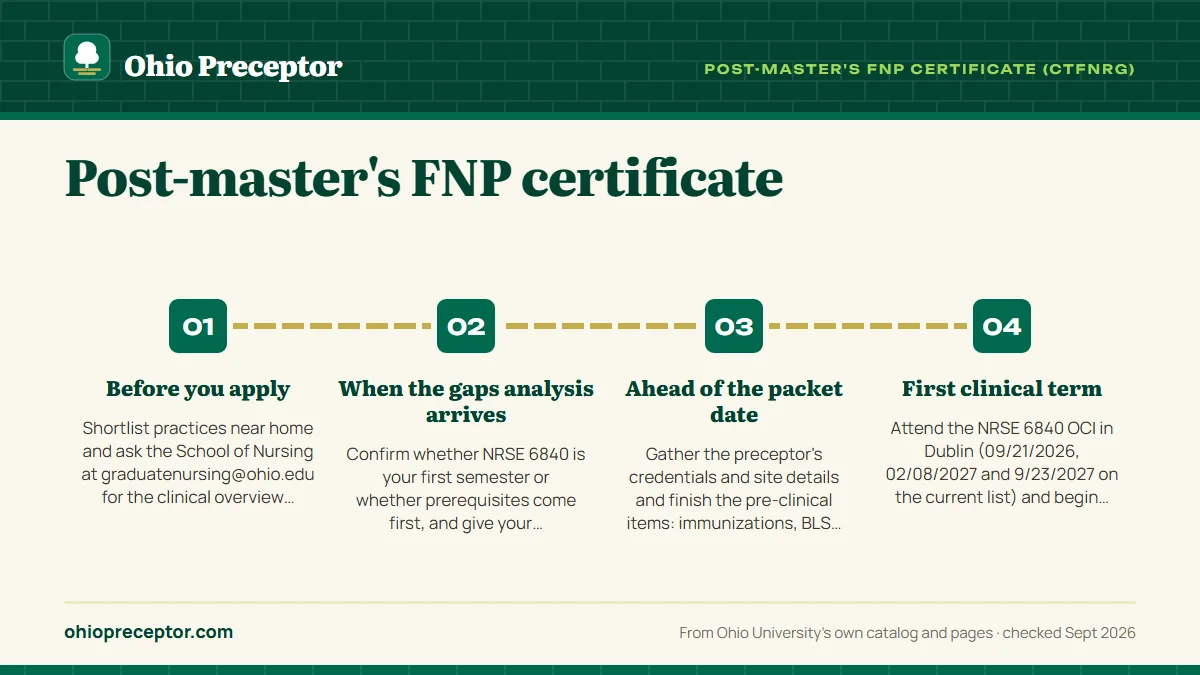
- Before you applyShortlist practices near home and ask the School of Nursing at graduatenursing@ohio.edu for the clinical overview sheets and preceptor packet for the FNP certificate, the same request the PMHNP certificate page tells APRN applicants to make.
- When the gaps analysis arrivesConfirm whether
NRSE 6840is your first semester or whether prerequisites come first, and give your preceptor the real start term. - Ahead of the packet dateGather the preceptor's credentials and site details and finish the pre-clinical items: immunizations, BLS, background checks and malpractice insurance.
- First clinical termAttend the
NRSE 6840OCI in Dublin (09/21/2026, 02/08/2027 and 9/23/2027 on the current list) and begin clinical days.
The certificate mistake: waiting for the admission letter before approaching preceptors. For a fall entry straight into NRSE 6840, the packet and the application can fall due in the same week.
Primary care settings for certificate students
The certificates index tells applicants they can “complete practicum hours locally in your preferred setting,” and the MSN FAQ describes FNP clinicals as usually completed “in primary-care offices or hospital/community-based clinics with an approved preceptor and an assigned clinical supervisor.” Ohio University's pages set no separate setting rules for the certificate, so the MSN description is the one to follow.
For an APRN coming from psychiatry or acute care, the adjustment is the patient mix. Practicum I covers individuals and families across the lifespan, and Practicum III casts you as an entry-level clinician handling acute, chronic and well visits. A family practice or community health center with children on its panel serves those courses better than an adult-only clinic.
Why certificate students choose us
Certificate students are usually working APRNs with little room for a long search. We start before your admission decision, shortlist family practices and community clinics that suit NRSE 6840, and confirm availability against your actual first term once the gaps analysis lands.
Your advisor prepares the preceptor's license, credentials and site details together with the items your clinical overview sheets and preceptor packet call for. Every preceptor and site still needs Ohio University faculty approval, and the file they receive from you is complete on the first pass.
With three practicums in three semesters, the next preceptor is always one term away. We keep NRSE 6841 and NRSE 6842 moving while you finish the current course, and arrange a replacement quickly if a preceptor leaves. Tell us your entry term through the form on this page to begin.
Questions Ohio University students ask
Can I start the FNP certificate in spring?
Possibly, but plan on fall. The catalog lists fall entry, while the certificates index says the program admits every semester and other Ohio University pages mention fall and spring. The certificate page itself shows Fall 2027 as the next start. Ask the School of Nursing to confirm your entry term in writing before you set a start date with a preceptor.
Will I need to take health assessment again?
The gaps analysis decides. Ohio University reviews your earlier graduate coursework against NRSE 7210, NRSE 7220 and NRSE 7230 or their equivalents, each passed with a B or better, and adds anything missing to your program of study. If health assessment is added, its pre-clinical OCI comes with it and Practicum I starts a semester later.
How many hours a week does the FNP certificate take?
The FAQ shared by the FNP track and certificate pages estimates 20 to 28 hours of school work each week, and clinical days sit on top of that. With 250 hours due in each practicum semester, a set weekly pattern agreed with your preceptor before the term opens keeps the hours on pace alongside a job.
Will I travel to Dublin during the certificate?
Expect at least one visit. The certificate FAQs mention two on-campus intensives, and the Knowledge Center marks NRSE 6840 as an OCI course, held at 6805 Bobcat Way in Dublin, Ohio. When the gaps analysis puts NRSE 7230 on your schedule, count its pre-clinical OCI as a second trip, and confirm with faculty which visits your program of study includes.
Can I add the Emergency NP certificate after the FNP?
That is the step it was designed for. Ohio University's Emergency NP certificate, new in Fall 2026, requires unencumbered FNP licensure and current ACLS, and adds three emergency practicums in a hospital or emergency care facility. The Emergency NP guide explains the 450 versus 500 hour conflict between Ohio University's own pages.
Related pages
Last checked 2026-09-24
We check these pages against Ohio University's own catalog, program pages and Nursing Knowledge Center. Your syllabus, the Graduate Nursing Student Handbook and your faculty have the final word.
Ohio University lets you choose your preceptor. We find the right one.
Tell us your Ohio University program, your community and your next clinical course. We find preceptors who fit the course and prepare what faculty review before they approve them.
- Preceptors matched to the course: primary care for the FNP
NRSE 6840sequence, acute care for AG-ACNP, psychiatric care for PMHNP - Your clinical packet details ready ahead of Ohio University's packet deadline
- Close to home, in Ohio or in any state where Ohio University admits graduate nurses
Start your placement plan
Program, city and clinical start is all we need to begin.