Ohio University clinical hours, program by program
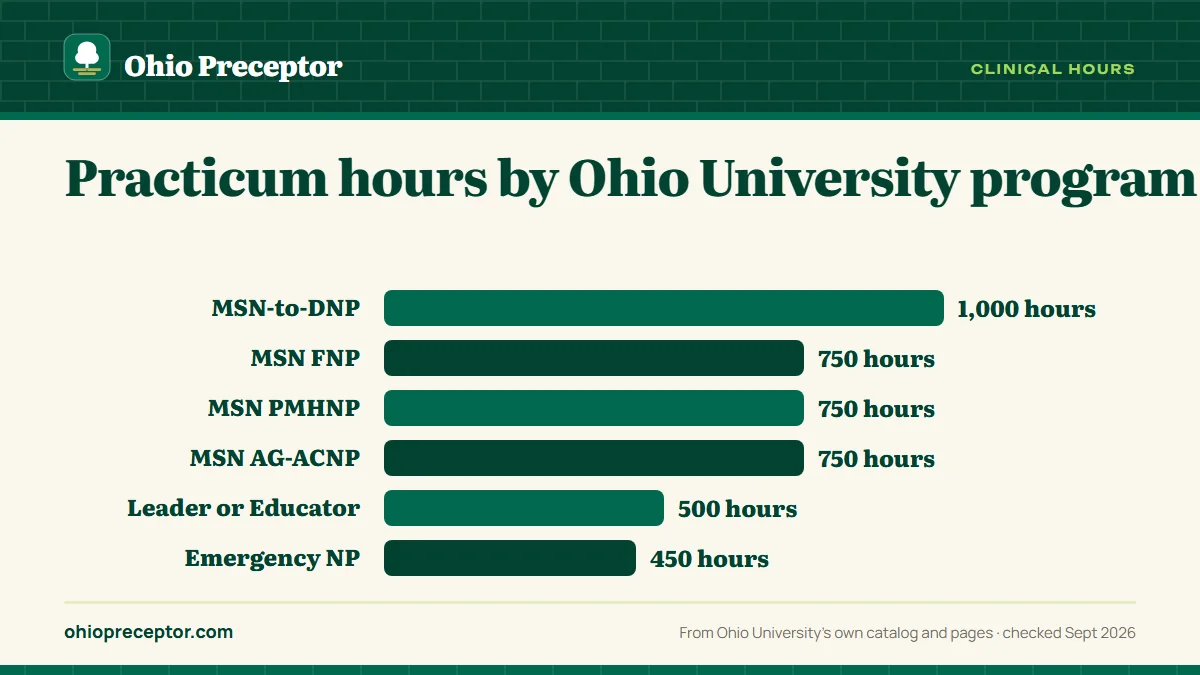
Each Ohio University MSN nurse practitioner track and post-master's NP certificate requires 750 practicum hours, the MSN-to-DNP counts 1,000 post-baccalaureate hours, and the Emergency NP certificate reads 450 in the catalog but 500 on its program page. Pick your track in the planner below, then use the rest of this page for the full comparison, how hours get documented and the week-14 finish line.
Get your placement plan
Tell us your Ohio University program and where you live. A placement advisor replies with the preceptor and site options that fit your course.
Pick your Ohio University program
Your clinical courses and hours, who can precept you, where, and when to start looking. From Ohio University's own catalog and program pages.
- Who precepts
- An approved preceptor in primary care across the lifespan, plus an assigned clinical supervisor
- Where
- Primary-care offices or hospital- and community-based clinics, close to home
- Start looking
- Before NRSE 7230 ends; the clinical packet is due months before each semester
- Who precepts
- An approved psychiatric-mental health preceptor across the lifespan
- Where
- Private or community mental health agencies, correctional, school-based or substance-use settings
- Start looking
- Before NRSE 7230 ends; NRSE 6848 carries an on-campus intensive
- Who precepts
- Acute-care physicians and advanced practice providers approved by faculty
- Where
- Critical care units, hospital-based medicine and emergency units
- Start looking
- Early: acute care sites often run their own hospital application window
- Who precepts
- The same approved preceptors as the matching MSN track
- Where
- FNP primary care, AG-ACNP acute care or PMHNP mental health settings
- Start looking
- Current APRNs often start clinicals in semester one: have preceptors in mind when applying
- Who precepts
- An approved preceptor in a hospital or emergency care facility
- Where
- Emergency departments; two on-campus intensives in Dublin
- Start looking
- Before NRSE 6857 in the fall; emergency departments often need long lead times
- Who precepts
- A preceptor-mentor chosen with faculty for your practice hours and DNP project
- Where
- An organization where your transformational change project can run
- Start looking
- Settle the project site before NRSE 7815, where the strategic plan is built
- Who precepts
- A nurse leader, or a nurse educator in academic and direct care settings
- Where
- Health system leadership units, nursing schools or professional development units
- Start looking
- Before the first practicum course; both run in fall and spring
- Who precepts
- A preceptor you secure, unless the site assigns one
- Where
- A local site of your choosing; the facility may need an affiliation agreement
- Start looking
- The preceptor agreement is due weeks before each 5-week course starts
Every program's hours, catalog against web
The planner shows one track at a time. This table lines up every Ohio University nursing program with a clinical or practicum requirement, the 2026-27 catalog figure beside the ohio.edu figure. Where they differ, that gap is what to settle with faculty.
| Program | Clinical courses | Catalog | ohio.edu page | Guide |
|---|---|---|---|---|
| MSN Family Nurse Practitioner | NRSE 6840, NRSE 6841, NRSE 6842 | 750 direct care, 250 per course | 750 | FNP hours |
| MSN Psychiatric Mental Health NP | NRSE 6846, NRSE 6847, NRSE 6848 | 750 direct care, 250 per course | 750 | PMHNP hours |
| MSN Adult-Gerontology Acute Care NP | NRSE 6843, NRSE 6844, NRSE 6845 | 750 direct care; no label beside NRSE 6845 | 750; NRSE 6845 missing from the list | AG-ACNP hours |
| Post-master's FNP, PMHNP or AG-ACNP certificate | The matching three practicums plus NRSE 7818 | 750 | 750 | FNP certificate |
| Emergency NP certificate | NRSE 6857, NRSE 6858, NRSE 6859 | 450 (150 each) | 500 (150, 150, 200) | ENP courses |
| MSN-to-DNP | NRSE 8920, NRSE 8921 | 1,000 post-baccalaureate; 250 per practicum | 250 each; sample schedule 100 and 150 | DNP 1,000 hours |
| BSN-to-DNP Nurse Anesthesia | NRSE 7438 through NRSE 7499 | Minimum of 2,300 direct care | 2,300 | n/a |
| MSN Nurse Educator | NRSE 7940, NRSE 7941 | 500 | 500 | Nurse Educator |
| MSN Nurse Leader | NRSE 6850, NRSE 6851 | 500 clock hours | 500 | Nurse Leader |
| Nurse Educator post-master's certificate | NRSE 7940, NRSE 7941 | Not stated on the certificate page | 500 | n/a |
| Nursing Leadership post-master's certificate | NRSE 6850, NRSE 6851 | 500 | 500 | n/a |
| School Nurse Certificate | NRSE 4740 | 120 with a school nurse preceptor | 120, 40 per school-age group | n/a |
| RN-to-BSN | NRSE 4585, NRSE 4595 | 31.5 | 31.5; course pages log 10.5 plus 40 true hours | RN-to-BSN |
| Campus BSN | NRSE 2212 through NRSE 4212 | Not totaled | 581.7 clinical clock hours on the semester plan | BSN clinicals |
Four places Ohio University's figures disagree
Ohio University publishes hour figures in several places, and four of them do not line up. None changes what you do this week, but each changes how much time you ask a preceptor for, so get the answer in writing from faculty before the semester in question.
- Emergency NP. The catalog gives
NRSE 6857,NRSE 6858andNRSE 6859150 hours apiece. The certificate page raisesNRSE 6859to 200, and the September 2025 news release says "a minimum of 500 hours." - DNP practicums. The catalog and the DNP curriculum page show 250 hours in each of
NRSE 8920andNRSE 8921. The sample schedule shows 100 and 150, and prints "Total Practicum Hours: 250." - The third AG-ACNP practicum. On the MSN catalog page,
NRSE 6843andNRSE 6844carry a 250-hour label andNRSE 6845carries none. The certificate catalog page labels all three, and the web course list omitsNRSE 6845entirely. - RN-to-BSN. Program pages say 31.5 clinical hours. Course pages ask for 10.5 true hours in
NRSE 4585and 40 inNRSE 4595, at least 21 of them in direct patient contact, so the log runs longer than the headline figure.
Where two numbers compete, book the preceptor for the larger one until faculty confirm otherwise. Stopping early is easy to arrange. Finding 50 extra hours in the last three weeks of a term often is not.
Documenting hours: what Ohio University's pages say
Ohio University's public pages name one system for clinical paperwork. The Nursing Knowledge Center describes Typhon as "a program which graduate students will use to upload documents as instructed by the School of Nursing for program/track requirements and/or clinical placements." The DNP FAQ lists Typhon use, next to textbooks, among the extra costs students should expect.
How the hours themselves are entered, signed off and checked is set inside each course, so log them as your course instructs and keep the syllabus open when you do. The Typhon page covers what the system holds, while school-wide rules sit in the Graduate Nursing Student Handbook, which you request from graduatenursing@ohio.edu.
The clearest public description of an hours log sits on the RN-to-BSN course pages. The NRSE 4585 log "must tally a total of 10.5 true hours" with preceptors across the lifespan, including at least one hour with each age group, and NRSE 4595 divides its 40 hours among preceptor time, topic research, direct patient contact and project work.
Habits that keep an hours log clean
- Enter each clinical day within a day or two, while times and patient mix are fresh.
- Keep a private week-by-week tally, so a shortfall shows up in week 6 instead of week 13.
- Record the site and preceptor exactly as they appear on your approved paperwork.
- Ask faculty early whether orientation, skills sessions or intensive days count; the public pages are silent on it.
The finish line is week 14, not week 15
Ohio University markets its semesters as "15-week courses" in fall, spring and summer. The MSN-to-DNP sample schedule is stricter: "All clinical/practicum hours for each clinical/practicum course must be completed by the end of the 14-week semester." The Graduate Catalog's drop rule also refers to "the 14-week semester." Two counts, one school.
Plan every practicum around 14 weeks, and let your syllabus set the exact cutoff. Simple division shows why it matters: 250 hours over 14 weeks is just under 18 hours a week, roughly two long clinic days. A preceptor's week of leave, a late site start or a holiday closure pushes that figure up fast, so bank extra hours early while the schedule still has slack.
The usual error is counting on all 15 weeks, including exam week, to close out hours. Aim to hit your total by the end of week 14.
What a clinical semester asks of your week
The MSN FAQ gives the most concrete estimate: "20-24 hours of schoolwork per week during the first year, about 18-20 hours per week through your clinical courses plus 2-3 days at your clinical site." The FNP track FAQ puts schoolwork at 20 to 28 hours a week. For the Emergency NP certificate, the news release expects 25 to 30 hours a week, rising to "more than 40 hours per week during clinical courses."
Once practicums begin, the FNP and PMHNP track FAQs say students "will take one clinical course per semester," so three 250-hour practicums need at least three semesters. Other Ohio University pages describe two courses a semester; the program of study your advisor sets is the version that governs you. The semester calendar page shows which practicum runs in which term.
If you work full time, the two or three site days are your fixed point. Settle them with your employer first, then offer a preceptor only days you can keep all term.
Why Ohio University students hand us their hours plan
Hours are only as dependable as the preceptor who signs for them. Your placement advisor looks for a preceptor and site close to where you live that suit your Ohio University course, then confirms the weekly days and the full total before anything goes to faculty. The 250 hours, or 200 in NRSE 6859, are agreed at the start instead of bargained for in week ten.
We also assemble what faculty examine before they approve anyone: credentials, license, site details and whatever your clinical packet requires. The approval decision belongs to Ohio University faculty; our part is a complete, rule-ready file on their desk well ahead of the clinical packet deadline.
If a preceptor steps away mid-semester, your advisor starts on a replacement at once, because every lost week loads the weeks left. Short on time already? Read behind on clinical hours or use the form below.
Questions Ohio University students ask
Do on-campus intensive days count toward Ohio University clinical hours?
Nothing published answers this directly. The intensives in Dublin attach to courses such as NRSE 7230 and the first or final practicum, but nothing published states whether that time counts toward practicum hours. Ask your course faculty, or check the Graduate Nursing Student Handbook, which graduatenursing@ohio.edu sends by email. Until you hear otherwise, plan as if every hour comes from your clinical site.
Are post-master's certificate hours the same as the MSN?
For the three NP certificates, yes. The FNP, PMHNP and AG-ACNP certificates each carry 750 practicum hours in the same three 250-hour courses as the matching MSN track, plus NRSE 7818. Current APRNs may move straight into a clinical course in their first semester, which is why the PMHNP certificate page wants applicants to come in with likely preceptors and sites already in view.
Do my MSN clinical hours count toward the Ohio University DNP?
Some may. Ohio University credits earlier precepted hours toward the DNP's 1,000 post-baccalaureate hours through an individual gaps analysis, and no public page sets a fixed number. Have records of your MSN clinical hours ready at admission. The DNP 1,000-hour page walks through how the two minimums, direct care and project, are counted.
What happens if I have not finished my hours when the semester ends?
Ohio University's pages do not cover unfinished practicum hours as such. Under Graduate Catalog rules, an Incomplete needs your instructor's agreement, and the outstanding work is due two weeks into your next enrolled semester or within two years, whichever is sooner, after which the I turns into an F. Withdrawal means retaking the course. See failing or repeating a clinical course.
Related pages
Last checked 2026-09-24
We check these pages against Ohio University's own catalog, program pages and Nursing Knowledge Center. Your syllabus, the Graduate Nursing Student Handbook and your faculty have the final word.
Ohio University lets you choose your preceptor. We find the right one.
Tell us your Ohio University program, your community and your next clinical course. We find preceptors who fit the course and prepare what faculty review before they approve them.
- Preceptors matched to the course: primary care for the FNP
NRSE 6840sequence, acute care for AG-ACNP, psychiatric care for PMHNP - Your clinical packet details ready ahead of Ohio University's packet deadline
- Close to home, in Ohio or in any state where Ohio University admits graduate nurses
Start your placement plan
Program, city and clinical start is all we need to begin.