Ohio University PMHNP clinical hours in mental health settings
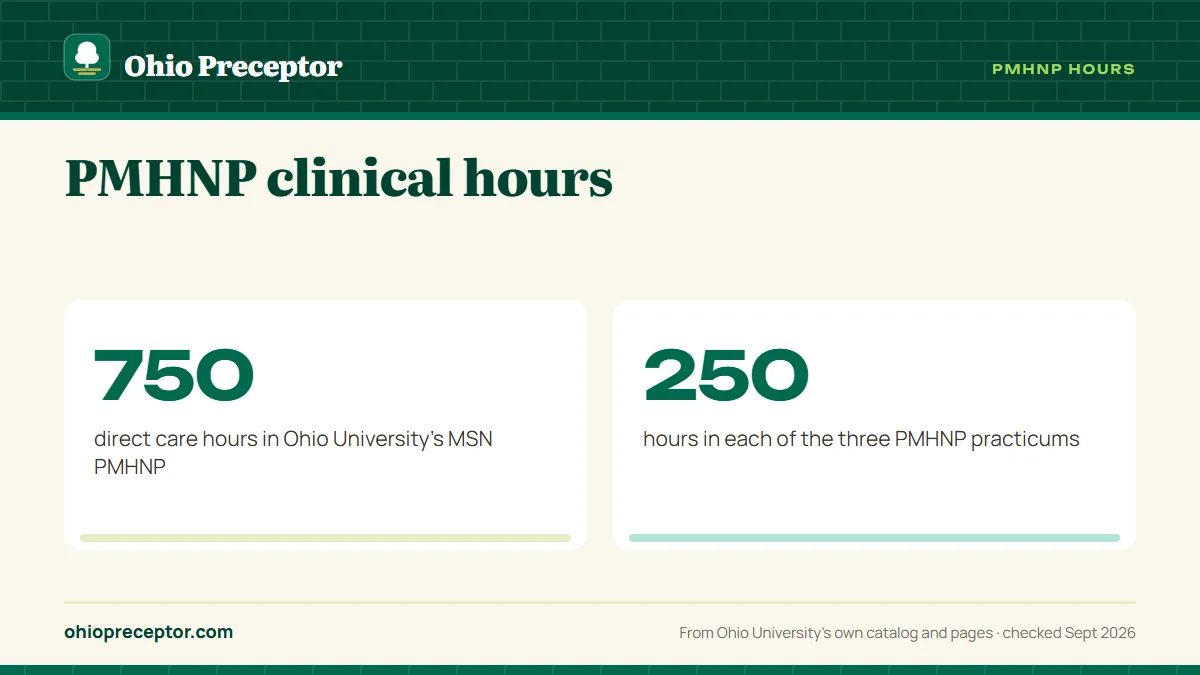
The Ohio University MSN Psychiatric Mental Health Nurse Practitioner track requires 750 direct care hours, 250 in each of NRSE 6846, NRSE 6847 and NRSE 6848, and every one of them must be in a mental health setting. Most of that time is community-based, and the third practicum brings inpatient care into view.
Get your placement plan
Tell us your Ohio University program and where you live. A placement advisor replies with the preceptor and site options that fit your course.
750 hours, and where they have to happen
The catalog is specific about place: every one of the 750 direct care hours happens in "mental-health care settings," supervised by qualified preceptors. The ohio.edu courses page describes those 750 hours in "community-based mental health agencies and programs," and the track page calls the supervised experiences "primarily community-based."
The MSN FAQ then lists where PMHNP students usually train, always with a faculty-approved preceptor and a clinical supervisor assigned by the school. The list is broader than many students assume, which widens the search considerably.
Settings Ohio University names for PMHNP clinicals
- Private mental health agencies
- Community mental health agencies
- Correctional facilities
- School-based health centers
- Substance-abuse treatment facilities
- Inpatient and community settings, named in the
NRSE 6848course description
Faculty approve the setting as well as the preceptor, so a less familiar site, such as a correctional health unit or a school clinic, needs the same complete paperwork as an outpatient psychiatry practice. Plan which setting belongs to which practicum before the first one starts.
What each PMHNP practicum asks of a site
Each practicum is 6 credits with 250 practicum hours. The catalog course entries show "3.5 lecture, 5.0 clinical," which are contact figures; the 250-hour count comes from the program page. The descriptions below are summarized from the 2026-27 catalog, and the right-hand column is our reading of what each course needs from a preceptor.
| Course | Requisite | Offered | Catalog focus | What to look for in a site |
|---|---|---|---|---|
NRSE 6846 PMHNP Practicum I | NRSE 7230 | Fall, spring | Moving into the PMHNP role with individuals and families across the lifespan | A preceptor willing to teach the role from the ground up |
NRSE 6847 PMHNP Practicum II | NRSE 6846 | Spring, summer | Working as a member of the interdisciplinary team with individuals, groups and families | A site with group and family work, not only one-to-one visits |
NRSE 6848 PMHNP Practicum III | NRSE 6847 | Fall, spring | Role, competencies and proficiencies in inpatient and community settings; on-campus intensive | Inpatient exposure, often through a second site |
Why your start term changes the path
Once practicums start, Ohio University's PMHNP and FNP track FAQs allow one clinical course per term. The tentative offerings table then decides the route, because NRSE 6848 runs in fall and spring but not in summer.
| Route | NRSE 6846 | NRSE 6847 | NRSE 6848 | Break |
|---|---|---|---|---|
| A | Spring | Summer | Fall | None: three semesters in a row |
| B | Fall | Spring | The next fall | Summer without a practicum |
| C | Fall | Summer | The next fall | Spring without a practicum |
This is a reading of the table, not a published rule, and your advisor sets the program of study you follow. The practical point stands, though: a practicum sequence that starts in the fall can leave a semester with no clinical course, and the NRSE 6848 preceptor may be needed nearly a year after the first. Line up that later preceptor early instead of assuming the first site will carry you through.
The third practicum and its intensive
NRSE 6848 is the PMHNP course marked "On-Campus OCI Required In Course" in the Knowledge Center table. The courses page describes the clinical skills workshops tied to the first and final clinical courses as 1-2 day visits, but for this track the table marks only the final one. This year it falls on 11/9 and 11/10/2026, on Ohio University's Dublin campus. Those days land in the last third of the fall semester, when hours pressure peaks, so build them into the schedule you agree with your preceptor.
The course description also widens the setting to "the inpatient and community setting." If your first two practicums were entirely outpatient or community-based, ask faculty how inpatient exposure fits into NRSE 6848, and look for it before the term opens. The NRSE 6848 page looks at the course in depth.
Certificate students and pacing
For the post-master's PMHNP certificate, the hour count does not shrink: 750 across the same three courses, with NRSE 7818 rounding out 20 credits. Its web page asks current APRNs to apply with likely preceptors and sites already identified, and to email graduatenursing@ohio.edu for the program's clinical overview sheets and preceptor packet, since most will begin with a clinical course. See the PMHNP certificate page.
The catalog gives the certificate a fall entry term, and ohio.edu shows Fall 2027 as the next start. Length is described differently from page to page, from three semesters in the catalog to "up to 2 years" in the certificate FAQ; your gaps analysis and program of study settle which applies to you.
Weekly pacing, the week-14 finish rule and how hours are documented apply to every track and live on the clinical hours hub.
How we build a PMHNP placement plan
Psychiatric preceptors are scattered across agencies, school health programs, correctional health and treatment services, and the right one for NRSE 6846 is not always the right one for NRSE 6848. A thorough search pays off here. Your placement advisor looks across every setting Ohio University names, close to where you live, and fits each practicum to its focus: role foundations first, team and group work second, inpatient and community care last.
For each preceptor we confirm the hours and weekly days, then gather the license, credentials and site details faculty review and the clinical packet asks for. Ohio University faculty hold the approval; we see to it that nothing in the file is missing or out of line with the rules. If a preceptor has to stop mid-semester, your advisor begins the replacement search at once. Start with the form below.
Questions Ohio University students ask
Can a PMHNP student complete clinical hours in a school?
Yes, when faculty approve the preceptor and site. School-based health centers appear on Ohio University's MSN FAQ list of usual PMHNP settings, alongside mental health agencies, correctional settings and addiction treatment programs. The school needs a qualified preceptor on site; the preceptor requirements page covers who qualifies.
Does the Ohio University PMHNP require inpatient psychiatric hours?
The public pages set no inpatient hour minimum. The track is described as primarily community-based, but the NRSE 6848 description covers the PMHNP role "in the inpatient and community setting." Ask your faculty how that course expects you to gain inpatient exposure, and arrange the site before the term.
Is the Ohio University PMHNP certificate also 750 hours?
Yes. The post-master's PMHNP certificate lists the same three 250-hour practicums, NRSE 6846, NRSE 6847 and NRSE 6848, for 750 hours, plus NRSE 7818. A gaps analysis of your earlier graduate coursework decides whether you take anything else first, such as NRSE 7210, NRSE 7220 or NRSE 7230.
When should a PMHNP student start looking for a preceptor?
No later than NRSE 7230, the last course before clinicals. Clinical packet deadlines fall months before each semester, and large hospital systems run their own application windows earlier still. Start the NRSE 6848 search as soon as the first practicum is settled. The packet deadlines page lists this year's dates.
Related pages
Last checked 2026-09-24
We check these pages against Ohio University's own catalog, program pages and Nursing Knowledge Center. Your syllabus, the Graduate Nursing Student Handbook and your faculty have the final word.
Ohio University lets you choose your preceptor. We find the right one.
Tell us your Ohio University program, your community and your next clinical course. We find preceptors who fit the course and prepare what faculty review before they approve them.
- Preceptors matched to the course: primary care for the FNP
NRSE 6840sequence, acute care for AG-ACNP, psychiatric care for PMHNP - Your clinical packet details ready ahead of Ohio University's packet deadline
- Close to home, in Ohio or in any state where Ohio University admits graduate nurses
Start your placement plan
Program, city and clinical start is all we need to begin.