How clinical placement works at Ohio University, from first search to first clinical day
At Ohio University, a graduate clinical comes together in a set order: you identify a preceptor and site, faculty approve them, and your clinical packet reaches the School of Nursing by your term's deadline, with hospital applications, compliance and a Dublin intensive fitted around it. This page maps the full route and links to the guide for each stop.
Get your placement plan
Tell us your Ohio University program and where you live. A placement advisor replies with the preceptor and site options that fit your course.
The rule that shapes every placement
Ohio University settles the placement question in four short sentences of its MSN FAQ, opening with the line that students "are permitted to identify their preceptors," subject to faculty approval. The other three name a second source of help, warn about hospital systems that assign preceptors centrally, and note that fees may apply.
Taken together, that gives four facts. You may choose your own preceptor. Faculty approve the choice. The coordinator is a second source of help, described in our Graduate Clinical Coordinator guide. And a large system that runs its own assignment process expects you to use it, often well ahead, whenever your site belongs to that system.
The same FAQ pairs every nurse practitioner clinical with two people: the preceptor faculty approved and a clinical supervisor Ohio University assigns. No ohio.edu page promises a placement, and Ohio University's news stories describe help "when possible." The route below therefore starts with your own search, the default the FAQ describes; finding your own preceptor covers how to run it well.
The route, stop by stop
Ohio University publishes no single placement checklist; this order is pieced together from its MSN FAQ, certificate pages, Nursing Knowledge Center and Graduate Catalog.
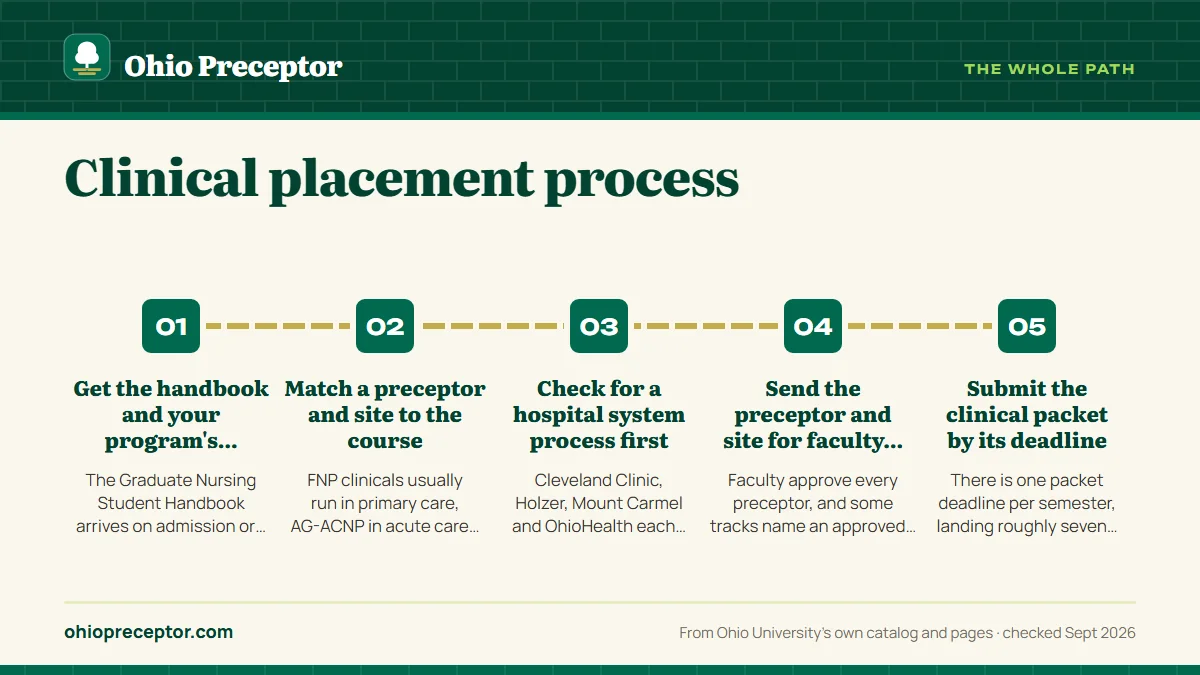
- Get the handbook and your program's preceptor materialsThe Graduate Nursing Student Handbook arrives on admission or by request from graduatenursing@ohio.edu. Ask the same inbox for your program's clinical overview sheets and preceptor packet; current APRNs entering a certificate should ask before applying.
- Match a preceptor and site to the courseFNP clinicals usually run in primary care, AG-ACNP in acute care units, PMHNP in mental health agencies and similar programs. Identify a preceptor in that setting, and bring in the Graduate Clinical Coordinator alongside your own search if you want the help.
- Check for a hospital system process firstCleveland Clinic, Holzer, Mount Carmel and OhioHealth each have a facility deadline on Ohio University's calendar that closes before the packet is due. See hospital system applications and, where a facility asks for one, affiliation agreements.
- Send the preceptor and site for faculty approvalFaculty approve every preceptor, and some tracks name an approved site too. Preceptor approval explains what makes the decision quick.
- Submit the clinical packet by its deadlineThere is one packet deadline per semester, landing roughly seven to nine weeks ahead of the first class. See the clinical packet and packet deadlines.
- Upload documents to Typhon as instructedTyphon is where your track and placement documents go, uploaded in the way the School of Nursing directs; Typhon at Ohio University explains the system.
- Clear compliance before your first clinical dayBefore day one you need the Graduate Handbook's health status items and BLS, background checks at both federal and state level, and malpractice insurance; clinical compliance takes each in turn.
- Register, attend the intensive and beginYour academic advisor registers you. Nurse practitioner students finish
NRSE 7230with a pre-clinical intensive in Dublin, and some practicums carry their own (on-campus intensives). From week one you work with your approved preceptor and an assigned clinical supervisor.
What Ohio University publishes at each stop
Several stops are only partly public. The table shows what Ohio University's open pages say and where the remaining detail is kept, so you know which questions to send to the School of Nursing and which to save for your course faculty.
| Stop | What Ohio University states publicly | Where the rest lives |
|---|---|---|
| Choosing a preceptor | Students may identify preceptors with faculty approval; the coordinator can help | MSN FAQ; your faculty |
| Preceptor materials | Clinical overview sheets and a preceptor packet exist for each program | By request from graduatenursing@ohio.edu |
| Hospital system applications | Dates for Cleveland Clinic, Holzer, Mount Carmel and OhioHealth, "subject to change at facilities discretion" | Knowledge Center important dates; each system's student page |
| Faculty approval | Required for every preceptor; criteria are not posted | Preceptor packet, handbook, course faculty |
| Clinical packet | One deadline per semester; contents not public | Login-only forms page; Typhon |
| Compliance | Health status, BLS, background checks, malpractice insurance | Graduate Nursing Student Handbook |
| On-campus intensives | Dated events at 6805 Bobcat Way, Dublin | Knowledge Center important dates |
| Supervision | An approved preceptor and an assigned clinical supervisor | Syllabus and first-week course materials |
How the route bends by program
The sequence above fits the MSN nurse practitioner tracks most closely: complete NRSE 7230, then three 250-hour practicums, with a packet deadline in front of each term. Other Ohio University programs change the route at specific points.
- Post-master's certificates: a gaps analysis comes first, and current APRNs often start a clinical course in semester one, so the search begins before admission.
- Emergency NP certificate: clinical hours are set in hospitals or emergency care facilities; the pages leave open who finds the preceptor, so ask the School of Nursing early.
- MSN-to-DNP: faculty work closely with you on the preceptor-mentor and setting, and a gaps analysis sets the hours you still owe.
- MSN Nurse Leader: the preceptor and the site both need approval, and a clinical supervisor is assigned to you.
- RN-to-BSN: you secure the preceptor unless the site says otherwise, and your Preceptor Agreement is approved through a Pre-Clinical Canvas course before you enroll.
Where the route usually stalls
Most delays come from sequence rather than effort. On Ohio University's 2026-27 calendar, the facility dates posted for all four systems land before the matching packet deadline, and Holzer's sits about four and a half months ahead of the term. A student who plans backward from the packet date alone can find that the preceptor they wanted is out of reach for that semester.
Quieter slow points add up too: waiting on one reply before opening a second lead, sending approval materials with gaps, or learning late that a facility wants an affiliation agreement. Each is far easier to fix a month early than a week before the deadline.
The common mistake is working back from the clinical packet deadline alone. If your site sits inside a hospital system, that system's own application date comes first, so plan from whichever deadline is earliest.
From approval to your first clinical week
With approval granted and the packet in, the Dublin schedule matters next. Intensive dates attach to the opening FNP and AG-ACNP practicums and to the last PMHNP practicum, and each one has to fit around your clinic days.
Ohio University's MSN FAQ describes clinical courses as about 18-20 hours of weekly study, with another 2-3 days spent on site. Settle your clinic days with the preceptor ahead of the term, intensive date included, so the 250 hours fit inside the semester.
If a preceptor steps away mid-term, any replacement goes back through faculty approval, and your clinical supervisor should hear about it first. Our who does what guide maps every role you will deal with along the way.
Why Ohio University students bring us the search
Our placement desk is built around this exact route. Your placement advisor starts with your track, your next NRSE course and every deadline in front of it, including any hospital system window, then looks near home for a preceptor and site that match that course.
Before anything reaches Ohio University, we gather your preceptor's license, credentials and practice details plus each item the packet asks for, and check them against the published rules so faculty receive a complete file. Faculty make the approval decision; we make that decision straightforward. If a preceptor drops during the term, your advisor keeps working your file and finds the replacement. To begin, add your program, city and upcoming clinical course to the form below.
Questions Ohio University students ask
Does Ohio University place nurse practitioner students with preceptors?
Not as a rule. The MSN FAQ leaves the choice of preceptor with you, subject to faculty approval, and offers the Graduate Clinical Coordinator as extra help. Ohio University news stories speak of local placements arranged "when possible." Treat that help as support to use alongside your own search, since no ohio.edu page promises an assignment.
How far ahead should I start the Ohio University placement process?
Start from the earliest deadline that applies to you. Your packet is due seven to nine weeks before the term, and the four Ohio systems on Ohio University's calendar close sooner, Holzer roughly four and a half months out. For a hospital-based site, beginning two terms out gives you room to recover if a first lead falls through.
Where do I submit my Ohio University clinical packet?
According to the Knowledge Center, Typhon is the upload point for graduate track and placement documents, while the packet forms themselves sit on a forms page behind your university login. The exact submission steps come from the School of Nursing, so follow the instructions that arrive in your Ohio University student email.
Is there a fee for Ohio University clinical placements?
The MSN FAQ says "Fees may apply" where a large hospital system runs a centralized process for assigning preceptors. No ohio.edu page gives an amount or says who charges it, so read each system's own student page. Separately, Ohio University's DNP pages tell students to expect costs for textbooks and the use of Typhon.
Who answers questions about Ohio University clinical paperwork?
The Graduate Nursing Knowledge Center sends program, placement and paperwork questions to graduatenursing@ohio.edu. Write from your Ohio University student email, the account Ohio University uses to correspond with students, and include your track, your next clinical course and the term you are planning for.
Related pages
Last checked 2026-09-24
We check these pages against Ohio University's own catalog, program pages and Nursing Knowledge Center. Your syllabus, the Graduate Nursing Student Handbook and your faculty have the final word.
Ohio University lets you choose your preceptor. We find the right one.
Tell us your Ohio University program, your community and your next clinical course. We find preceptors who fit the course and prepare what faculty review before they approve them.
- Preceptors matched to the course: primary care for the FNP
NRSE 6840sequence, acute care for AG-ACNP, psychiatric care for PMHNP - Your clinical packet details ready ahead of Ohio University's packet deadline
- Close to home, in Ohio or in any state where Ohio University admits graduate nurses
Start your placement plan
Program, city and clinical start is all we need to begin.