Ohio University MSN AG-ACNP: acute care practicums on a yearly cycle
Ohio University's Adult-Gerontology Acute Care NP track admits in fall only and offers each of its three practicums once a year: NRSE 6843 in fall, NRSE 6844 in spring and NRSE 6845 in summer. Its 750 hours happen in hospitals, with acute-care physicians and advanced practice providers, which is why the big systems' own application windows shape this timeline more than in any other Ohio University track.
Plan your acute care practicums
Tell us your cohort year, your city and the hospitals nearest you. Your placement advisor replies with an acute care plan built around Ohio University's AG-ACNP calendar.
The AG-ACNP track in brief
The MSN in Adult Gerontology-Acute Care Nurse Practitioner (catalog code MS1236) is an online track of 40 credit hours, taken “not necessarily in the order listed,” across about six semesters. The track FAQ calls it two years, with most students taking two 15-week courses a semester, and a comprehensive program exam closes it.
Fall is the only entry term in the catalog, and the track page names Fall 2027 as the next cohort (application deadline 07/05/27; first classes 08/23/27). Admission mirrors the other NP tracks: a BSN, two years' worth of full-time RN work inside the last five years, and residence plus an unencumbered RN license in one of Ohio University's approved states.
One gap on the web: the AG-ACNP course page promises “11 courses for 40 total credits” but lists only ten, leaving out NRSE 6845, and the ten shown add up to 34 credits. The catalog includes Practicum III, so treat the catalog as the full list.
Three practicums on a fixed yearly cycle
Each practicum carries 6 credits and, by the catalog, 250 hours. Where FNP and PMHNP students get two chances a year at each practicum, the Knowledge Center's tentative offerings table allows the AG-ACNP courses one term apiece.
| Course | Catalog focus | Hours | Runs in | Catalog note |
|---|---|---|---|---|
NRSE 6843 AG-ACNP Practicum I | Comprehensive care of adults and older adults with acute and emergent complex conditions; OCI | 250 | Fall only | Requires NRSE 7230 |
NRSE 6844 AG-ACNP Practicum II | The AG-ACNP as an interdisciplinary team member in acute care | 250 | Spring only | Requires NRSE 6843 |
NRSE 6845 AG-ACNP Practicum III | Advanced clinical judgment within a team caring for adults with complex conditions | 250 on the certificate page; unlabeled on the MSN page | Summer only | Requisite printed as NRSE 6847, a PMHNP course |
Read that way, a missed term costs a full year rather than a semester, because the course only comes back the following year. Dropping a nursing course also knocks you off your planned sequence, and you then need a fresh program of study; the out-of-sequence guide explains what follows. The NRSE 6847 requisite printed for Practicum III reads like an error, so confirm with your advisor that NRSE 6844 is the real prerequisite.
Acute care settings and who can precept
The catalog is specific: practicums occur “in acute-care settings under supervision of acute-care physicians and advanced practice providers.” The MSN FAQ lists the usual units as “critical care units, hospital-based medicine and emergency units,” each placement pairing an approved preceptor with a clinical supervisor Ohio University assigns. Intensive care, hospitalist services and emergency departments are all in scope.
That catalog line reaches further than Ohio's student-practice statute, ORC 4723.32(F), which frames APRN students practicing under APRN supervisors, and Ohio Board of Nursing guidance does not address physician-only precepting. If your likely preceptor is a physician, ask faculty how they pair that with your clinical supervisor. The preceptor requirements guide compares the tracks side by side.
Hospitals publish their own preferences too. Premier Health's archived student page accepts MD/DO, PA or NP preceptors, while The Ohio State University Wexner Medical Center's education page says its APPs precept APRN students but posts no request route for other schools' students.
Hospital system applications matter most here
Ohio University's MSN FAQ flags that larger hospital systems can run their own centralized preceptor process, that students must use it where it exists, that requests often have to go in well ahead, and that fees may apply. For an acute care student, that process is often the main door into the hospital.
The Knowledge Center posts facility deadlines for four Ohio systems. For a Fall 2027 NRSE 6843 they run from 4/1/2027 at Holzer to 6/1/2027 at OhioHealth, and the hospital system applications page keeps the full table. Each system also sets its own terms on its own pages:
- Cleveland Clinic takes applications through ACEMAPP, lists Ohio University among eligible schools, matches the preceptor itself and asks students not to call or email its sites directly.
- OhioHealth wants a new application every semester, is not starting new school agreements, and for fall asks students to apply only once a preceptor has agreed.
- Holzer requires an active Clinical Education Affiliation Agreement on file and assigns the preceptor.
- Mount Carmel's own site shows no NP student page, although Ohio University lists deadlines for it; ask the School of Nursing how requests there run.
Miss a window and your choices for that term narrow to sites outside the system, which is why the calendar below starts in winter.
When to start: count back from fall
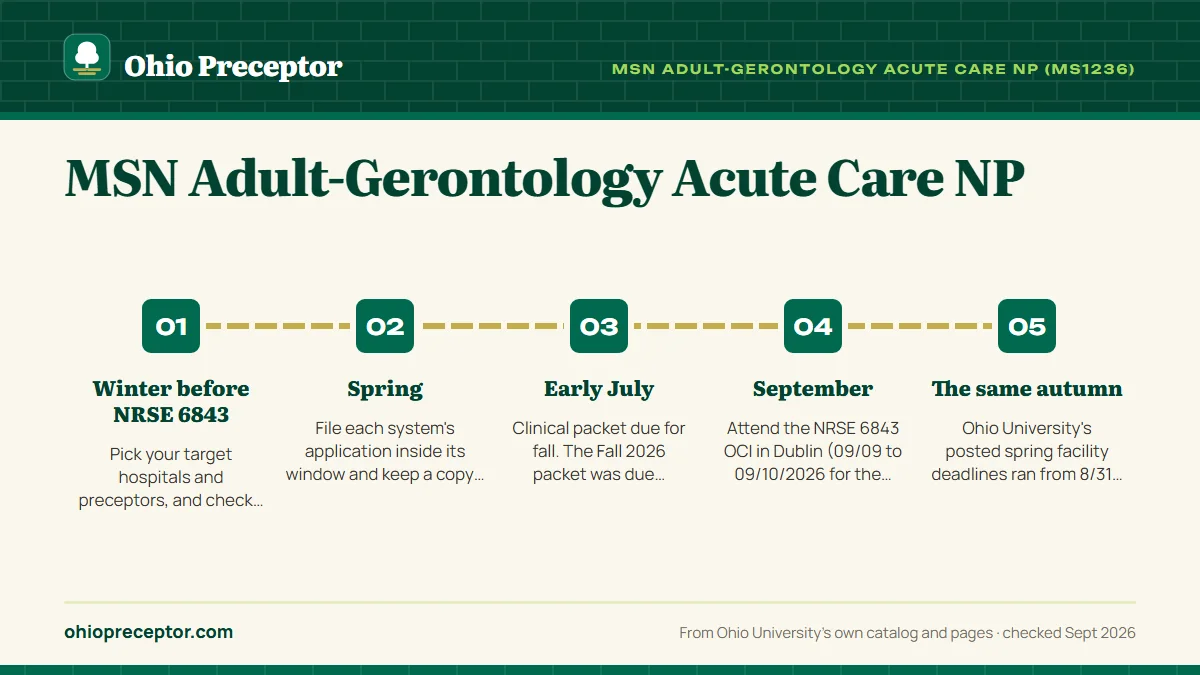
Every AG-ACNP clinical year opens with NRSE 6843 in fall, so the plan runs backward from that September.
- Winter before
NRSE 6843Pick your target hospitals and preceptors, and check whether each system needs an affiliation agreement Ohio University already holds. - SpringFile each system's application inside its window and keep a copy of every confirmation.
- Early JulyClinical packet due for fall. The Fall 2026 packet was due 07/06/2026, and the packet deadlines page lists each term.
- SeptemberAttend the
NRSE 6843OCI in Dublin (09/09 to 09/10/2026 for the current cohort) and begin clinical days. - The same autumnOhio University's posted spring facility deadlines ran from 8/31 to 11/1/2026, and the Spring 2027 packet is due 11/09/2026, so planning for Practicum II overlaps Practicum I.
The costly slip: treating the fall packet date as the first deadline. For a hospital-based NRSE 6843, the system's spring application window closes months earlier.
OCIs for acute care students
The AG-ACNP track FAQ counts two on-campus intensives, and the Knowledge Center's course table flags NRSE 7230 and NRSE 6843 as OCI courses. Both visits happen at 6805 Bobcat Way in Dublin, Ohio: the health assessment OCI first ran this cycle on 9/18 to 9/19/2026 and has further dates in summer and fall 2027, and the NRSE 6843 OCI ran 09/09 to 09/10/2026.
The Practicum I visit falls in the third week of the fall term, right as clinical days get going, so tell your preceptor about it before you fix the schedule. The on-campus intensives page has every date in one list. If your first acute care practicum falls in Fall 2027, watch the Important Dates page for that year's NRSE 6843 visit; the 2026-27 list shows only the September 2026 dates.
Why AG-ACNP students choose us
Acute care placement is a calendar problem as much as a search problem. Your placement advisor maps all three practicums against Ohio University's packet dates and each hospital's windows, then works both routes at once: system applications where they are required, and hospitalists, intensivists and acute care NPs approached directly where a system's rules allow it.
We assemble the preceptor's credentials and license, the unit and hospital details, and whatever your clinical packet asks for, so faculty receive a complete, rule-ready file. Approval of every preceptor and site stays with Ohio University faculty; our work makes their review straightforward.
If a unit changes staffing mid-term and your preceptor steps back, the replacement search starts at once, which matters more here because the course only returns a year later. Your cohort year and nearest hospitals are enough to begin; the form at the bottom of the page reaches the placement desk, and how it works walks through the rest.
Questions Ohio University students ask
Can I start the AG-ACNP in spring?
Not according to the catalog, which names fall as the sole entry term for this track, matching the Fall 2027 start on the track page. Ohio University's general MSN application page mentions three intakes a year, but that sentence covers the MSN as a whole and conflicts with the track's own pages. Treat fall as the AG-ACNP start unless the School of Nursing confirms a different term in writing.
Does emergency department time count toward AG-ACNP hours?
Ohio University's MSN FAQ lists emergency units alongside critical care units and hospital-based medicine as usual AG-ACNP settings, so an emergency department can qualify with an approved preceptor. Faculty approve each site, and the catalog's focus on adults and older adults with complex conditions still applies. Nurses after an emergency-only credential can compare the Emergency NP certificate, which requires FNP licensure.
Can I do AG-ACNP clinicals at the hospital where I work?
Ohio University's public pages set no MSN rule on workplace sites; faculty approve each preceptor and site, and the Graduate Nursing Student Handbook holds the detail. Hospitals set their own terms: Holzer, for example, gives its own employees first priority for advanced practice student rotations. Keep student hours clearly separate from paid RN shifts in your logs.
Do Ohio hospitals charge for NP student placements?
Ohio University's MSN FAQ says fees may apply to centralized hospital processes, without naming amounts. OhioHealth's own FAQ refers to a badge fee for students, and University Hospitals' system-wide process refers to an ACEMAPP subscription. Ask each system about its charges when you apply, and see the cost page for what shapes a quote from us.
What happens if I withdraw from an AG-ACNP practicum?
Per the Knowledge Center, a withdrawal forces a repeat of the course, a WF grade is treated as a failed attempt, and a third failed attempt means dismissal. The catalog's practicum entries say “May not be retaken”, at odds with that one-repeat rule, and each AG-ACNP course runs once a year. Request the handbook's grading policy from graduatenursing@ohio.edu.
Related pages
Last checked 2026-09-24
We check these pages against Ohio University's own catalog, program pages and Nursing Knowledge Center. Your syllabus, the Graduate Nursing Student Handbook and your faculty have the final word.
Ohio University lets you choose your preceptor. We find the right one.
Tell us your Ohio University program, your community and your next clinical course. We find preceptors who fit the course and prepare what faculty review before they approve them.
- Preceptors matched to the course: primary care for the FNP
NRSE 6840sequence, acute care for AG-ACNP, psychiatric care for PMHNP - Your clinical packet details ready ahead of Ohio University's packet deadline
- Close to home, in Ohio or in any state where Ohio University admits graduate nurses
Start your placement plan
Program, city and clinical start is all we need to begin.