Finding your own preceptor as an Ohio University nursing student
Ohio University's MSN FAQ opens its placement answer with a permission: "Students are permitted to identify their preceptors with faculty approval." You choose who teaches you and where, and Ohio University faculty confirm the fit. The wording shifts from program to program, and a good search starts from the course you are entering rather than from a list of names.
Get your placement plan
Tell us your Ohio University program and where you live. A placement advisor replies with the preceptor and site options that fit your course.
A permission, with approval attached
The sentence is short, and each part carries weight. "Permitted" means you may bring your own preceptor instead of waiting to be assigned one. "With faculty approval" means the choice counts once Ohio University faculty sign off. The FAQ then adds that the Graduate Clinical Coordinator "can help facilitate clinical placements" and that larger hospital systems may require students to use their own centralized process.
So the choice is yours within three limits: the preceptor has to suit the course, pass faculty review and, if they work inside a large system, come through that system's channel. Everything below is about meeting all three in one search rather than discovering them one at a time.
How the wording changes across Ohio University programs
Ohio University does not use one sentence for every program. The table sets each program's official wording beside what it means for the way you search.
| Program | Ohio University's wording | What it means for your search |
|---|---|---|
| MSN FNP, PMHNP and AG-ACNP | Students "are permitted to identify their preceptors with faculty approval"; the coordinator "can help facilitate" | You lead, faculty approve, large systems' own processes apply |
| Post-master's FNP, PMHNP and AG-ACNP certificates | Current APRNs "should have possible preceptors and sites in mind when applying" | Search before admission, since clinicals can start in semester one |
| Emergency NP certificate | An "approved preceptor in a hospital or emergency care facility" | Who finds the preceptor is not stated; ask the School of Nursing |
| MSN-to-DNP | "Faculty work closely with students in the selection of a preceptor-mentor and clinical setting" | A shared choice, shaped by your project and program of study |
| MSN Nurse Leader and Nurse Educator | "An approved preceptor at an approved site" (Leader); "qualified preceptors" (Educator) | Leadership units, or academic and professional development settings |
| RN-to-BSN | "It is the responsibility of the student to secure a preceptor, unless the clinical site specifies otherwise" | Confirm whether the site assigns preceptors or requires one on its staff |
| Campus BSN | Each senior "is assigned to work with a preceptor nurse" | Assigned by the program |
The certificate sentence speaks of APRN certificates in general, though Ohio University prints it only on the PMHNP certificate pages. If you already hold an APRN license and are entering any certificate, plan as though your first clinical course is weeks away.
Start from the course, not the contact list
Faculty approve a preceptor against the course, so begin there. The MSN FAQ says FNP clinicals usually take place in "primary-care offices or hospital/community-based clinics," AG-ACNP clinicals in "critical care units, hospital-based medicine and emergency units," and PMHNP clinicals in mental health agencies, correctional facilities, school-based health centers or substance-abuse treatment facilities.
The catalog course descriptions narrow it further. The FNP practicums describe care for individuals and families across the lifespan, NRSE 6843 centers on adults in the acute care setting, and the Emergency NP courses describe the emergent setting. Build your target list from those words, then apply distance: at 2-3 clinic days a week, a practice you can reach reliably all semester is worth more than a better-known one two hours away.
Search methods that hold up
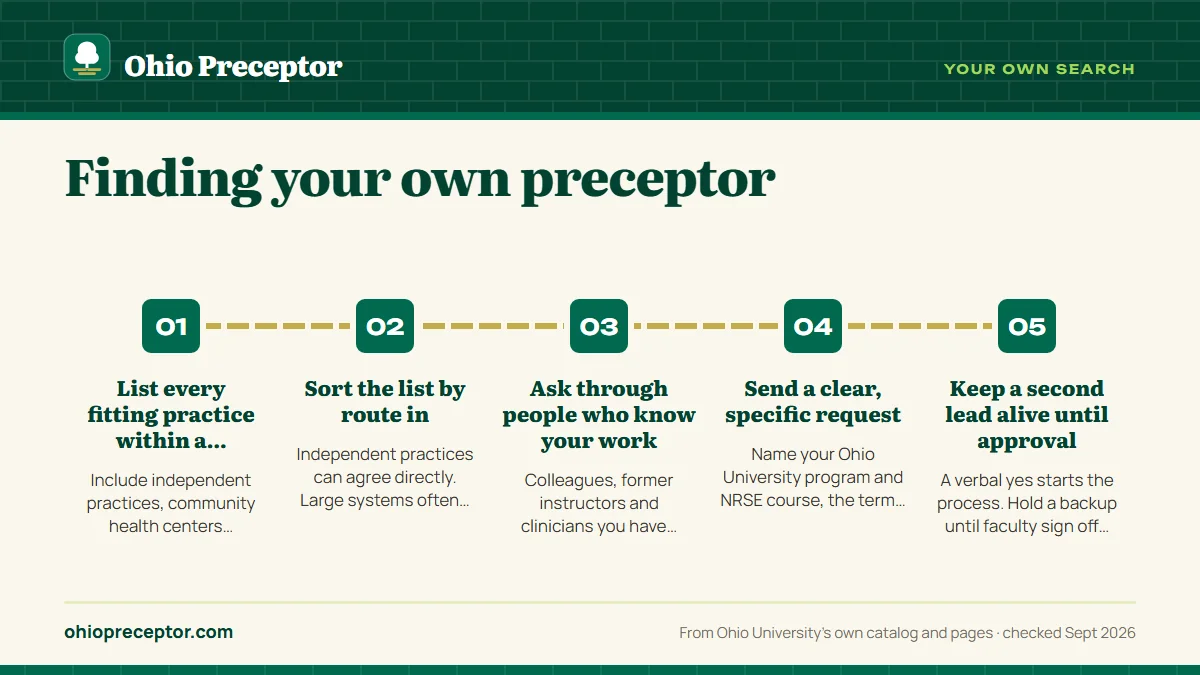
- List every fitting practice within a sustainable driveInclude independent practices, community health centers, specialty groups and hospital units that match the course. Note who owns each one, because ownership decides the route in.
- Sort the list by route inIndependent practices can agree directly. Large systems often route students through a central application: Cleveland Clinic asks students not to call or email its individual sites or caregivers, while OhioHealth's application lets you name a preceptor who has already agreed. Those are each system's own rules; see hospital system applications.
- Ask through people who know your workColleagues, former instructors and clinicians you have worked beside can vouch for you before a first conversation, which often shortens it.
- Send a clear, specific requestName your Ohio University program and NRSE course, the term dates, the hours you need and the days you can offer. A specific request is easier to say yes to.
- Keep a second lead alive until approvalA verbal yes starts the process. Hold a backup until faculty sign off and any facility steps are complete.
What to ask a prospective preceptor
A ten-minute conversation settles most of what faculty will later check. These questions come straight from Ohio University's published settings, state notes and hospital rules.
- Does your patient mix fit the course, for example all ages for an FNP practicum or adult acute care for AG-ACNP?
- Which days can you offer across the whole semester, and are any weeks already blocked by leave?
- Where are you licensed, and is the clinic in that same state? Maryland and Illinois, among others, add their own preceptor licensing rules.
- Does your employer run a central student application or ask for an affiliation agreement before a student starts?
- Will you complete the preceptor packet Ohio University provides and keep in touch with the clinical supervisor during the term?
- Are you already precepting another student that semester?
Write the answers down; they become the first draft of what faculty review. For the credential side, read who can precept Ohio University students.
The most common mistake is treating a clinician's personal yes as the finish line. If that preceptor works inside a hospital system, the system's own application, with its own deadline, still has to go through.
When your own search runs short
If leads dry up, add capacity without dropping your own work. The Graduate Clinical Coordinator can help facilitate placements, and the School of Nursing takes placement questions at graduatenursing@ohio.edu; our coordinator guide explains how to use that route. You can also hand the legwork to a placement service that already knows Ohio University's forms and dates.
Whichever route you add, share what you have already tried. A short list of the practices you contacted, their answers and any hospital applications in progress keeps two people from approaching the same clinic and shows where the gaps are, whether that is a specialty, a county or a term.
Then move before the earliest deadline in front of you. Can't find a preceptor covers the options when time is already tight.
How we make your own search fast
Choosing your own preceptor gives you the pick; we supply the legwork behind it. Your placement advisor builds the target list from your NRSE course and home area, contacts practices on your behalf, confirms days and patient mix, and checks for any system application before a yes is counted.
Next we assemble what Ohio University faculty review: license and credentials, practice details and the items your packet calls for, complete ahead of your deadline. The preceptor is still your choice and still close to home, and faculty still give the approval; we shorten everything in between. Use the form below to share your program, city and next clinical course.
Questions Ohio University students ask
Do I have to find my own preceptor in Ohio University's FNP program?
Ohio University's MSN FAQ frames it as a permission: students are permitted to identify their preceptors with faculty approval, and the Graduate Clinical Coordinator can help facilitate placements. The default is that you identify the preceptor, so start early and treat the coordinator's help as extra capacity alongside your own search.
Can my Ohio University preceptor be in a different state from where I live?
Ohio University's public pages set a residence rule for admission but say nothing either way about where graduate clinicals take place. The provost's licensure disclosures add state rules in some places, such as Illinois and Maryland preceptor licensing. Confirm any cross-state plan with faculty, and see clinicals outside Ohio.
How many preceptors can I use in one Ohio University practicum?
No public Ohio University page sets a minimum or maximum. Some hospitals set their own limit; Nationwide Children's, for example, allows graduate students one preceptor per term. Check your syllabus and clinical overview sheets, and ask faculty before splitting hours across two sites or two preceptors.
Should I contact hospital units directly to find a preceptor?
Only where the system allows it. Cleveland Clinic and University Hospitals both ask students not to call or email individual sites or caregivers and handle requests through their own applications. Independent practices and community clinics are usually approached directly, with a short request naming your course and dates.
When should I start looking for an Ohio University preceptor?
At least a full term before the practicum, and earlier for a hospital-based site. The Ohio hospital systems on Ohio University's calendar close their applications weeks to months before the clinical packet deadline, and the packet itself is due seven to nine weeks before classes begin.
Related pages
Last checked 2026-09-24
We check these pages against Ohio University's own catalog, program pages and Nursing Knowledge Center. Your syllabus, the Graduate Nursing Student Handbook and your faculty have the final word.
Ohio University lets you choose your preceptor. We find the right one.
Tell us your Ohio University program, your community and your next clinical course. We find preceptors who fit the course and prepare what faculty review before they approve them.
- Preceptors matched to the course: primary care for the FNP
NRSE 6840sequence, acute care for AG-ACNP, psychiatric care for PMHNP - Your clinical packet details ready ahead of Ohio University's packet deadline
- Close to home, in Ohio or in any state where Ohio University admits graduate nurses
Start your placement plan
Program, city and clinical start is all we need to begin.