Doing Ohio University clinicals outside Ohio
Ohio University's online graduate students live across 28 approved states, and the certificates hub promotes completing practicum hours "locally in your preferred setting." No ohio.edu page confines clinicals to Ohio. What changes out of state is the rulebook: the state where you train decides which license you practice under and whether it wants anything from an out-of-state program, while your on-campus intensives still happen in Dublin.
Get your placement plan
Tell us your Ohio University program and where you live. A placement advisor replies with the preceptor and site options that fit your course.
What Ohio University says about clinical location
Less than you might expect. The approved-state rule concerns where you live and the RN license you hold, not where your site is. Ohio University's pages neither require graduate clinicals to stay in your home state or on the approved list nor permit them elsewhere; the question is simply not addressed. The Important Dates table of hospital deadlines lists Ohio facilities only, so it is silent on sites beyond the border.
The marketing pages lean toward home. Besides the certificates hub line, an August 2025 news story describes placements set up in students' home regions where that can be done. That is help Ohio University may offer alongside your own search, not a promise, and the MSN FAQ's rule still stands: students identify preceptors, and faculty approve them.
Two cautions appear on Ohio University's own pages. The Knowledge Center tells students to check with their home state's licensing agency before starting a program based elsewhere, and the certificates hub notes that "Clinical hour requirements for state licensure may vary by state."
The license you train under
During clinicals you are practicing nursing wherever the site is located, so your license has to be valid in that state. A multistate license from a Nurse Licensure Compact state reaches other compact states; a single-state license covers its own state only. Some states let nurses licensed elsewhere practice as graduate students without a new license, and others insist on their own. The RN license page works through the combinations.
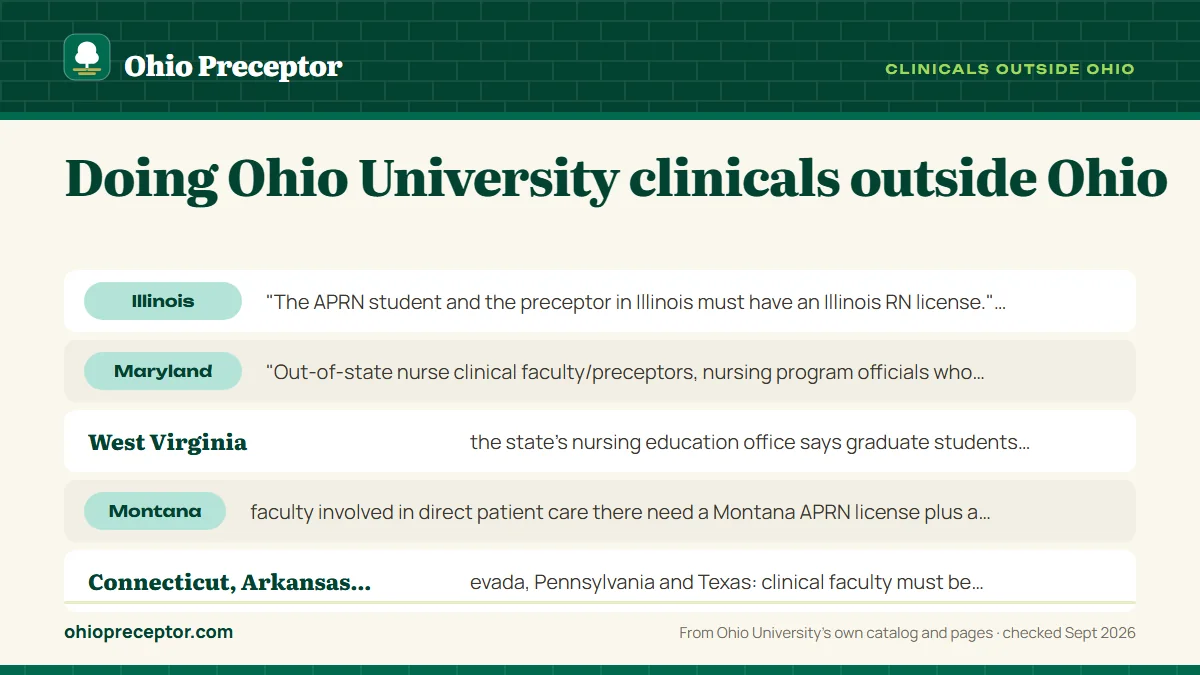
Ohio University's licensure disclosures, and one state's own guide, add license lines worth knowing before you choose a site:
- Illinois: "The APRN student and the preceptor in Illinois must have an Illinois RN license." Illinois is outside the compact.
- Maryland: "Out-of-state nurse clinical faculty/preceptors, nursing program officials who visit/consult with students, or facility personnel must be licensed in Maryland."
- West Virginia: the state's nursing education office says graduate students training there need a West Virginia license if they live in the state, or a multistate license if they live elsewhere.
- Montana: faculty involved in direct patient care there need a Montana APRN license plus a Montana or multistate RN license.
- Connecticut, Arkansas, Missouri, Nevada, Pennsylvania and Texas: clinical faculty must be licensed in the state.
- Alaska: preceptors need appropriate credentials, and students must apply for preceptorship with the Alaska board.
State approval of out-of-state programs
Some states want the program approved, or at least notified, before its students train there. Ohio University handles that at the program level: the Office of the Provost runs a committee that identifies state board regulations and seeks approvals, and the University takes part in NC-SARA through the Ohio Department of Higher Education. Your part is to name the site's state early so faculty can check it.
West Virginia shows why. Ohio University's disclosure lists the state as requiring board approval plus proof that the student's home state lets its nursing students train out of state, and notes the West Virginia board already has that proof from Ohio, Pennsylvania, Kentucky and Virginia. West Virginia's own sources frame it differently: its RN board limits itself to pre-licensure programs and refers graduate programs to the state's higher education commission, whose guide wants approval only when a program is outside NC-SARA or places ten or more students at a single site. Treat Ohio University's disclosure as the working rule and let faculty confirm.
Elsewhere, New Hampshire sends programs to its "School Approval Needed Chart" for clinical placements, while the Kentucky and Virginia boards leave out-of-state and post-licensure programs out of their approval work, so neither adds a board step.
Colorado and other RN-to-BSN rules
RN-to-BSN students work from different state lists and a few extra rules. The NRSE 4585 and NRSE 4595 pages report that Colorado's Board of Nursing insists on an affiliation agreement for every student precepting in the state, and Ohio University's disclosure adds that Colorado requires workers' compensation coverage during clinical experiences. Colorado is on the RN-to-BSN program list but not on the graduate list.
The RN-to-BSN disclosures flag other states too. Maryland asks for notice before a student's clinical placement, New Hampshire requires programs to register their intent, and Washington, Tennessee, Wyoming and Louisiana each set an approval step. RN-to-BSN preceptors need an active license in the student's state and the facility's state alike. The affiliation agreements page and the RN-to-BSN page cover the details.
Choosing a site close to home
Out of state, Ohio University's table of Ohio hospital deadlines no longer applies, but the same logic does. The MSN FAQ's warning about big systems, with their mandatory central processes and early request dates, holds in every state. Check the student or education page of a system before you approach a preceptor who works there; the hospital system applications page shows how the Ohio ones operate.
Affiliation agreements are the other variable. Ohio University's RN-to-BSN pages say the University does not require one but a facility may, and the process can be slow. No public graduate page describes the graduate process, though a form titled "Affiliation Agreement Request Form Graduate" appeared in a January 2026 snapshot of the forms page. Ask the site early whether it needs an agreement with Ohio University. Community practices and clinics can be simpler to arrange than large systems, though every site still needs faculty approval.
The Dublin trips still apply
Training out of state does not move the on-campus intensives. Every 2026-27 visit on the Important Dates page is at 6805 Bobcat Way in Dublin, Ohio, and several fall in the middle of a practicum. From Texas, Florida or Alaska, a two-day intensive can take most of a week once travel is counted, so an out-of-state preceptor needs those dates at the very start.
Book travel as soon as your advisor confirms the term, and ask your preceptor whether you can bank a few extra hours in the weeks before the trip so the 250-hour target stays on pace. If your site works from a fixed schedule, give the practice manager the Dublin dates too, since the manager may be the one who sets it. The dates and a planning checklist are on the on-campus intensives page.
Why out-of-state students choose us
We search in your state, not just in Ohio. Your placement advisor looks near your home for a preceptor and clinical setting that fit the course, verifies the preceptor's license for the state where you will train, and notes any state rule, such as Maryland's preceptor licensing or West Virginia's approval language, that faculty will want addressed.
We also check the site's own application or agreement requirements, prepare the credentials, license and site details that go into your clinical packet, and build the weekly schedule around your Dublin dates. Faculty sign off on each preceptor and site, and your submission reaches them whole. Look up your state in the state guides, then tell us where you live and which course is next using the form below.
Questions Ohio University students ask
Can I do Ohio University clinicals in a state that is not on the approved list?
No public Ohio University rule says yes or no. Faculty approve every site, and the site's state brings its own rules: California's Board of Registered Nursing, for one, requires prior approval before a non-California NP program places students there. Raise any such site with faculty before you approach a preceptor.
Will Ohio University faculty visit my out-of-state site?
Ohio University's public pages do not describe site visits for any location. They mention only that each NP clinical pairs an approved preceptor with a clinical supervisor the school assigns. Your syllabus and supervisor will explain how your progress is checked, whether your site is in Ohio or elsewhere.
Can I split my practicum between two states?
Ohio University's public pages set no rule on the number of sites or preceptors. Each site would need faculty approval, each state's license rules would apply to the days you spend there, and each site may have its own onboarding. Ask your course faculty before planning it, and allow for the extra paperwork.
Does a Kentucky or Pennsylvania site need anything extra?
Kentucky's board does not require approval of programs based in other states, though faculty and preceptors overseeing online APRN students in Kentucky must hold a Kentucky APRN license. Pennsylvania lets RNs licensed elsewhere who are enrolled, unpaid, in an accredited graduate program practice in required clinical settings without a Pennsylvania license. Both states are in the compact.
Related pages
Last checked 2026-09-24
We check these pages against Ohio University's own catalog, program pages and Nursing Knowledge Center. Your syllabus, the Graduate Nursing Student Handbook and your faculty have the final word.
- Ohio University Office of the Provost: health sciences licensure disclosures
- Ohio University: graduate nursing certificates
- Ohio University Nursing Knowledge Center: NRSE 4585 requirements
- Ohio University Office of the Provost: state authorization
- West Virginia Office of Nursing Education: out-of-state clinical rotation guide
Ohio University lets you choose your preceptor. We find the right one.
Tell us your Ohio University program, your community and your next clinical course. We find preceptors who fit the course and prepare what faculty review before they approve them.
- Preceptors matched to the course: primary care for the FNP
NRSE 6840sequence, acute care for AG-ACNP, psychiatric care for PMHNP - Your clinical packet details ready ahead of Ohio University's packet deadline
- Close to home, in Ohio or in any state where Ohio University admits graduate nurses
Start your placement plan
Program, city and clinical start is all we need to begin.