Ohio University's online RN-to-BSN and its two clinical courses
Ohio University's RN-to-BSN is fully online, with 31.5 clinical hours across two 5-week courses, NRSE 4585 and NRSE 4595, at a local site of your choosing. The course pages put it plainly: "It is the responsibility of the student to secure a preceptor, unless the clinical site specifies otherwise." We find a qualified preceptor and site near you and have the Preceptor Agreement details ready well before the deadline.
Line up your RN-to-BSN preceptor
Your city, your license state and your clinical start date are all we need.
What the RN-to-BSN is
The RN-to-BSN (BS1203) is Ohio University's 100% online bachelor's completion program for licensed RNs, with no travel to campus. Only nine nursing courses, 31 credit hours, must be completed at Ohio University toward the 120-credit degree, and Ohio University says the degree can be finished in as little as one year.
Courses run five weeks each, with eight start dates a year: three in fall, three in spring and two in summer. Transfer credit is not accepted for NRSE 4515, NRSE 4585 or NRSE 4595, and Ohio University allows at most three attempts to pass any course.
The two clinical courses come last. Students admitted after Summer 2024-25 are on the new curriculum and take NRSE 4575, NRSE 4585 and NRSE 4595 in that order, with NRSE 4585 taken on its own. Students admitted earlier finish with the old 7-week clinical course, NRSE 4600.
The clinical path
The 31.5 figure lines up with the direct hours on the course pages: 10.5 with a preceptor in NRSE 4585, plus the minimum 21 hours of direct patient contact inside the 40 hours you log in NRSE 4595. Counting everything you log, the two courses come to 50.5 hours.
| Course | Length | Hours logged | What the log must show |
|---|---|---|---|
NRSE 4585 Professional Care of the Community and Populations | 5 weeks, taken alone | 10.5 | True hours with preceptors overseeing direct care, with at least 1 hour in each age group: birth to 17, 18 to 64, and 65 and over |
NRSE 4595 Professional Nursing Practice Capstone | 5 weeks | 40 | At least 3 hours with the preceptor, no more than 6 researching the topic, at least 21 in direct patient contact, and the remaining 10 developing your project |
NRSE 4600 (old curriculum only) | 7 weeks | 21 | Preceptor time, topic research, patient contact and project work, split as the course page sets out |
The catalog frames the clinicals a little differently, calling them the final two courses "focused on Community and Leadership", and its NRSE 4585 entry shows 0.0 clinical hours. The hour logs above come from the Nursing Knowledge Center course pages; follow those and your syllabus.
Sites and the preceptor you need
NRSE 4585 must take place at a community-based site with patients across the lifespan. Ohio University's examples include community health centers, federally qualified health centers, rural health clinics, urgent care, physician offices, local health departments, home health agencies, homeless shelters, parish nursing and mobile clinics. For NRSE 4595, any site where nurses are employed meets the requirement, and your own workplace is allowed as long as the project can be implemented into direct clinical practice with patients or clients.
Ohio University's preceptor rules for both courses
- A bachelor's degree in nursing or an advanced nursing degree
- An active nursing license in the same state as you and the same state as the facility
- Not a close relative
- The site's own say: confirm whether it assigns preceptors itself and, if not, whether the preceptor must be its employee
The old-curriculum NRSE 4600 page adds that the preceptor does not need to work at the site where the project is implemented, and that the course is not a shadowing experience. Because the preceptor's license has to match both your state and the facility's, our RN license for clinicals page is worth a look if you live near a state line.
The Preceptor Agreement Form and its deadlines
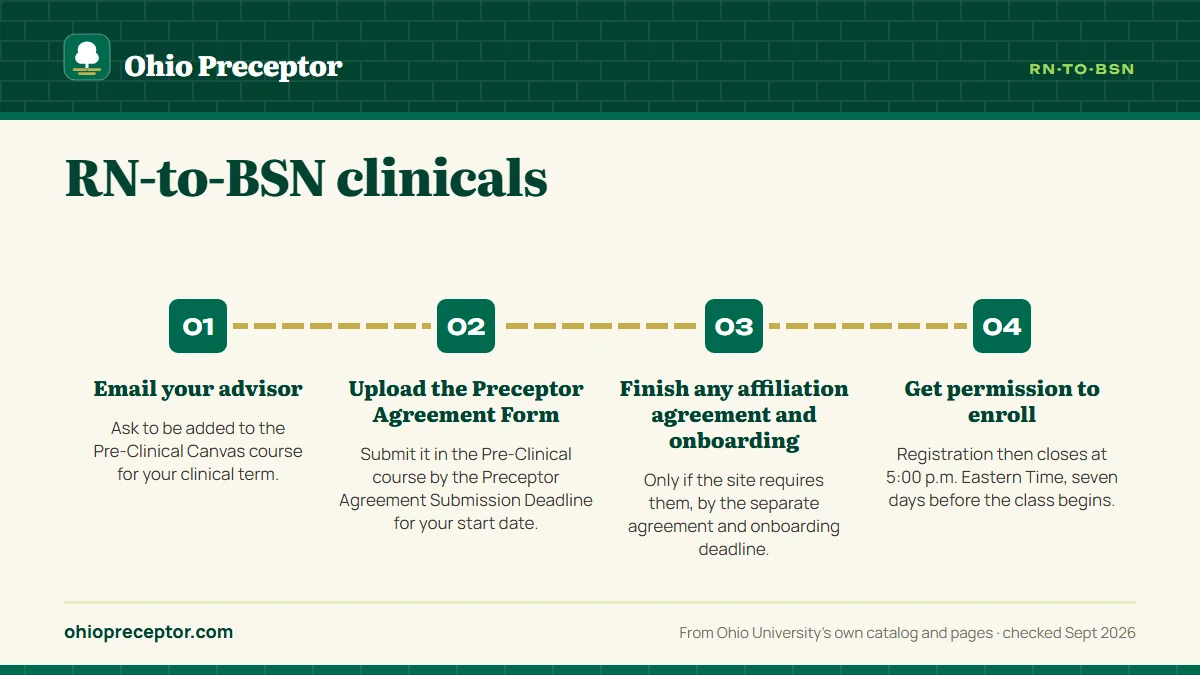
The paperwork starts months before the course does. The Nursing Knowledge Center sets out the order:
- Email your advisorAsk to be added to the Pre-Clinical Canvas course for your clinical term.
- Upload the Preceptor Agreement FormSubmit it in the Pre-Clinical course by the Preceptor Agreement Submission Deadline for your start date.
- Finish any affiliation agreement and onboardingOnly if the site requires them, by the separate agreement and onboarding deadline.
- Get permission to enrollRegistration then closes at 5:00 p.m. Eastern Time, seven days before the class begins.
| Course | Starts | Preceptor Agreement due | Project proposal due | Agreement and onboarding due | Register by |
|---|---|---|---|---|---|
NRSE 4585 | 02/15/27 | 10/23/26 | n/a | 12/11/26 | 02/08/27 |
NRSE 4595 | 03/22/27 | 10/23/26 | 10/30/26 | 12/11/26 | 03/15/27 |
The mistake to avoid: starting the preceptor search when NRSE 4575 begins. For a February 2027 clinical, the Preceptor Agreement was due in October 2026.
Affiliation agreements and where you can train
Affiliation agreements are not an Ohio University requirement, yet a facility can insist on one, and it is on you to find out. Ohio University cautions that the process has no set timeline and may not end in an agreement if the two sides cannot settle the terms. Its capstone page gives examples: Cleveland Clinic needs contact at least 70 days in advance, Specialty Select Hospitals can take 2 to 3 months to approve an agreement, and OhioHealth sites are open only to OhioHealth employees.
State rules can add a step. Ohio University's course pages note that the Colorado Board of Nursing requires an affiliation agreement for every student completing precepting hours in Colorado. Timing advice for all of this is in our affiliation agreements guide.
Where you live matters too, and Ohio University's own lists disagree. The RN-to-BSN program and eligibility pages list 32 states plus DC, while the NRSE 4585 and NRSE 4595 pages say the program is currently authorized in 28 states plus DC and leave out Arkansas, Hawaii, Maine and Wisconsin. If you live in one of those four, confirm with your advisor before you enroll; the approved states page compares the lists.
Why RN-to-BSN students choose us
Five-week courses leave no slack. Once NRSE 4585 opens you have five weeks to log 10.5 hours across three age groups, and NRSE 4595 asks for 40 hours with a project built into direct care. The preceptor, the site's rules and any affiliation agreement all have to be settled months before either course begins. If your deadline is already close, read need a preceptor fast.
We take that search on for you. Your placement advisor finds a nurse with a BSN or higher, licensed in your state, at a community site with patients of every age for NRSE 4585, and a site where your capstone project can run for NRSE 4595. We confirm whether the site assigns its own preceptors, whether it needs an affiliation agreement and how much notice it wants, and we have the Preceptor Agreement details ready ahead of the deadline. Tell us your start date in the form, and see how it works for what follows.
Questions Ohio University students ask
Can I do my Ohio University RN-to-BSN clinicals where I work?
For the capstone, yes, with a condition: Ohio University allows the site where you are employed as long as the project can be implemented into direct clinical practice with patients or clients. NRSE 4585 needs a community-based site with patients across the lifespan, so check that your workplace meets that first. OhioHealth sites are limited to OhioHealth employees.
Can my manager or a coworker be my RN-to-BSN preceptor?
Ohio University's published rules do not exclude them. They ask for a bachelor's degree in nursing or an advanced nursing degree, an active license in your state and the facility's state, and no close family tie. The site may set its own rules about who precepts students, so ask before you name anyone on the Preceptor Agreement Form.
What if I'm still on the old RN-to-BSN curriculum?
Then your clinical course is NRSE 4600, a 7-week course with 21 logged hours: at least 3 with the preceptor, up to 6 on topic research, 1 to 2 in direct patient contact, and 10 to 11 developing and implementing the project. The Knowledge Center's example puts the Spring 2026-27 S2 preceptor agreement due date at 12/04/26 for a 03/01/27 start.
Do I need a different preceptor for NRSE 4595?
The course pages apply the same preceptor rules to both courses and do not require a change of preceptor. What differs is the site: NRSE 4585 needs community-based care across the lifespan, while NRSE 4595 needs a setting where nurses work and your project can run. In the Spring 2026-27 table, one Preceptor Agreement deadline, 10/23/26, covers both courses.
What if the clinical site assigns its own preceptor?
That is the exception Ohio University builds in: securing a preceptor is your job unless the clinical site specifies otherwise. Ask the site early whether it assigns preceptors and, if it does not, whether yours must be one of its employees. Either way, the person still has to meet Ohio University's degree, license and close-relative rules.
Related pages
Last checked 2026-09-24
We check these pages against Ohio University's own catalog, program pages and Nursing Knowledge Center. Your syllabus, the Graduate Nursing Student Handbook and your faculty have the final word.
Ohio University lets you choose your preceptor. We find the right one.
Tell us your Ohio University program, your community and your next clinical course. We find preceptors who fit the course and prepare what faculty review before they approve them.
- Preceptors matched to the course: primary care for the FNP
NRSE 6840sequence, acute care for AG-ACNP, psychiatric care for PMHNP - Your clinical packet details ready ahead of Ohio University's packet deadline
- Close to home, in Ohio or in any state where Ohio University admits graduate nurses
Start your placement plan
Program, city and clinical start is all we need to begin.