Ohio University's approved states for graduate nursing
To enter an Ohio University MSN, post-master's certificate or DNP, you must live in one of 28 approved states and show a valid, unrestricted RN license. Ohio University's own pages do not all print the same list, and the RN-to-BSN works from different lists again. Here is the full list, the states left off it, the places where the sources disagree, and what to do if you move.
Get your placement plan
Tell us your Ohio University program and where you live. A placement advisor replies with the preceptor and site options that fit your course.
The rule, in Ohio University's words
The MSN application page asks for "Proof of residence and evidence of valid, unrestricted RN licensure in one of the approved states below," and the DNP apply page repeats the same list. Program pages shorten it to "Resident of and evidence of valid, unrestricted RN licensure in an approved state," and the Graduate Catalog uses the word "unencumbered." The rule covers the MSN tracks, the post-master's certificates and the MSN-to-DNP.
The Emergency NP certificate adds a second license, FNP licensure in an approved state, and the catalog asks for current ACLS certification as well. For applicants abroad, the application page is direct: "Generally, students that reside outside of the United States are not eligible to enroll in an OHIO Online program." The list itself carries no date; ohio.edu's sitemap shows the page was last changed on 2026-08-13.
The 28 approved states
Ohio University prints the list alphabetically. It is grouped by region below so you can find your state quickly, and every one of Ohio's five neighbors is on it. Twenty-two of the 28 have the Nurse Licensure Compact in effect, which starts to matter once clinicals begin; the RN license page has the breakdown.
| Region | Approved states |
|---|---|
| Ohio and its neighbors | Ohio, Indiana, Kentucky, Michigan, Pennsylvania, West Virginia |
| Northeast | Connecticut, Maine, Massachusetts, New Hampshire, New Jersey, Vermont |
| Mid-Atlantic and South | Arkansas, Florida, Maryland, Mississippi, North Carolina, South Carolina, Texas, Virginia |
| Midwest | Illinois, Missouri, Wisconsin |
| West and Pacific | Alaska, Hawaii, Montana, Nevada, New Mexico |
Each state has its own guide on this site, from Ohio to Kentucky and West Virginia; the full set is on the state guides hub.
The 22 states not on the list
Ohio University does not print a list of excluded states. Subtracting the 28 from all 50 gives this one: Alabama, Arizona, California, Colorado, Delaware, Georgia, Idaho, Iowa, Kansas, Louisiana, Minnesota, Nebraska, New York, North Dakota, Oklahoma, Oregon, Rhode Island, South Dakota, Tennessee, Utah, Washington and Wyoming. The District of Columbia and the US territories are missing from the application list too.
Under the current application page, a resident of one of these states does not meet the graduate residence requirement, whatever license they hold. The RN-to-BSN is a separate case with separate lists: its program page names 32 states plus DC, including several of the states above, while its course pages print shorter versions. The RN-to-BSN page sorts those out.
Where Ohio University's own lists disagree
Three sets of Ohio University pages deal with states, and they do not line up. The graduate hub says graduate nursing programs "are available to residents of the following states" and lists 27: the application list without Maryland. The provost's professional licensure disclosures, which follow a federal rule in force since July 1, 2024 and are reviewed yearly or when a state changes its rules, mark each state "Yes" or "No" separately for the MSN, the post-master's certificate and the DNP.
| State | Application list | Graduate hub | MSN disclosure | Certificate disclosure | DNP disclosure |
|---|---|---|---|---|---|
| Maryland | Yes | No | Yes | No | Yes |
| Virginia | Yes | Yes | Yes | Yes | No |
| Delaware | No | No | No | Yes, with special DE Board of Nursing approval | No |
| District of Columbia | No | No | Yes | Yes | Yes |
The disclosures are a licensure determination, separate from the admissions list, and the provost's FAQ notes that programs requiring a professional license for admission need no attestation. If you live in Maryland, Virginia, Delaware or DC, get Ohio University's answer for your exact program in writing before you apply.
How the list has changed: California out, Maryland in
The list has moved before. A July 22, 2019 College of Health Sciences and Professions story announced the MSN and DNP expanding "to 22 new states," from Alaska to Wisconsin, joining the six states already served: California, Indiana, Kentucky, Michigan, Ohio and West Virginia. The page announcing it has since been removed and survives only in the Internet Archive.
Set that beside today's 28 and two changes stand out: California has been dropped and Maryland added. No ohio.edu page explains either one. If you come across a six-state list elsewhere online, it predates 2019, and a California nurse should treat the current application page, not an older article, as the rule.
Moving during the program
Ohio University publishes no graduate rule on moving mid-program, so raise a move before it happens. Residence is an admission requirement, the licensure disclosures depend on where you are located, and the provost's office sets your location from the address on file under University Policy 12.022. The RN-to-BSN contact page is more explicit, warning that a move to an unauthorized state puts continued eligibility at risk; expect graduate programs to take the question just as seriously.
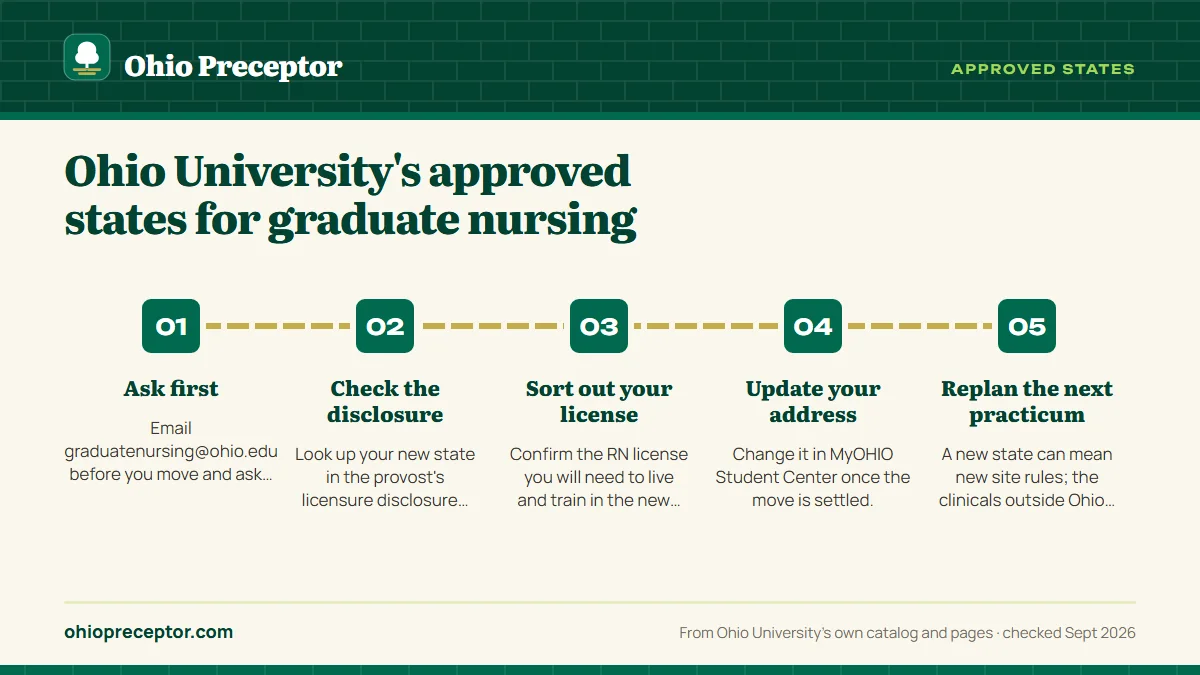
- Ask firstEmail graduatenursing@ohio.edu before you move and ask how the new state affects your program.
- Check the disclosureLook up your new state in the provost's licensure disclosure for your specific program.
- Sort out your licenseConfirm the RN license you will need to live and train in the new state; see RN license for clinicals.
- Update your addressChange it in MyOHIO Student Center once the move is settled.
- Replan the next practicumA new state can mean new site rules; the clinicals outside Ohio page covers them.
Why students across the 28 states choose us
Wherever you are on the list, we search where you live. Your placement advisor searches your own area for a preceptor and site suited to your Ohio University course, checks the preceptor's license against the state where you will train, and flags any state rule faculty or the site will ask about.
Students in compact states can sometimes train across a nearby state line. Those in Alaska, Hawaii, Illinois, Michigan or Nevada, which sit outside the Nurse Licensure Compact, may find it simplest to keep the search at home. We plan around whichever case is yours. Ohio University faculty approve each preceptor and site, and your file reaches them complete and checked against the rules, ahead of the clinical packet deadline. Tell us your state and course in the form below.
Questions Ohio University students ask
Is Maryland an approved state for Ohio University nursing?
On the MSN and DNP application lists, yes, and the MSN and DNP licensure disclosures mark it "Yes." The graduate hub page leaves it off, and the post-master's certificate disclosure marks it "No." A Maryland resident applying for a certificate in particular should confirm with Ohio University before applying.
Can I apply to an Ohio University MSN from California or New York?
Neither state is on the graduate application list, and both are marked "No" in the MSN licensure disclosure. California was on the list in 2019 and has since been dropped. The RN-to-BSN program page does include both states, but that list belongs to a different program with different rules.
Does the approved-state rule limit where I do clinicals?
Not in so many words. The rule is tied to where you live and your RN license. No ohio.edu page says graduate clinicals must happen in your home state or in an approved state, and none says they may happen elsewhere. The state where the site sits brings its own rules, covered on the clinicals outside Ohio page.
Does a multistate compact license let me apply from a state that is not on the list?
No. The requirement is residence in an approved state as well as a valid, unrestricted RN license, so a multistate license issued by a state off the list does not stand in for living in one on it. Compact licenses matter more once you are enrolled, when they can cover clinicals across state lines.
Related pages
Last checked 2026-09-24
We check these pages against Ohio University's own catalog, program pages and Nursing Knowledge Center. Your syllabus, the Graduate Nursing Student Handbook and your faculty have the final word.
Ohio University lets you choose your preceptor. We find the right one.
Tell us your Ohio University program, your community and your next clinical course. We find preceptors who fit the course and prepare what faculty review before they approve them.
- Preceptors matched to the course: primary care for the FNP
NRSE 6840sequence, acute care for AG-ACNP, psychiatric care for PMHNP - Your clinical packet details ready ahead of Ohio University's packet deadline
- Close to home, in Ohio or in any state where Ohio University admits graduate nurses
Start your placement plan
Program, city and clinical start is all we need to begin.