Ohio University MSN PMHNP: mental health practicums and preceptors
Every one of the 750 direct care hours in Ohio University's online PMHNP track takes place in a mental health setting, and the program page says most of them are community-based. The three practicums, NRSE 6846, NRSE 6847 and NRSE 6848, come after NRSE 7230, and the last one includes an OCI in Dublin. This page covers the sequence, the settings Ohio University names, and how early to secure each psychiatric preceptor.
Find your PMHNP preceptor
Tell us your start term, where you live and which practicum is next. Your placement advisor replies with mental health sites and preceptors that match Ohio University's PMHNP courses.
What the PMHNP track involves
Ohio University's Psychiatric Mental Health Nurse Practitioner MSN (catalog code MS1238) shares its non-clinical core with the other NP tracks and puts all of its practicum time into psychiatric care.
From the catalog and the PMHNP pages
- 40 credit hours in 11 courses, including 750 practicum hours
- Core courses
NRSE 7001,NRSE 7210,NRSE 7220,NRSE 7230,NRSE 7810,NRSE 7811,NRSE 7812andNRSE 7818 - Six semesters at the typical load of two courses a semester; the track FAQ says “up to 2 years”, the same span once summer terms count
- Entry in fall and spring, with the next start in Spring 2027 (applications due 11/02/26, classes from 01/11/27)
- Admission: a BSN, the equivalent of two years' full-time RN experience in the last five, and residence and RN licensure in an approved state
- A comprehensive program exam at the end
The catalog places practicums “in mental-health care settings under the supervision of qualified preceptors,” and the course page calls them “community-based mental health agencies and programs.” Those two phrases are the brief for your preceptor search.
The three PMHNP practicums
Each practicum carries 6 credits and 250 hours, and each requires the one before it. Read in order, the catalog descriptions move from taking on the role, to working inside a team, to full competency across inpatient and community care.
| Course | Catalog focus | Hours | Offered | What to look for in a preceptor |
|---|---|---|---|---|
NRSE 6846 PMHNP Practicum I | Transition into the PMHNP role with individuals and families across the lifespan; requires NRSE 7230 | 250 | Fall, spring | A clinician who lets you assess and follow your own patients |
NRSE 6847 PMHNP Practicum II | The PMHNP as an interdisciplinary team member with individuals, groups and families | 250 | Spring, summer | A team setting with group or family work |
NRSE 6848 PMHNP Practicum III | Role, competencies and proficiencies in the inpatient and community setting; OCI | 250 | Fall, spring | Access to both inpatient and community patients |
Set side by side, those terms leave one unbroken order in the tentative table: NRSE 6846 in spring, NRSE 6847 in summer and NRSE 6848 in fall. A student who takes Practicum I in fall meets no summer section of NRSE 6848 on that table, so check your program of study rather than assuming three straight semesters. The track FAQ confirms one clinical course per semester once practicums begin.
Mental health settings Ohio University names
The MSN FAQ lists where PMHNP clinicals usually happen: “private or community mental health agencies, correctional facilities, school-based health centers or substance-abuse treatment facilities with an approved preceptor and an assigned clinical supervisor.” That list is broad, and it opens options well beyond the nearest outpatient psychiatry office.
Around Athens, for example, the region holds Appalachian Behavioral Healthcare, the state psychiatric hospital for adults from southeastern Ohio, plus Integrated Services for Behavioral Health offices and Hopewell Health Centers, which carries a federal mental health shortage designation. None of these is a promised student slot; they show how many kinds of site match the catalog. The Southeast Ohio guide goes further.
Large hospital systems are a narrower door for PMHNP students. On their own pages, Nationwide Children's Hospital calls psychiatric mental health NP placements “very limited,” and Premier Health's archived page lists mental health among the specialties it takes no placement requests for. University Hospitals runs a separate Behavioral Health Institute process for graduate APRN students, with its own windows and an affiliation agreement requirement.
Who arranges the placement
Ohio University's MSN FAQ gives the student the first move: you may identify your own preceptor, subject to faculty approval, and the Graduate Clinical Coordinator “can help facilitate clinical placements.” Each placement pairs an approved preceptor with an assigned clinical supervisor. The finding your own preceptor guide explains the student-led route step by step.
The catalog leaves the preceptor's profession open and asks only for “qualified preceptors.” Psychiatric nurse practitioners are the natural fit. If you hope to train with a psychiatrist, raise it with faculty early, because Ohio's student-practice exemption in ORC 4723.32(F) is written around APRN supervisors.
Large systems with a centralized process are the exception to the student-led rule: the same FAQ warns that such requests “must be made well in advance” and that fees may apply. For most PMHNP students the stronger route is a community agency or group practice where a psychiatric NP agrees to precept, backed by a complete file for faculty review.
Timing: packets, the NRSE 6848 OCI and your search
Every practicum semester has its own clinical packet deadline, roughly two months before the term opens: 11/09/2026 for Spring 2027, with the full set on the packet deadlines page. Build the search around those dates.
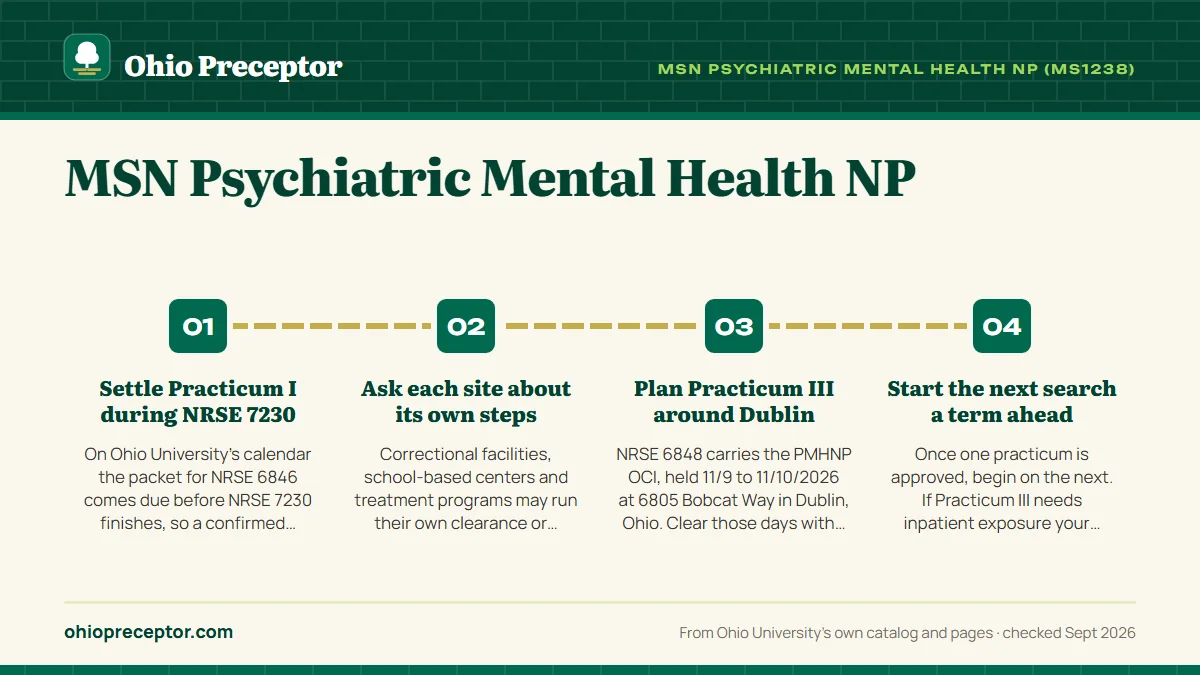
- Settle Practicum I during
NRSE 7230On Ohio University's calendar the packet forNRSE 6846comes due beforeNRSE 7230finishes, so a confirmed preceptor has to exist by then. - Ask each site about its own stepsCorrectional facilities, school-based centers and treatment programs may run their own clearance or orientation before a student's first day. Ask in the first conversation and fit those steps ahead of the packet date.
- Plan Practicum III around Dublin
NRSE 6848carries the PMHNP OCI, held 11/9 to 11/10/2026 at 6805 Bobcat Way in Dublin, Ohio. Clear those days with your preceptor when you agree the schedule. - Start the next search a term aheadOnce one practicum is approved, begin on the next. If Practicum III needs inpatient exposure your current site lacks, that search takes longer.
A common trap: planning all three practicums inside one outpatient office. The catalog describes NRSE 6848 as inpatient and community practice, so ask faculty early what Practicum III expects of a site.
How many OCIs, and when
Ohio University's pages give two answers. The PMHNP courses page describes three on-campus intensives, while the FAQ on the same track says two, and the Knowledge Center marks NRSE 7230 and NRSE 6848 as the OCI courses. The courses page ties clinical OCIs to the first and final clinical courses, yet the table marks only the final one for PMHNP students.
Plan on the pre-clinical OCI in NRSE 7230 (9/18 to 9/19/2026, with summer and fall 2027 dates also posted) and the NRSE 6848 visit, and ask faculty whether NRSE 6846 adds one for your cohort. Dublin is a long drive or a flight for many students outside central Ohio, so settle travel before you promise clinical days in those weeks. The on-campus intensives page collects every date.
Why Ohio University PMHNP students work with us
Psychiatric preceptors carry full caseloads, and each setting Ohio University lists has its own gatekeepers. Your placement advisor searches agencies, practices and programs near you that match each practicum's focus, from the first-semester role transition to the inpatient and community mix of Practicum III.
Before your file goes to Ohio University, we confirm the preceptor's credentials and license, the site details and everything the clinical packet asks for. Faculty decide on every preceptor and site; we give them a complete, rule-ready file to decide on.
Through the whole program we watch your packet dates and the OCI, keep the next practicum's preceptor moving a term early, and step in with a replacement if a preceptor leaves mid-semester. The form at the end of this page reaches your placement advisor directly, and how it works shows each step.
Questions Ohio University students ask
Can telehealth visits count toward Ohio University PMHNP hours?
Nothing on Ohio University's public pages addresses telehealth hours in the PMHNP practicums. The rules sit in your course syllabus and in the Graduate Nursing Student Handbook, which the School of Nursing sends by email from graduatenursing@ohio.edu. Ask course faculty before agreeing a schedule that leans on virtual visits, and keep in-person days in the plan until you have an answer.
Do PMHNP hours have to include children and adolescents?
The catalog describes Practicum I “across the lifespan” and Practicum II with individuals, groups and families “throughout the lifespan”, so expect faculty to look for a range of ages over the three courses. Any specific age-group minimum would sit in the syllabus rather than on a public page. A site that sees both young people and adults keeps the question simple.
How many hours a week do PMHNP clinicals take?
Ohio University's MSN FAQ estimates about 18 to 20 hours of coursework a week in clinical courses plus two to three days at your clinical site. With 250 hours due inside each semester, a fixed weekly pattern agreed with your preceptor in week one works far better than saving hours for the end of the term.
Can a correctional facility be my PMHNP site?
Yes. Ohio University's MSN FAQ names correctional facilities among the usual PMHNP settings, next to community agencies, school-based health centers and substance-abuse treatment programs. Faculty still approve the specific preceptor and site. Correctional sites may run their own security screening for students, so open the conversation early and build those steps into your packet timeline.
Is there a PMHNP route for nurses who already hold an MSN?
Yes. Ohio University's post-master's PMHNP certificate uses the same three practicums plus NRSE 7818, for 20 credits after a gaps analysis of earlier coursework, and licensed APRNs usually go straight into a clinical course. The PMHNP certificate guide explains how that changes the timing.
Related pages
Last checked 2026-09-24
We check these pages against Ohio University's own catalog, program pages and Nursing Knowledge Center. Your syllabus, the Graduate Nursing Student Handbook and your faculty have the final word.
Ohio University lets you choose your preceptor. We find the right one.
Tell us your Ohio University program, your community and your next clinical course. We find preceptors who fit the course and prepare what faculty review before they approve them.
- Preceptors matched to the course: primary care for the FNP
NRSE 6840sequence, acute care for AG-ACNP, psychiatric care for PMHNP - Your clinical packet details ready ahead of Ohio University's packet deadline
- Close to home, in Ohio or in any state where Ohio University admits graduate nurses
Start your placement plan
Program, city and clinical start is all we need to begin.