Ohio University's Emergency NP certificate and its emergency department practicums
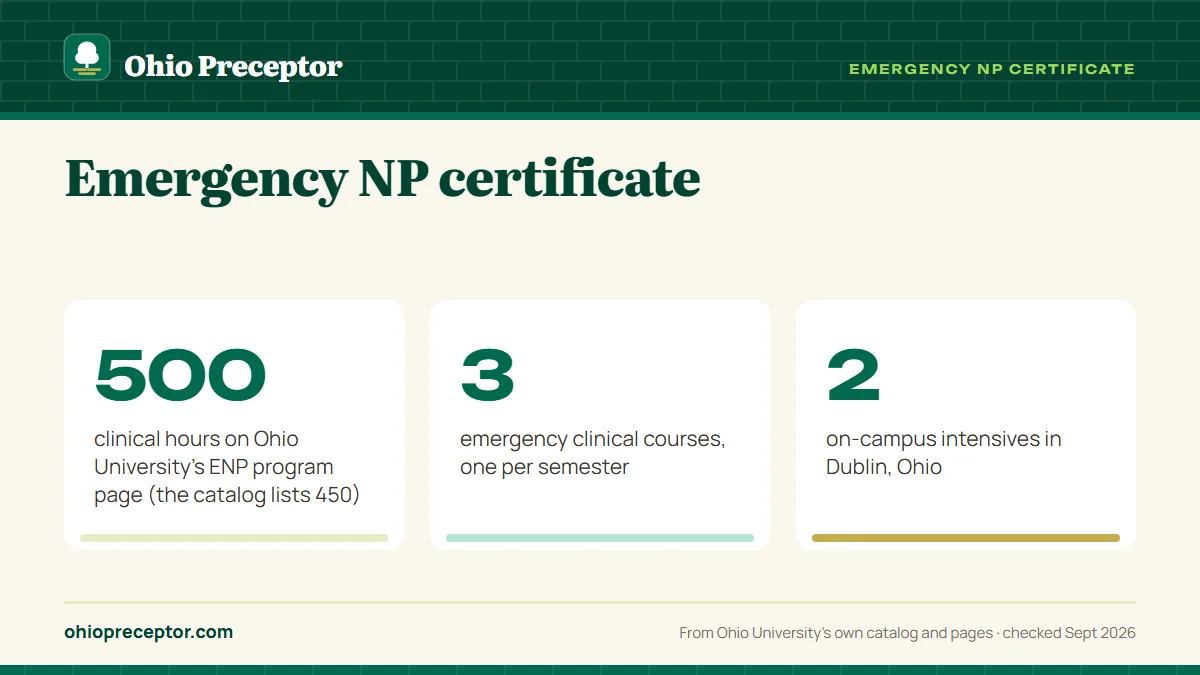
Ohio University's new Post-Graduate Emergency Nurse Practitioner Certificate (CTENPG) opens in Fall 2026 for nurses already certified as family nurse practitioners. Its three clinical courses take place in a hospital or emergency care facility. Ohio University's own pages give two totals for them: 450 hours in the catalog, 500 on the program page. We find emergency department preceptors within reach of your home and have the details faculty review ready well before your clinical packet is due.
Find an emergency department preceptor
Your city, your FNP license state and your start term are enough to begin.
What the Emergency NP certificate is
The certificate is a 20-credit online program for nurses who already hold a graduate nursing degree and certification as a family nurse practitioner. Ohio University announced it in September 2025 for a Fall 2026 launch and described a three-semester, part-time hybrid: online coursework, two short on-campus intensives in Dublin, Ohio, and supervised clinical practice in emergency care.
Admission asks for more than an RN license. The 2026-27 graduate catalog lists valid, unencumbered APRN licensure as an FNP in an approved state and a current Advanced Cardiac Life Support (ACLS) certification. The program page words it as a current FNP license or certification with prescriptive authority and the ability to practice in an approved state. Residence and RN licensure must also fall within Ohio University's approved states.
The catalog prerequisites are NRSE 7210, NRSE 7220, NRSE 7230 and a lab it names NRSE 7230L Advanced Health Assessment for Advanced Practice Nursing Lab, each at a B or better. A search of the 2026-27 graduate catalog finds no separate course entry for NRSE 7230L, so put the question to graduatenursing@ohio.edu: how will your earlier health assessment coursework be read against it?
The practicum path, course by course
Three emergency clinical courses run one per semester, fall to spring to summer, in the Nursing Knowledge Center's tentative course offerings. Each carries 6 credits, the second and third each require the one before, and NRSE 7818 Advanced Diagnostics for Clinical Reasoning (2 credits) completes the 20.
| Course | Term offered | Catalog hours | Program page hours | Catalog focus |
|---|---|---|---|---|
NRSE 6857 Emergency Nurse Practitioner Clinical I | Fall | 150 | 150 | Care for individuals and families in the emergent setting; intensive in Dublin per the program page |
NRSE 6858 Emergency Nurse Practitioner Clinical II | Spring | 150 | 150 | Assessment, diagnosis, procedural skills and management of acute or traumatic problems across the lifespan |
NRSE 6859 Emergency Nurse Practitioner Clinical III | Summer | 150 | 200 | Acute, complex or traumatic problems in the emergent setting; intensive in Dublin per the program page |
| Total | 450 | 500 |
Each course's catalog listing, requisites and contact hours are set out in detail on our Emergency NP courses page.
450 or 500 hours: reading Ohio University's conflict
The whole gap sits in NRSE 6859. The 2026-27 graduate catalog, like the 2025-26 edition, prints 150 practicum hours for each course, a total of 450. The program page prints 150, 150 and 200, a total of 500, and the September 2025 news release describes a minimum of 500 hours of supervised clinical practice.
The catalog's own contact-hour lines lean the same way as the program page: NRSE 6857 and NRSE 6858 each show 1.5 clinical, while NRSE 6859 shows 2.0. That is a pattern in the listings rather than a stated rule, so your NRSE 6859 syllabus and course faculty decide the number.
For planning, size the summer around 200 hours. For the first cohort that course lands in Summer 2027, which runs 05/10 to 08/14/2027, and asking a preceptor for 50 extra hours in July is far harder than agreeing on 200 in the spring.
The mistake to avoid: booking a summer preceptor for 150 hours because the catalog says so, then learning NRSE 6859 needs 200.
Start terms, weekly load and the two intensives
In the catalog, fall is the one entry term, which suits the fall, spring, summer run of the clinical courses. On the program page, Fall 2027 is the next start, with an 08/02/27 application deadline and classes from 08/23/27, yet the same page says Ohio University offers three start dates a year. Pin down your entry term with graduatenursing@ohio.edu before any preceptor dates are fixed.
Expect a heavy stretch. The news release estimates 25 to 30 hours a week for coursework, rising to more than 40 during clinical courses, over three 15-week semesters at 6 to 8 credits each. The program page describes the same certificate as finished in as few as 12 months.
The program page flags NRSE 6857 and NRSE 6859 as the courses with on-campus intensives in Dublin. Neither the Knowledge Center's course table nor its important-dates page shows ENP intensives yet, so keep an eye on our on-campus intensives page and your course site. Tell your preceptor about those days as soon as they are posted.
Settings and the preceptor you need
Ohio University is specific about where the hours happen. The news release names a hospital or emergency care facility, with an approved preceptor supervising, and the program page describes hands-on work in the emergency room itself. The primary care offices that suited your FNP training sit outside that description, so the search starts with emergency departments and the hospitals that run them. Whether a freestanding emergency site or an urgent care center qualifies is a question for your faculty.
The public pages do not list the credentials an ENP preceptor must hold. An Ohio University certificate page tells APRNs starting a certificate to email graduatenursing@ohio.edu for their program's preceptor packet and clinical overview sheets; that packet is the place to check ENP criteria. Faculty sign off on every preceptor and site, and the broader rules are gathered in our preceptor requirements guide.
Emergency departments inside large systems may run their own student applications. Ohio University's graduate important-dates page carries facility deadlines for OhioHealth, Mount Carmel, Holzer and Cleveland Clinic, and its MSN FAQ notes that larger systems may insist on a centralized request made well ahead of time. The windows are on our hospital system applications page.
Why Emergency NP students choose us
An emergency department placement has more moving parts than an office rotation. The unit, the hospital's student office and sometimes a system-wide application all have a say, and the placement has to hold for three terms in a row. We run that search for you: emergency departments within reach of home, clinicians willing to take you across fall, spring and summer, and a check on whether the hospital routes students through its own application and when that window closes.
Then we build the file Ohio University faculty review: your preceptor's license and credentials, a description of the emergency department, and each item your clinical packet calls for, ready ahead of the packet deadline for your term. Approval stays with faculty, and our job is to hand them a complete file on the first pass. If a preceptor's schedule changes mid-year, your placement advisor starts on a replacement straight away.
What you get
- An emergency department preceptor near home for
NRSE 6857,NRSE 6858andNRSE 6859 - A summer plan sized for 200 hours in
NRSE 6859 - Hospital application windows tracked on your behalf
- Preceptor and site details prepared for faculty review
Send us your city and start term below; how it works explains each step.
Questions Ohio University students ask
Can I apply to Ohio University's Emergency NP certificate without an FNP license?
Ohio University's published requirements say no. The catalog asks for unencumbered APRN licensure as a family nurse practitioner in an approved state, and the program page asks for an FNP license or certification with prescriptive authority. The catalog also describes the certificate as designed for nurses who already hold a graduate nursing degree with FNP certification, so nurses without it would look at the FNP routes first.
Do I need ACLS before starting the ENP certificate?
Yes. The graduate catalog lists a current Advanced Cardiac Life Support (ACLS) certification among the admission requirements for this certificate. Plan to keep it current through all three clinical terms, and check the Graduate Nursing Student Handbook (the School of Nursing emails it on request) for the other pre-clinical items such as immunizations, BLS and background checks.
How many hours a week does Ohio University's ENP certificate take?
The news release estimates 25 to 30 hours a week for coursework and more than 40 hours a week during clinical courses. Over a 15-week semester, 150 clinical hours averages about 10 hours a week; 200 hours in a summer term needs more. Agree on a steady weekly pattern with your preceptor early so the hours do not bunch up in the final weeks.
Does Ohio University find ENP preceptors for students?
Ohio University has not published an ENP-specific rule on who arranges clinicals. For the MSN programs, Ohio University lets students put forward their own preceptors for faculty approval, offers the Graduate Clinical Coordinator as a second route, and warns that big hospital systems may run their own assignment process. Ask graduatenursing@ohio.edu how that applies to the certificate, and use us to find and prepare an emergency department preceptor near you.
When are the Emergency NP on-campus intensives?
The program page ties them to NRSE 6857 in the fall and NRSE 6859 in the summer, and the news release places both at Ohio University's Dublin campus. No ENP intensive dates were posted on the Knowledge Center as of September 2026, so check it and your course site through the fall term and pass the dates to your preceptor quickly.
Related pages
Last checked 2026-09-24
We check these pages against Ohio University's own catalog, program pages and Nursing Knowledge Center. Your syllabus, the Graduate Nursing Student Handbook and your faculty have the final word.
Ohio University lets you choose your preceptor. We find the right one.
Tell us your Ohio University program, your community and your next clinical course. We find preceptors who fit the course and prepare what faculty review before they approve them.
- Preceptors matched to the course: primary care for the FNP
NRSE 6840sequence, acute care for AG-ACNP, psychiatric care for PMHNP - Your clinical packet details ready ahead of Ohio University's packet deadline
- Close to home, in Ohio or in any state where Ohio University admits graduate nurses
Start your placement plan
Program, city and clinical start is all we need to begin.