Who can precept Ohio University nursing students, track by track
For most Ohio University graduate tracks, the public pages describe where clinicals happen but not who may precept; those qualifications sit in the preceptor packet the School of Nursing sends on request. Two exceptions are clear: the AG-ACNP catalog names "acute-care physicians and advanced practice providers," and the RN-to-BSN publishes a full set of preceptor rules. This page gathers everything public and shows where to find the rest.
Get your placement plan
Tell us your Ohio University program and where you live. A placement advisor replies with the preceptor and site options that fit your course.
The short answer
Ohio University publishes a credential rule for one graduate track and a complete rule set for one undergraduate program. The remaining detail on graduate preceptors, including credential type, experience and any limits on relatives or supervisors, is kept in the preceptor packet, the clinical overview sheets and the Graduate Nursing Student Handbook.
Request the packet for your program from graduatenursing@ohio.edu before you approach anyone. It is the document your preceptor will complete, so reading it first means you ask the right clinician from the start, and faculty can then approve the preceptor without sending questions back. No School of Nursing web page is written for preceptors, so the packet is also what you hand a clinician who asks what precepting involves.
Track by track, in Ohio University's words
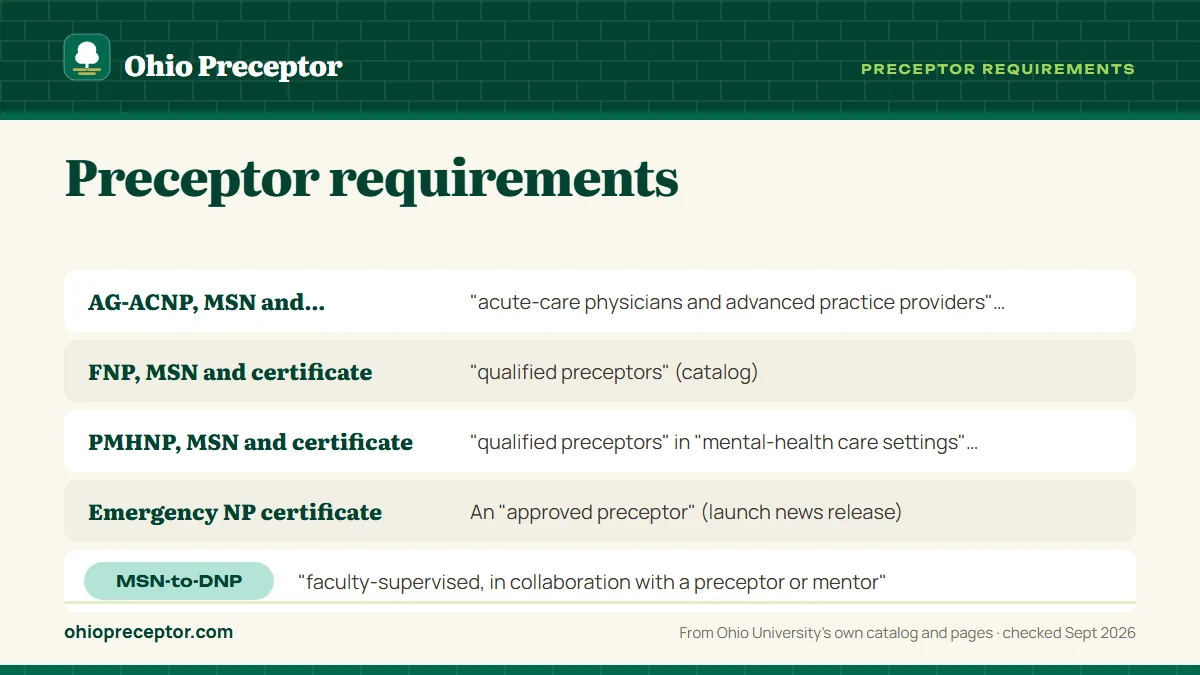
| Track | Who supervises (official wording) | Setting (official wording) |
|---|---|---|
| AG-ACNP, MSN and certificate | "acute-care physicians and advanced practice providers" (catalog) | "critical care units, hospital-based medicine and emergency units" (MSN FAQ) |
| FNP, MSN and certificate | "qualified preceptors" (catalog) | "primary-care offices or hospital/community-based clinics" (MSN FAQ) |
| PMHNP, MSN and certificate | "qualified preceptors" in "mental-health care settings" (catalog) | Private or community mental health agencies, correctional facilities, school-based health centers, substance-abuse treatment facilities (MSN FAQ) |
| Emergency NP certificate | An "approved preceptor" (launch news release) | "hospital or emergency care facility" |
| MSN-to-DNP | "faculty-supervised, in collaboration with a preceptor or mentor" | "individualized based on the program of study" |
| MSN Nurse Educator | "qualified preceptors" | "academic and direct care settings" |
| MSN Nurse Leader | "qualified preceptors"; "an approved preceptor at an approved site" | "nursing/healthcare leadership settings" |
"Qualified" is defined in the packet rather than on the web. Where a track says only "qualified preceptors," read your program's preceptor packet before assuming any credential is accepted or ruled out, and treat the AG-ACNP line as that track's rule only.
What the public pages leave to the packet
Not published for graduate nurse practitioner students
- Which credentials may precept FNP and PMHNP students: nurse practitioner, physician, physician assistant or others
- A minimum number of years in practice
- A general rule on the preceptor's state of licensure
- Limits on relatives, direct supervisors or your own workplace
- How many preceptors or sites one course may use
- Set pediatric or women's health hours inside the FNP practicums
Each of these is a fair question, and faculty can answer it. Ask before a preceptor commits rather than after the packet is filed, when a mismatch costs you weeks. Our finding your own preceptor guide includes the questions to raise with the clinician too.
The RN-to-BSN rules, published in full
Ohio University's pages for NRSE 4585 and NRSE 4595 spell out who may precept an RN-to-BSN student:
- "A preceptor must have a bachelor's degree in nursing or an advanced nursing degree."
- "The preceptor must also hold an active nursing license in the same state as the student and the same state of the facility that is being used."
- "The preceptor cannot be a close relative."
The NRSE 4600 page adds that the preceptor does not need to work at the project implementation site, noting that "this is not a shadowing experience." In the first week of each clinical course, students upload license verification for themselves and their preceptor from NURSYS. These rules belong to the undergraduate program, so graduate students should confirm rather than assume that any of them carries over.
State notes that reach your preceptor
Ohio University's professional licensure disclosures for the MSN, post-master's certificate and DNP include notes that bear directly on who can precept in a given state:
- Maryland: out-of-state nurse clinical faculty and preceptors must be licensed in Maryland.
- West Virginia: clinicals need West Virginia Board approval and evidence that your home state permits nursing students to attend out-of-state clinicals; the board already holds that evidence for Ohio, Pennsylvania, Kentucky and Virginia.
- Illinois: the APRN student and the preceptor must both hold an Illinois RN license.
- Alaska: preceptors need appropriate credentials, and students apply for preceptorship with the Alaska board.
If your clinic sits in one of these states, settle the licensing point before the preceptor signs anything. Our clinicals outside Ohio guide covers cross-state planning in more depth.
Ohio law, in brief
In Ohio, Revised Code 4723.32(F) lets an APRN student practice under the program's auspices while supervised by an advanced practice registered nurse serving as faculty member, teaching assistant or preceptor; Ohio's standard care arrangement and preceptors explains how that interacts with collaboration rules.
Some Ohio hospital systems list other preceptor types for APRN students on their own pages; Premier Health, for example, names MD/DO, PA or NP. Whether a physician or physician assistant may serve as your only preceptor is a question for Ohio University faculty and your preceptor packet.
The mistake is assuming a preceptor qualifies because a hospital accepts them. Hospitals set their own student rules; Ohio University faculty decide whether that preceptor fits your course.
How we match preceptors to these rules
Your placement advisor reads the rules for your track before the first call: the setting, the patient population in your NRSE course description, the credential wording and any state note where the clinic sits. Every preceptor we put forward has been checked against that list, and we collect license and credential details in the shape faculty expect. Where your track's wording leaves a credential open, we flag it early so you can confirm with faculty before the preceptor commits.
Faculty make the final call on every preceptor. We make sure the person they review is a clear fit, close to your home and ready before your packet deadline. Tell us your track and area in the form below.
Questions Ohio University students ask
Can a physician precept an Ohio University FNP student?
Ohio University's public pages leave it open. The FNP catalog page asks for "qualified preceptors," and only the AG-ACNP catalog names physicians alongside advanced practice providers. Ohio's exemption for APRN students refers to supervision by an APRN serving the program. Read your preceptor packet and ask faculty before approaching a physician.
How many years of experience does an Ohio University preceptor need?
No public Ohio University page sets a minimum. Any experience requirement for your track would appear in the preceptor packet or clinical overview sheets for your program, which you can request from graduatenursing@ohio.edu. Hospital systems sometimes add preceptor rules of their own, so check the facility's student page too.
Can a relative or my manager be my Ohio University preceptor?
For the RN-to-BSN, Ohio University states that the preceptor cannot be a close relative. For graduate students, no public page addresses relatives or supervisors, so put both questions to faculty. Even where a tie is allowed, a preceptor with no family or reporting link keeps evaluation simple for everyone.
Does my preceptor need a license in the state where I do clinicals?
For the RN-to-BSN, yes: the preceptor must be licensed in the same state as both the student and the facility. Graduate tracks have no general published rule, but state notes apply, such as Maryland's requirement that out-of-state preceptors hold a Maryland license and Illinois's RN license rule.
Is there an Ohio University web page for preceptors?
No School of Nursing page is written for preceptors, and the likely addresses return errors. The preceptor packet, sent on request through graduatenursing@ohio.edu, is the document preceptors actually see. Our page for preceptors explains what precepting an Ohio University student involves.
Related pages
Last checked 2026-09-24
We check these pages against Ohio University's own catalog, program pages and Nursing Knowledge Center. Your syllabus, the Graduate Nursing Student Handbook and your faculty have the final word.
Ohio University lets you choose your preceptor. We find the right one.
Tell us your Ohio University program, your community and your next clinical course. We find preceptors who fit the course and prepare what faculty review before they approve them.
- Preceptors matched to the course: primary care for the FNP
NRSE 6840sequence, acute care for AG-ACNP, psychiatric care for PMHNP - Your clinical packet details ready ahead of Ohio University's packet deadline
- Close to home, in Ohio or in any state where Ohio University admits graduate nurses
Start your placement plan
Program, city and clinical start is all we need to begin.