Ohio's standard care arrangement and who can precept you
Nurse practitioners in Ohio work under a written standard care arrangement with a collaborating physician or podiatrist, and they prescribe within rules set by the Board of Nursing. For an Ohio University student, the provision that matters most is the student exemption in ORC 4723.32(F), which names an APRN as the supervising preceptor. Here is the law in plain terms and what it means for your search.
Get your placement plan
Tell us your Ohio University program and where you live. A placement advisor replies with the preceptor and site options that fit your course.
Ohio's model in brief
Ohio licenses four APRN designations (CRNA, CNM, CNS and CNP) and requires a separate license for each. A certified nurse practitioner needs a written standard care arrangement, or SCA, with a qualified collaborating physician or podiatrist under ORC 4723.431. The American Association of Nurse Practitioners classifies Ohio as reduced practice and describes the arrangement as career-long, so it covers experienced NPs as much as new graduates.
Inside that framework, CNPs provide preventive and primary care, care for acute illness, and wellness evaluation and promotion within their population focus, and they prescribe in collaboration with one or more physicians. Every preceptor you meet in an Ohio clinic practices under these rules, so they shape what you observe and learn.
What a standard care arrangement contains
The Board of Nursing does not approve an SCA in advance, though it may review one, and the employer keeps a copy on file. Within 30 days of starting practice, the APRN reports each collaborator's name and business address to the Board. The collaborator must be authorized to practice in Ohio and work in a specialty the same as or similar to the nurse's.
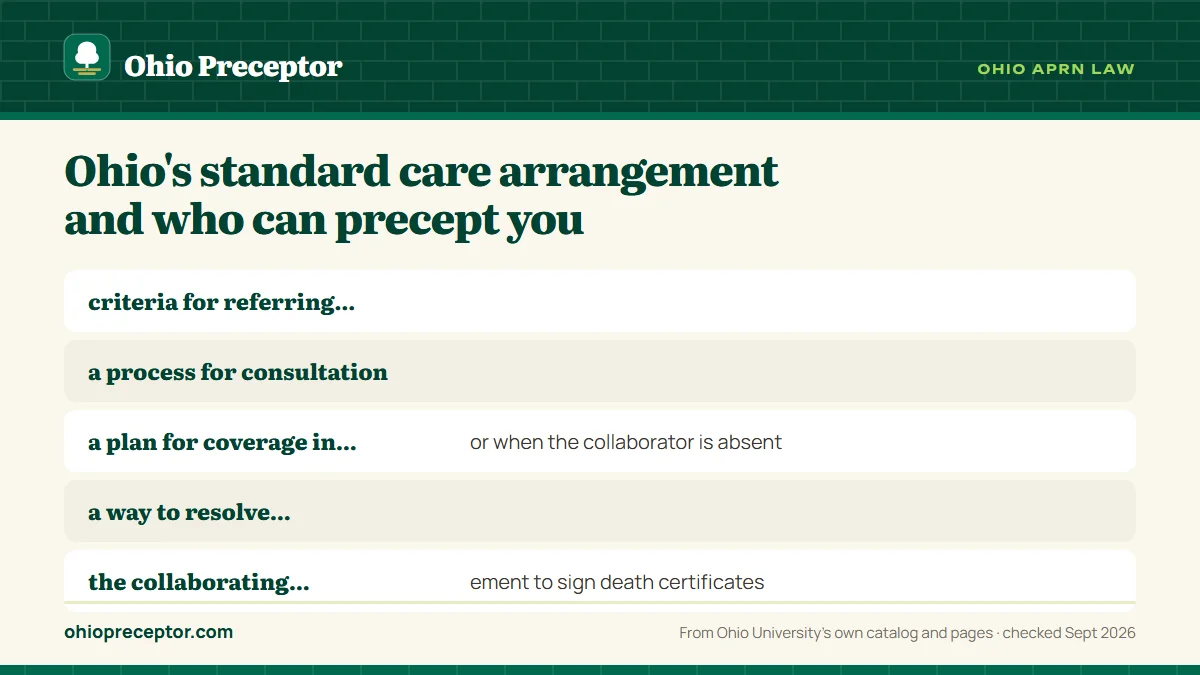
Required contents under ORC 4723.431 and OAC 4723-8-04
- criteria for referring patients
- a process for consultation
- a plan for coverage in emergencies or when the collaborator is absent
- a way to resolve disagreements
- the collaborating physician's agreement to sign death certificates
- any other criteria required by rule
A physician or podiatrist with arrangements covering more than five nurses may collaborate with no more than five at a time in the prescribing part of their practice. If a collaboration ends, the APRN may continue under the existing arrangement for up to 120 days after notifying the Board. For psychiatric-mental health CNPs, the collaborator must be a physician in psychiatry, pediatrics, or primary care or family practice.
Prescribing rules your preceptor works within
CNMs, CNSs and CNPs are authorized to prescribe under ORC 4723.481 and follow the exclusionary formulary in OAC 4723-9-10(B). Schedule II drugs are tightly limited: outside the locations listed in ORC 4723.481(C)(2), an APRN may prescribe one only when the patient has a terminal condition, a physician has already prescribed the drug, and the supply does not exceed 72 hours. Opioids for acute, sub-acute and chronic pain carry their own limits, and APRNs must register with OARRS and review its reports as the rules require.
For a student, this explains why prescribing in an Ohio clinic looks the way it does: when your preceptor pulls an OARRS report, the rule is part of the lesson.
The student exemption: ORC 4723.32(F)
Ohio's Nurse Practice Act lets a student enrolled in an APRN program practice as an APRN when three conditions hold:
- the program qualifies the student for a Board-approved national certification exam, or leads to the required master's or doctoral degree;
- the student's practice is under the auspices of the program;
- the student acts under the supervision of an APRN serving for the program as a faculty member, teaching assistant or preceptor.
The wording names an APRN. No Board of Nursing guidance was found on whether a physician or PA may be the sole preceptor for an NP student in Ohio, and the Board's preceptor qualification rules in OAC 4723-5 cover pre-licensure programs only. Meanwhile, several Ohio hospital pages accept physician and PA preceptors, and Ohio University's catalog describes AG-ACNP practicums under acute-care physicians and advanced practice providers.
In practice, Ohio University faculty decide who qualifies for your course. The Graduate Nursing Student Handbook and clinical overview sheets, both from graduatenursing@ohio.edu, carry the details, and the preceptor requirements page summarizes them by track.
The usual misstep: asking a physician you know to precept before checking with faculty. Confirm the preceptor type your course accepts, then make the request.
Licensure after graduation and the 45-hour pharmacology rule
To license as a CNP in Ohio you must be an RN, hold a qualifying master's or doctoral degree, pass a Board-approved national certification exam and file an application under oath (ORC 4723.41). Applications go through eLicense Ohio only once the degree and certification are complete, and the school sends your transcript to the Board directly.
ORC 4723.482 adds an advanced pharmacology requirement. The course must be completed no more than five years before you apply, run at least 45 contact hours, be specific to your specialty, and include at least 36 contact hours of pharmacology plus instruction on the fiscal and ethical sides of prescribing, prescribing law and schedule II controlled substances.
The Board notes that not every pharmacology course contains the required content and that qualifying continuing education can fill the gap. If you plan to license in Ohio, ask the School of Nursing how NRSE 7220 maps to the rule.
Bills to watch: SB 258, HB 449 and HB 508
Three bills in the 136th General Assembly share the name Better Access to Health Care Act. SB 258 was referred to the Senate Health Committee in October 2025, HB 449 is its House companion, and HB 508 went to the House Medicaid Committee the same month. As introduced, HB 508 would let a CNP, CNS or CNM practice without an SCA after 5,000 hours of clinical practice and would allow certain APRNs to serve as collaborators.
As of September 2026, all three are pending in committee, with no committee report or floor vote found. That status comes from archived copies of the legislature's pages, so check the Ohio General Assembly's site for the latest. Until a bill passes, the SCA rules above apply to every Ohio NP, your preceptor included.
What this means for your Ohio search
For an Ohio University student, the law narrows the field in a useful way: an APRN preceptor in your population focus fits the statute's wording, and any other preceptor type needs a clear yes from faculty first. We build that check into every Ohio search: your placement advisor confirms the preceptor's license, designation and population focus before a name reaches you.
That is why Ohio University students choose us for Ohio placements: the preceptor we bring already fits Ohio's rules and your course, so what reaches faculty is complete and fits the rules the first time. See how it works, or send your course with the form below.
Questions Ohio University students ask
Can a physician be my NP preceptor in Ohio?
Ohio's student exemption names an APRN as the supervising faculty member, teaching assistant or preceptor, and no Board of Nursing guidance on physician-only precepting was found. Some Ohio hospitals list physicians and PAs as preceptors, and Ohio University's AG-ACNP catalog mentions acute-care physicians. Your Ohio University faculty decide for your course, so ask them before you approach a physician.
Does Ohio give nurse practitioners full practice authority?
Not today. Ohio requires a written standard care arrangement with a collaborating physician or podiatrist for CNP practice, and AANP classifies the state as reduced practice. Bills that would remove the arrangement after a practice-hour threshold were pending in committee as of September 2026, so check the Ohio General Assembly's site for any change before relying on it.
Does the Ohio Board of Nursing approve Ohio University's NP programs?
The Board says it does not regulate education programs that prepare RNs for APRN licensure and keeps no list of them. Ohio University's professional licensure page says the same and marks its MSN, post-master's certificate and DNP as meeting Ohio's requirements. Questions about the program itself go to the accrediting agency or the Ohio Department of Higher Education.
I live outside Ohio. Do these rules apply to my clinicals?
State boards set their own rules for clinicals and licensure within their borders, so a clinical in another approved state follows that state's board. Ohio University's licensure page carries state notes; Illinois, for example, requires an Illinois RN license for both the APRN student and the preceptor. The clinicals outside Ohio page covers those rules.
Related pages
Last checked 2026-09-24
We check these pages against Ohio University's own catalog, program pages and Nursing Knowledge Center. Your syllabus, the Graduate Nursing Student Handbook and your faculty have the final word.
Ohio University lets you choose your preceptor. We find the right one.
Tell us your Ohio University program, your community and your next clinical course. We find preceptors who fit the course and prepare what faculty review before they approve them.
- Preceptors matched to the course: primary care for the FNP
NRSE 6840sequence, acute care for AG-ACNP, psychiatric care for PMHNP - Your clinical packet details ready ahead of Ohio University's packet deadline
- Close to home, in Ohio or in any state where Ohio University admits graduate nurses
Start your placement plan
Program, city and clinical start is all we need to begin.