Three ways to find your Ohio University preceptor
Ohio University gives you two official routes: identify a preceptor yourself for faculty approval, or ask the Graduate Clinical Coordinator to help facilitate a placement. A placement service is a third route that works alongside both. Here is how the three compare on time, reach, packet readiness and what happens if a preceptor drops.
Compare your options with us
Tell us your course and term. Your placement advisor explains how our search would fit next to Ohio University's routes.
What Ohio University's policy says
The School of Nursing answers the question directly in its MSN FAQ. Students "are permitted to identify their preceptors," as long as faculty approve; the Graduate Clinical Coordinator stands as the alternative; and a large hospital system may insist on its own central request, filed early and sometimes with a fee. The finding your own preceptor guide quotes the passage in full.
In plain terms, that gives you a choice. You may pick your own preceptor, faculty approve the pick, and help from the coordinator is available as an alternative. The DNP FAQ frames the same partnership for doctoral students, with faculty helping each one settle on a preceptor-mentor and a setting. Ohio University's 2025 news stories sound warmer still, mentioning local placements set up for students "when possible." Treat that as support Ohio University offers where it can, alongside a search of your own.
Route one: your own search
Ohio University explicitly permits this route, and it suits students with a strong local network. You may already know a nurse practitioner at your hospital, a physician group that has taken students before, or a community health center near home. A preceptor who knows you often says yes quickly.
The work is all yours, though. You make the calls and follow-ups, check whether the site runs its own student application or wants an affiliation agreement, gather the preceptor's credentials and site details for the clinical packet, and watch each hospital window. Ohio University's MSN FAQ puts clinical-course schoolwork at roughly 18 to 20 hours a week, on top of two to three days on site, so the search usually has to fit around a full load. The finding your own preceptor guide walks through doing it well.
Route two: the Graduate Clinical Coordinator
Ohio University's FAQ offers this route as the alternative to your own search, with the coordinator helping to arrange a placement. The coordinator's title does not appear on the public staff list, so start with graduatenursing@ohio.edu, the School of Nursing address the Nursing Knowledge Center publishes for placement and paperwork questions.
This route draws on Ohio University's own relationships. Its news pages describe collaboration with health care organizations across the state. It works best when you write early, name your course, term and county, and list the sites you have already tried. Missing your program's overview sheets or preceptor packet? Ask for them in the same email; Ohio University's PMHNP certificate page names that inbox for exactly this. The Graduate Clinical Coordinator page explains how to use it.
Route three: a placement service
A placement service takes on the search itself. With us, your placement advisor reaches out to practices, clinics and health centers suited to your NRSE course, confirms real interest and availability, and prepares the preceptor and site details your clinical packet asks for, well before the deadline.
Nothing about Ohio University's process changes. The preceptor is still one you choose, faculty still approve every preceptor and site, and your assigned clinical supervisor still oversees the course. What changes is who carries the outreach, the follow-up and the paperwork preparation. Students choose us for the time it returns to them and for the backup plan if a preceptor leaves mid-semester. Each step is laid out on the how it works page.
The three routes side by side
The last row matters most. Every route ends at the same approval step, so the real differences are speed, reach and how complete the file is when it arrives.
| Your own search | Graduate Clinical Coordinator | Placement service (us) | |
|---|---|---|---|
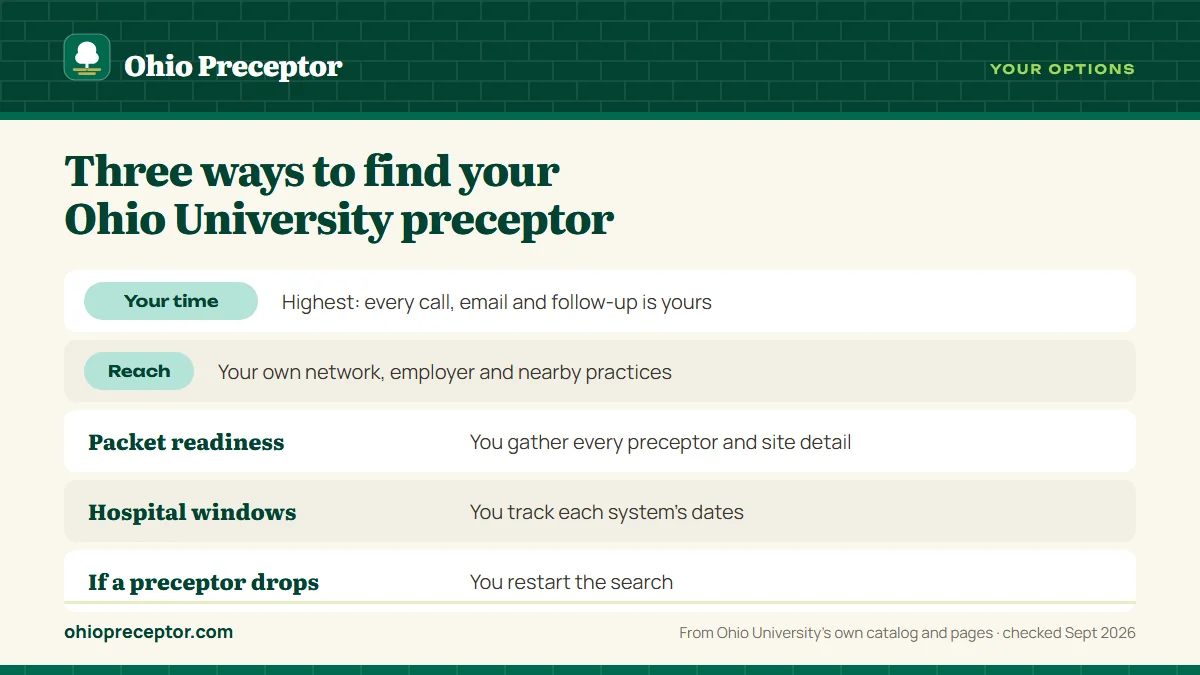
| Your time | Highest: every call, email and follow-up is yours | Shared: you write in and follow up while the School of Nursing helps facilitate | Lowest: your placement advisor handles outreach and follow-up |
| Reach | Your own network, employer and nearby practices | Ohio University's relationships with health care organizations | A dedicated search of your area by course and setting, in Ohio and the other approved states |
| Packet readiness | You gather every preceptor and site detail | You complete the clinical packet as the School of Nursing instructs | Preceptor and site details prepared in packet order before your deadline |
| Hospital windows | You track each system's dates | Ohio University lists dates for four Ohio systems on its Important Dates page | Tracked for you against your packet deadline |
| If a preceptor drops | You restart the search | Contact faculty and the School of Nursing | Replacement search starts that week |
| Final approval | Ohio University faculty | Ohio University faculty | Ohio University faculty |
Using the routes together
The routes combine well. Many students keep asking their own contacts, write to the School of Nursing, and bring us in at the same time. Coordination is the only rule: tell each party who else is helping, so no clinician receives two requests about the same student, and make sure faculty receive a single, complete file for each preceptor.
Timing decides how much weight each route should carry. With a term or more before the packet deadline, all three can run at an easy pace. With only weeks left, lean on whichever route is producing live conversations, and let the others run in parallel rather than one after another.
The habit that costs students a semester: waiting for one route to answer before starting the next. The calendar keeps moving while you wait.
Which route fits you
- Your own search fits if you already have a likely preceptor, strong local contacts and time in your week to follow up.
- The Graduate Clinical Coordinator fits if you want Ohio University's own help and can write in early with your course and county.
- A placement service fits if your weeks are full, your area is thin on willing preceptors, a deadline is close, or you want a replacement plan in place from day one.
If you are unsure, send your details through the form. Your placement advisor explains what our search would look like for your course, and you decide which mix of routes to use.
Questions Ohio University students ask
Can Ohio University students use a placement service?
Yes. Ohio University's MSN FAQ lets you choose your own preceptor for faculty to approve, and a service helps you do exactly that. The preceptor remains your choice and still goes to faculty for approval, the same as any other preceptor. If you want to confirm anything for your own course, ask your faculty or the School of Nursing.
Does the Graduate Clinical Coordinator place every student?
Ohio University's wording is that the coordinator can help facilitate clinical placements, presented as an alternative to your own search. The published pages describe help rather than an assigned placement for each student. Write to graduatenursing@ohio.edu early, and keep a search of your own moving at the same time.
Which route is fastest?
Usually the one with the most outreach behind it. A student with a willing preceptor already lined up can move fastest on their own. Without one, a placement service contacts many suitable clinicians in parallel, which tends to shorten the search. Close to a deadline, see need a preceptor fast.
Do faculty review a preceptor found by a service differently?
Ohio University's approval step applies to every preceptor and site, whoever made the introduction. What helps approval is a preceptor who fits the course and a file with nothing missing. That is why we assemble each preceptor's credentials, license and site information to match the packet's own sequence.
Can I switch routes partway through a search?
Yes. Students often start alone, then add the School of Nursing or bring us in when time gets short. Share what you have already tried, including any clinician who said no, so the next route starts from where you are rather than repeating your first weeks.
Related pages
Last checked 2026-09-24
We check these pages against Ohio University's own catalog, program pages and Nursing Knowledge Center. Your syllabus, the Graduate Nursing Student Handbook and your faculty have the final word.
Ohio University lets you choose your preceptor. We find the right one.
Tell us your Ohio University program, your community and your next clinical course. We find preceptors who fit the course and prepare what faculty review before they approve them.
- Preceptors matched to the course: primary care for the FNP
NRSE 6840sequence, acute care for AG-ACNP, psychiatric care for PMHNP - Your clinical packet details ready ahead of Ohio University's packet deadline
- Close to home, in Ohio or in any state where Ohio University admits graduate nurses
Start your placement plan
Program, city and clinical start is all we need to begin.