The Graduate Clinical Coordinator at Ohio University, and how to use that route well
Ohio University's MSN FAQ gives graduate students a second route to a clinical placement: "Alternatively, the Graduate Clinical Coordinator can help facilitate clinical placements." That is help from inside the School of Nursing, reached through the graduate nursing inbox. Here is what Ohio University publishes about the role, how to ask for help clearly, and why many students keep their own search running at the same time.
Get your placement plan
Tell us your Ohio University program and where you live. A placement advisor replies with the preceptor and site options that fit your course.
What the MSN FAQ actually says
The coordinator sentence sits in the middle of a four-sentence answer. First, students "are permitted to identify their preceptors with faculty approval." Then comes the alternative: the Graduate Clinical Coordinator "can help facilitate clinical placements." The answer closes on larger hospital systems, whose centralized processes students must use, often well in advance, with the note that "Fees may apply."
"Alternatively" presents the coordinator as another path open to you, next to your own search. "Facilitate" is a support verb: Ohio University does not list the coordinator's individual tasks, but the word points to help in bringing a placement together. The MSN FAQ is the only ohio.edu page that uses the title at all.
What is published about the role, and what is not
Published on ohio.edu
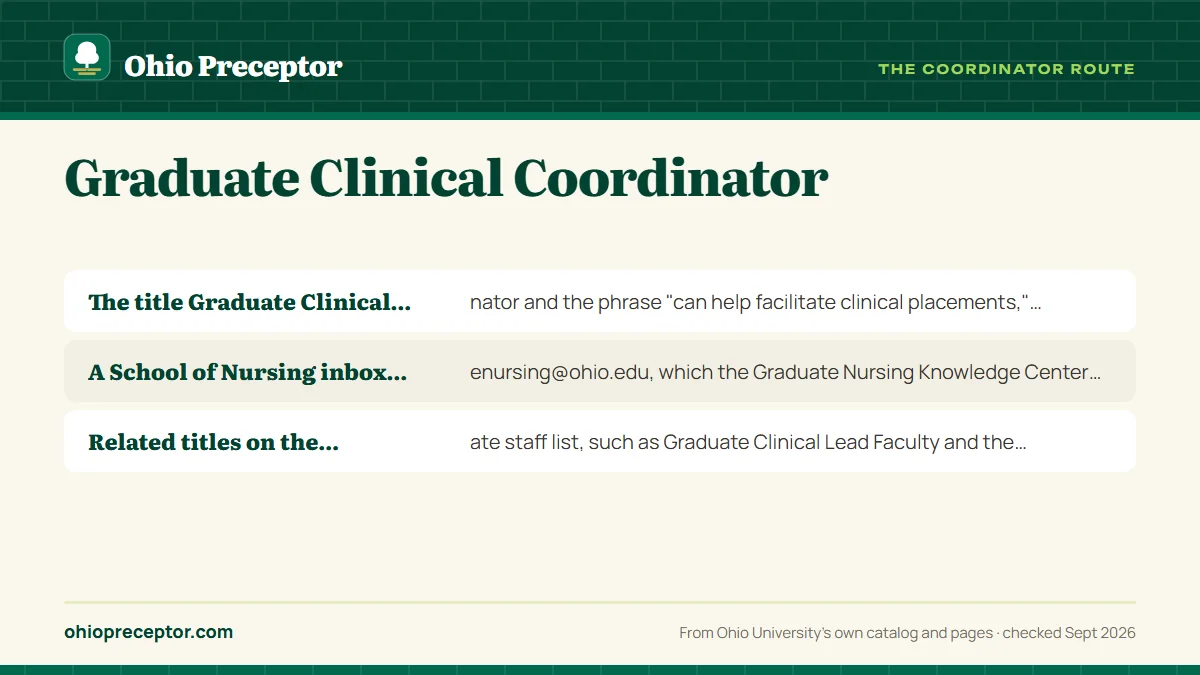
- The title Graduate Clinical Coordinator and the phrase "can help facilitate clinical placements," both in the MSN FAQ.
- A School of Nursing inbox, graduatenursing@ohio.edu, which the Graduate Nursing Knowledge Center gives for questions about graduate programs, clinical placements and paperwork.
- Related titles on the public graduate staff list, such as Graduate Clinical Lead Faculty and the Director and Coordinator of Graduate Operations and Student Experience, shown without published duties.
What Ohio University leaves unpublished: a person listed under the coordinator title, the scope of the role, how requests are prioritized, typical response times, and whether the role reaches beyond the MSN tracks. That is common for an internal support role. It simply means the way to learn what the coordinator can do for you is to ask, and our who does what guide shows where the role sits among the others you will meet.
Reaching the School of Nursing
The Graduate Nursing Knowledge Center gives one contact for placement questions: graduatenursing@ohio.edu. For graduate clinical placements and paperwork it lists this inbox rather than a phone line, so email is the way in. Write from your Ohio University student email, since the Knowledge Center FAQ says Ohio University must correspond with students exclusively through those accounts.
A short, complete first message gets a more useful answer than a general request for help. Include:
- your program and track, and the next clinical course by number, such as
NRSE 6840; - the term you are planning for and its packet date, from our packet deadlines page;
- your home city or county and how far you can travel each clinic day;
- the practices you have already approached, with their answers, and any hospital system applications under way;
- one clear question, such as whether sites in your area can be suggested or whether a lead you found looks suitable.
How Ohio University describes its placement support
Ohio University's news stories describe the help in warm terms. An August 2025 story on the nurse practitioner program speaks of "clinical placements arranged in students' home regions, when possible," and says Ohio University "helps students secure clinical sites that provide exposure to a wide range of patient populations and healthcare settings." A February 2025 story says Ohio University "collaborates with healthcare organizations across the state," and a June 2025 story on the BSN-to-DNP mentions "assistance securing clinical placements."
That is support Ohio University describes offering, and each phrase carries its own qualifier: "when possible," "helps," "assistance." The policy statement remains the MSN FAQ, so read the news wording as help available alongside your own search rather than a promise that a site will be arranged. The certificates page puts it in similar spirit: "Complete practicum hours locally in your preferred setting."
Why many students run both routes at once
Asking the coordinator for help and searching yourself fit together well, and each covers the other's blind spots. Ohio University's graduate students live across 28 approved states, so any one source of leads will be stronger in some regions than others. Hospital system windows also close early, as our hospital system applications guide shows, and a single stalled lead can cost a term.
Keep the coordinator informed about what you find. A preceptor you identify still goes to faculty for approval, and a coordinator who knows your leads can aim help at the gaps that remain. Our finding your own preceptor guide covers the search side.
The mistake is pausing your own search while you wait for a reply. Send the email, then keep contacting practices; if both routes produce a preceptor, you simply choose the better fit.
Where our placement desk fits
Our service sits on your side of the process, next to the coordinator route. Your placement advisor runs a full search in your home area, confirms each preceptor's willingness, days and patient mix, and prepares the file faculty review. Any site the coordinator suggests can join the same shortlist, and because every contact is logged, you can forward the School of Nursing a clean summary of where your search stands at any point.
Faculty approve every preceptor, whoever found them. What we add is speed and thoroughness: one advisor tracking your packet deadline, any hospital system window and every open lead at once. If you are weighing the options, placement help versus your own search lays them side by side, or share your program, city and next clinical course in the form below.
Questions Ohio University students ask
Who is Ohio University's Graduate Clinical Coordinator?
Ohio University names the role in its MSN FAQ but lists nobody under that title on its public graduate staff pages. Reach the role through the School of Nursing at graduatenursing@ohio.edu, the address the Knowledge Center gives for questions about clinical placements and paperwork, and mention the coordinator in your subject line.
Will the Graduate Clinical Coordinator find a preceptor for me?
The MSN FAQ says the coordinator "can help facilitate clinical placements," and Ohio University news stories speak of placements arranged in home regions "when possible." That describes support rather than an assignment, so ask what help is available for your area and keep your own search moving at the same time.
Is there a phone line for Ohio University clinical placement help?
The graduate Knowledge Center directs clinical placement and paperwork questions to the graduatenursing@ohio.edu inbox. Email from your Ohio University student account, include your track, next NRSE course and term, and keep the thread with your placement notes so you can quote earlier answers.
Can I use the coordinator and a placement service together?
Yes. Ohio University's FAQ presents your own search and the coordinator as open options, and a service adds capacity to your side of that. Tell the coordinator which practices are already being approached so no clinic hears from two people, and remember that faculty approve every preceptor.
Does the Graduate Clinical Coordinator help RN-to-BSN students?
The title appears only in the MSN FAQ. RN-to-BSN students follow their own published steps: email the advisor for permission, join the Pre-Clinical Canvas course and upload the Preceptor Agreement by its deadline. Questions about RN-to-BSN clinicals start with your advisor.
Related pages
Last checked 2026-09-24
We check these pages against Ohio University's own catalog, program pages and Nursing Knowledge Center. Your syllabus, the Graduate Nursing Student Handbook and your faculty have the final word.
Ohio University lets you choose your preceptor. We find the right one.
Tell us your Ohio University program, your community and your next clinical course. We find preceptors who fit the course and prepare what faculty review before they approve them.
- Preceptors matched to the course: primary care for the FNP
NRSE 6840sequence, acute care for AG-ACNP, psychiatric care for PMHNP - Your clinical packet details ready ahead of Ohio University's packet deadline
- Close to home, in Ohio or in any state where Ohio University admits graduate nurses
Start your placement plan
Program, city and clinical start is all we need to begin.