Ohio University's MSN-to-DNP: practice hours, project site and preceptor-mentor
Ohio University's online MSN-to-DNP (DN1234) asks for 1,000 post-baccalaureate practice hours, and a gaps analysis decides how many of your MSN clinical hours count toward them. The hours are faculty-supervised practice with a preceptor or mentor, and the two practicums, NRSE 8920 and NRSE 8921, center on a change project. We find the preceptor-mentor and project site you and your faculty are looking for, close to home.
Plan your DNP practice hours
Tell us your specialty, your city and when your first practicum starts.
What the MSN-to-DNP is
The MSN-to-DNP is Ohio University's post-master's Doctor of Nursing Practice. In the 2026-27 graduate catalog it appears as DN1234, taught in a hybrid model of online courses plus some courses with an on-campus intensive, and it admits nurses who already hold an MSN. Unconditional admission needs a graduate GPA of at least 3.20 and RN experience equal to two full-time years within the previous five, and you must live in, and hold your RN license in, one of the approved states.
Credit totals vary by page. The catalog sets a minimum of 36 credits, the doctorate page and FAQ say 36, and the curriculum page says 37. Adding an Ohio University certificate inside the DNP raises the total on the curriculum page to 67 credits for AG-ACNP, FNP or PMHNP, 57 for Nurse Educator and 55 for Nurse Leader.
The doctorate page says students take two or three courses a term and can finish in six semesters. The DNP FAQ allows up to 6 years, while the graduate catalog's time limit for a professional doctorate is seven calendar years; your advisor can tell you which limit your program of study runs under.
The 1,000 hours and the gaps analysis
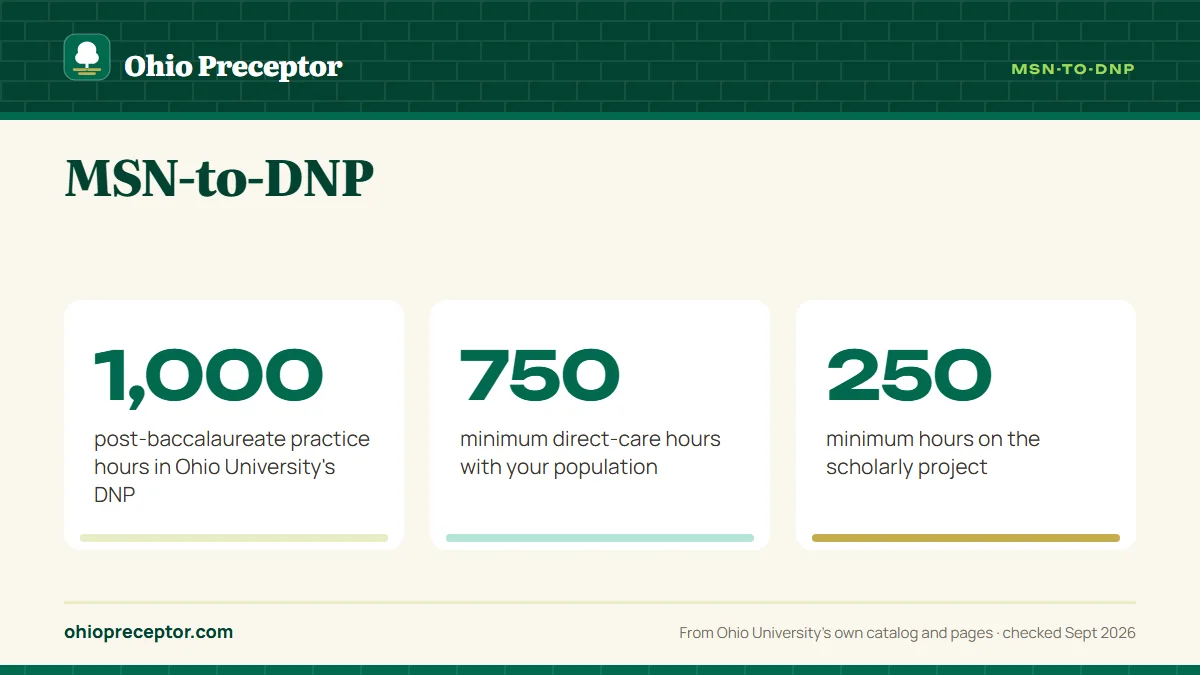
Ohio University counts DNP practice from the bachelor's degree onward. The catalog sets the total at 1,000 post-baccalaureate hours, with floors inside it: 750 direct-care hours with your patient population and 250 hours of scholarly project work.
Hours from your earlier graduate program can count, but no fixed number transfers. The DNP FAQ says a gaps analysis of the clinical and practice hours in your previous graduate coursework sets the additional hours you need, and the curriculum page says credit is decided on an individual basis. The catalog therefore tells new students to be prepared at admission to document any precepted practicum or clinical hours earned in a graduate nursing program.
Pull together whatever proves those hours, such as clinical logs and course records from your MSN program, and ask the School of Nursing what format it wants. Our DNP 1,000-hour guide goes deeper on how the hours add up.
The mistake to avoid: assuming your MSN hours carry over automatically. Ohio University credits them one student at a time, from the documentation you provide at admission.
The practicum path
Nine courses come before the first practicum in Ohio University's sample schedule, which is headed "Subject to change" and orders a fall start like this:
| Semester | Courses | Practicum hours |
|---|---|---|
| Fall, year 1 | NRSE 7810, NRSE 7826, NRSE 7001 | None |
| Spring, year 1 | NRSE 7811, NRSE 7813 | None |
| Summer, year 1 | NRSE 7812, NRSE 7814 | None |
| Fall, year 2 | NRSE 7815 Evidence-Based Practice Application, NRSE 7002 | None; the change project is planned here |
| Spring, year 2 | NRSE 8920 Doctor of Nursing Practice Practicum I, NRSE 7817 | 100 on the sample schedule, 250 in the catalog |
| Summer, year 2 | NRSE 8921 Doctor of Nursing Practice Practicum II | 150 on the sample schedule, 250 in the catalog |
The sample schedule totals 250 practicum hours across both courses, while the catalog and curriculum page list 250 for each. The Knowledge Center's offerings table also runs NRSE 8920 in spring and summer and NRSE 8921 in fall and summer, so your own program of study may place them differently. Both courses have their own page: the NRSE 8920 and 8921 guide.
What happens in the two practicums
NRSE 8920 centers on the role of the DNP-prepared nurse leader and on developing, implementing and evaluating a scholarly healthcare change project. NRSE 8921 prepares you for an advanced practice or leadership role and focuses on disseminating that project. Each carries 5 credits, and NRSE 8921 requires NRSE 8920.
The groundwork comes a term earlier in NRSE 7815, where you build a strategic plan to improve care for individuals, groups or populations and the data collection and analysis methods to evaluate it. The finished DNP project is a transformative change to promote quality healthcare, shared through presentation or publication, and the catalog's culminating experience adds a practice-related intern or externship experience and a comprehensive portfolio. NRSE 8921 closes with final presentations in Dublin, Ohio.
The sample schedule adds a timing rule worth writing on your calendar: every practicum hour for a course is due by the close of a 14-week semester, although course pages describe 15-week terms. Plan to finish early.
Settings, preceptor-mentors and the three intensives
Per Ohio University's DNP FAQ, course objectives drive the practice hours, faculty supervise them together with a preceptor or mentor, and each student's hours follow an individual program of study. It also says faculty take an active part, with you, in choosing the preceptor-mentor and the clinical setting. What you are looking for, then, is a leader with the standing to host a change project in their unit or organization, in a setting where that project can run across two consecutive terms.
Malpractice cover has its own DNP rule. Students in APRN tracks need nurse practitioner malpractice insurance, Nurse Leader/Executive and Nurse Educator tracks need registered nurse malpractice insurance, and insurance provided by the employer is not accepted. See our malpractice insurance page.
The DNP core carries three on-campus intensives, described on Ohio University's intensives page as three three-day visits over six semesters, and the Knowledge Center marks three courses as intensive ones: NRSE 7810, NRSE 7815 and NRSE 8921. Specialty courses may add more. Ohio University lists the Fall 2026 DNP orientation as a two-day virtual event starting 08/19/2026.
Start terms and the BSN-to-DNP question
The catalog and the doctorate page list a fall-only start, and the apply page names Fall 2027 as the next intake, with a 07/05/27 application deadline and classes beginning 08/23/27. The DNP FAQ contradicts itself, saying in one answer that students are admitted in the fall term and in another that the MSN-DNP admits in fall and spring. Treat fall as the working assumption until the School of Nursing says otherwise.
BSN-to-DNP tracks for AG-ACNP, FNP, PMHNP, Nurse Educator and Nurse Leader are still written into the 2026-27 catalog, at 70 credits, with the NP tracks typically taking nine semesters. The public pages show something different: the old BSN-to-DNP web address now lands on the doctorate page, which offers only BSN-to-DNP Nurse Anesthesia and the post-master's DNP, and the DNP application carries a single code, DN1234. Ohio University has not published a statement that those NP, NE and NL tracks are closed; its application simply does not offer them.
Why DNP students choose us
A DNP placement is often two searches in one: a preceptor-mentor who can sponsor your project, and, if your gaps analysis leaves direct-care hours to make up, a clinical preceptor for your population. We run both. Your placement advisor looks for organizations near you with an improvement problem worth solving and a leader ready to back the work, then lines up the direct-care side if you need it.
We prepare the mentor's credentials, a site profile and each clinical packet item, so your conversation with faculty starts from a complete shortlist rather than a blank page. Faculty have the final say on the preceptor-mentor and setting, and we give them a shortlist that already meets Ohio University's rules. When you are ready, the form on this page starts the search, and how it works shows what happens next.
Questions Ohio University students ask
How many of my MSN clinical hours count toward Ohio University's DNP?
Ohio University publishes no set number. It runs a gaps analysis on the clinical and practice hours from your earlier graduate coursework, credits them individually and then sets the extra hours you need to reach 1,000 post-baccalaureate hours. The more complete your MSN hour records are when you start, the more the analysis can weigh.
Is Ohio University's MSN-to-DNP 36 or 37 credits?
Both figures appear. The catalog gives a minimum of 36, the doctorate page and FAQ say 36, and the curriculum page totals 37. The sample schedule reaches 36 with NRSE 7002 at 1 credit, while the catalog course entry lists that course at 2. Your program of study, agreed with your advisor, is the figure that counts.
Can I do my DNP project at my own workplace?
Ohio University's public DNP pages do not rule on this. They describe individualized, faculty-supervised hours with a preceptor or mentor, chosen with faculty involvement. Put your employer forward as an option early in those conversations, and read our guide to workplace clinical sites first.
Does Ohio University still offer a BSN-to-DNP for nurse practitioners?
Not through the public application, as far as Ohio University's pages show. The NP tracks remain in the 2026-27 catalog, yet the application offers MSN-to-DNP entry alone, and Nurse Anesthesia is the one BSN-entry doctorate the pages actively recruit for. With a BSN and NP ambitions, the MSN tracks are the open route; the MSN FNP is one, and its clinical hours can later feed a DNP gaps analysis.
When are Ohio University's DNP final presentations?
Ohio University lists the NRSE 8921 DNP final presentations for 08/01 to 08/03/2027 at its Dublin, Ohio, center, a year after the 2026 event held 08/06 to 08/08/2026. Book the dates with your employer as soon as your program of study places NRSE 8921 in a summer term.
Related pages
Last checked 2026-09-24
We check these pages against Ohio University's own catalog, program pages and Nursing Knowledge Center. Your syllabus, the Graduate Nursing Student Handbook and your faculty have the final word.
Ohio University lets you choose your preceptor. We find the right one.
Tell us your Ohio University program, your community and your next clinical course. We find preceptors who fit the course and prepare what faculty review before they approve them.
- Preceptors matched to the course: primary care for the FNP
NRSE 6840sequence, acute care for AG-ACNP, psychiatric care for PMHNP - Your clinical packet details ready ahead of Ohio University's packet deadline
- Close to home, in Ohio or in any state where Ohio University admits graduate nurses
Start your placement plan
Program, city and clinical start is all we need to begin.