Malpractice insurance for Ohio University clinicals
Ohio University lists evidence of malpractice insurance among the items every graduate nursing student proves before clinicals. Its DNP pages are more specific: students in APRN tracks need nurse practitioner malpractice insurance, Nurse Leader and Nurse Educator students need registered nurse coverage, and "Insurance provided by the employer is not acceptable." Here is where each rule appears, how it applies to MSN and certificate students, and when to buy.
Get your placement plan
Tell us your Ohio University program and where you live. A placement advisor replies with the preceptor and site options that fit your course.
Where Ohio University states the requirement
The requirement appears in two versions. The brief version turns up on the MSN application page, on each certificate page and in the catalog's program entries, which list "Malpractice insurance" or "Evidence of malpractice insurance" among the items students must prove "Prior to clinical/practicum experiences."
The long one is on the DNP apply page, the post-master's DNP page and the DNP FAQ: "Students in the APRN program tracks are required to have nurse practitioner malpractice insurance; students in the Nurse Leader/Executive or Nurse Educator program track are required to have registered nurse malpractice insurance. Insurance provided by the employer is not acceptable."
The MSN and certificate pages do not repeat the employer sentence. That is a gap in the wording rather than a stated exception, so check the rule for your program in the Graduate Nursing Student Handbook, sent on request by graduatenursing@ohio.edu.
Which coverage fits your track
Set the two versions side by side and the gaps show. The table lists what Ohio University's pages state for each track.
| Track | Coverage type named | Employer-provided policy |
|---|---|---|
| MSN FNP, PMHNP and AG-ACNP | "Malpractice insurance"; type not stated | Not addressed on the MSN pages |
| Post-master's FNP, PMHNP, AG-ACNP and Emergency NP certificates | "Malpractice insurance"; type not stated | Not addressed on the certificate pages |
| MSN-to-DNP, APRN tracks | Nurse practitioner malpractice insurance | "Not acceptable" |
| DNP Nurse Leader/Executive or Nurse Educator track | Registered nurse malpractice insurance | "Not acceptable" |
| MSN Nurse Leader and Nurse Educator | "Malpractice insurance"; type not stated | Not addressed |
Until your handbook or faculty say otherwise, NP-track students are safest with nurse practitioner student coverage, the type the DNP pages name for APRN tracks, and Nurse Leader and Nurse Educator students with registered nurse coverage. Confirm before you pay for a policy, since the MSN and certificate pages leave the type unstated.
Why an employer's policy is not enough
Ohio University states the rule without giving a reason, so take it as a firm requirement rather than a preference. Many working RNs, and many current APRNs entering a certificate, already have some coverage through a hospital or practice, and it is natural to assume it travels with them. The DNP pages say it does not.
The questions to put to any insurer are practical. Does the policy name you personally, rather than your employer? Would it respond to a claim arising from your student NP work at a site that does not employ you? Does it cover every date of your practicum? If any answer is no or unclear, the policy is unlikely to meet Ohio University's wording, and a separate student policy is the cleaner route.
Current APRNs should read the rule closely too. An NP license does not change the employer exclusion, and a certificate practicum is a student role in a new population focus. The FNP certificate page covers that route.
The common error: assuming a hospital or practice policy covers you as a student. Ohio University's DNP pages rule employer insurance out, so check your own track's rule before your packet goes in.
When to buy it
Proof of insurance is due before clinicals start, and it belongs in your file before the clinical packet goes in, the last fixed date ahead of your practicum. The dates are on the packet deadlines page.
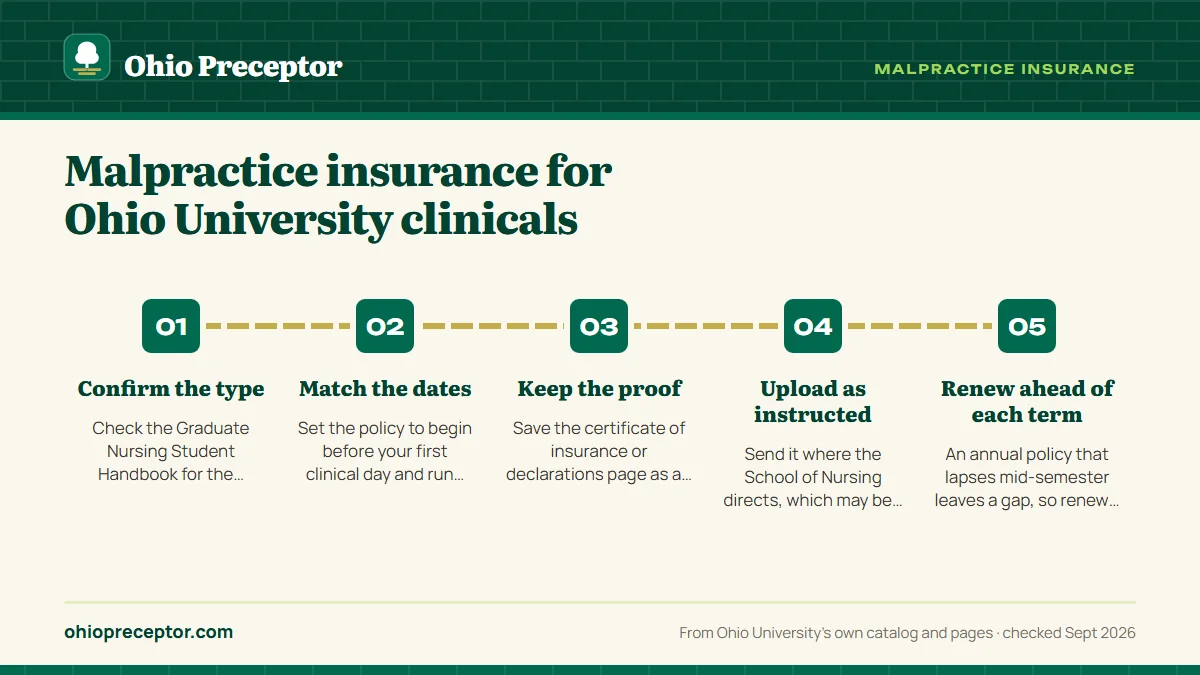
- Confirm the typeCheck the Graduate Nursing Student Handbook for the coverage Ohio University expects for your track, and ask faculty about any limits it names.
- Match the datesSet the policy to begin before your first clinical day and run past your last, including any time needed to finish hours.
- Keep the proofSave the certificate of insurance or declarations page as a PDF, since the catalog asks for evidence of insurance, not just a policy number.
- Upload as instructedSend it where the School of Nursing directs, which may be Typhon, the system graduate students use for program and track requirements. See the Typhon guide.
- Renew ahead of each termAn annual policy that lapses mid-semester leaves a gap, so renew before the packet for your next practicum.
Other Ohio University programs, for comparison
Malpractice coverage runs through Ohio University's other nursing programs as well. The RN-to-BSN's list of onboarding items a facility may require includes personal malpractice insurance. The associate degree program asks for current professional liability insurance before the first clinical day. The School Nurse Certificate's clinical course, NRSE 4740, lists "Licensed RN and malpractice insurance" among its requisites.
Those rules belong to their own programs, but the pattern is consistent: Ohio University expects a student in a clinical setting to carry coverage, and the DNP pages give the most specific version of that expectation. Clinical sites can ask separately too, and a hospital system's onboarding may want to see your policy. RN-to-BSN readers will find their onboarding steps on the RN-to-BSN page.
How we fit around your insurance and paperwork
Insurance is yours to buy, and your placement advisor makes sure it lines up with the placement. When a preceptor confirms, we note the site's onboarding list, including whether the site wants to see your malpractice policy and in what form, and give you the practicum dates your policy needs to cover. If the site wants proof on its own schedule, you hear the date early, so one document serves both the site and Ohio University.
That way the certificate you upload matches the semester, the site and the track, and coverage never becomes the item that holds up approval. Faculty at Ohio University decide on approval, and your insurance proof is one item they will find in order. Use the form below to begin, or review the full list of pre-clinical requirements.
Questions Ohio University students ask
Does Ohio University provide malpractice insurance for students?
Ohio University's public graduate pages list malpractice insurance as something students must prove before clinicals, and the DNP pages say students "are required to have" it. Nothing public says the university supplies a policy. Check the Graduate Nursing Student Handbook, and plan to buy your own coverage in the type your track requires.
Can I use my hospital's malpractice coverage for Ohio University clinicals?
Ohio University's DNP pages say plainly: "Insurance provided by the employer is not acceptable." The MSN and certificate pages leave that sentence out, so look up your program's rule in the Graduate Nursing Student Handbook. Until you have that answer in writing, plan on an individual policy in your own name.
Do Nurse Educator and Nurse Leader students need NP coverage?
No. The DNP pages say Nurse Leader/Executive and Nurse Educator track students need registered nurse malpractice insurance, while APRN-track students need nurse practitioner coverage. For the MSN Nurse Leader and Nurse Educator tracks, the MSN pages list malpractice insurance without naming the type, so check the handbook for your track before buying.
How much malpractice coverage do I need?
Ohio University's public pages do not state coverage limits. The Graduate Nursing Student Handbook, available by email from graduatenursing@ohio.edu, is the place to look, and a clinical site may state its own minimums in its onboarding paperwork. Ask both before buying, so one policy satisfies the School of Nursing and your site.
When should I buy malpractice insurance for my first practicum?
Before your clinical packet goes in. Ohio University requires proof before clinical experiences begin, and the packet deadline is the last fixed date ahead of your practicum. Buy once your track's coverage type is confirmed, set the policy to cover every date of the semester, and keep the proof ready to upload.
Related pages
Last checked 2026-09-24
We check these pages against Ohio University's own catalog, program pages and Nursing Knowledge Center. Your syllabus, the Graduate Nursing Student Handbook and your faculty have the final word.
Ohio University lets you choose your preceptor. We find the right one.
Tell us your Ohio University program, your community and your next clinical course. We find preceptors who fit the course and prepare what faculty review before they approve them.
- Preceptors matched to the course: primary care for the FNP
NRSE 6840sequence, acute care for AG-ACNP, psychiatric care for PMHNP - Your clinical packet details ready ahead of Ohio University's packet deadline
- Close to home, in Ohio or in any state where Ohio University admits graduate nurses
Start your placement plan
Program, city and clinical start is all we need to begin.