Pre-clinical requirements for Ohio University graduate students
Before any clinical or practicum experience, Ohio University graduate nursing students must prove four things: health status items such as immunizations and TB screening as set out in the Graduate Nursing Student Handbook, state and federal background checks, malpractice insurance, and Basic Life Support certification. Clinical sites and hospital systems may add requirements of their own. Here is what Ohio University publishes, what it leaves to the handbook, and when to get each item done.
Get your placement plan
Tell us your Ohio University program and where you live. A placement advisor replies with the preceptor and site options that fit your course.
What Ohio University requires before clinicals
Three sets of Ohio University pages, for the MSN application, the certificates and the catalog programs, share nearly identical wording: "Prior to clinical/practicum experiences, students must also provide proof of the following."
- Health status. "Specified health status requirements (immunization status, TB screening, etc. as delineated in the current Graduate Nursing Student Handbook)." The catalog version names immunization status and BLS certification "per the current Graduate Handbook."
- Background checks. "State and Federal background checks," which must come back without disqualifying offenses.
- Malpractice insurance. Listed as "Malpractice insurance," or "Evidence of malpractice insurance" in the catalog.
- Basic Life Support. "Basic Life Support (BLS) Required."
The type of malpractice coverage matters: Ohio University's DNP pages require nurse practitioner coverage for APRN tracks and say employer insurance does not count. The malpractice insurance page covers that in full.
The Emergency NP certificate adds "A current Advanced Cardiac Life Support (ACLS) certification" at admission, alongside Family Nurse Practitioner licensure. If that is your program, keep ACLS as current as BLS.
What the handbook holds, and what is not public
The detail behind "health status" lives in the Graduate Nursing Student Handbook, which Ohio University provides on admission and sends on request from graduatenursing@ohio.edu. The public pages do not list which immunizations graduate students need, whether a drug screen is required, whether personal health insurance is expected, or whether HIPAA or bloodborne pathogen training must be documented.
Nor do they name a compliance tracking company. The only systems Ohio University names are Typhon, where graduate students upload documents "for program/track requirements and/or clinical placements," and Canvas for coursework. If an outside service becomes part of your onboarding, the instruction will come from the School of Nursing or your clinical site. Upload practice is covered on the Typhon page.
A 2024 archived copy of the graduate forms page listed a "Graduate Clinical Checklist." No checklist by that name shows in the 2025 or 2026 copies; ask the School of Nursing whether a current one exists for your track.
Background checks: what the graduate pages say
Graduate pages ask for "State and Federal background checks" and stop there. They do not name a method, such as fingerprinting, or say how recent the results must be.
The Ohio-specific "BCI/FBI" wording appears on ohio.edu only for the associate degree program. Its materials page reads: "BCI/FBI Background Check. Required to apply to program. May also be required annually." That is an undergraduate rule and should not be read across to the MSN, the certificates or the DNP. The associate degree's clinical checklist also wants checks clear of disqualifying offenses "in the state(s) in which clinical experiences will be completed," a useful prompt to ask whether your own site wants a check covering its state.
Ask the School of Nursing which checks it accepts for your track and how current they must be, then ask your site whether it runs its own. Results take time to come back, so order them well before the packet deadline.
What clinical sites add on top
Ohio University's list is the floor, and facilities set their own onboarding above it. The most detailed public example is on the RN-to-BSN pages, which list "Common AA Onboarding Requirements" to complete only when a site asks for them:
- State and federal background checks
- Urine drug screen
- Immunizations for TB, Tdap, MMR, varicella, hepatitis B, COVID and influenza
- Personal health insurance
- BLS certification
- Personal malpractice insurance
- Proof of HIPAA and bloodborne pathogen education
That list was written for undergraduates, but it shows what a facility can ask of any student. Ohio hospital systems add conditions of their own: an active Ohio RN license is a stated condition at Cleveland Clinic, University Hospitals and Nationwide Children's, and document lead times run from Holzer's ten business days to ProMedica's two weeks and Premier Health's eight weeks before the start. See hospital system applications and, for licensing questions, RN license for clinicals.
Timing your requirements against the packet deadline
Ohio University's rule is "prior to clinical/practicum experiences," but everything should be current before the clinical packet goes in, so faculty see a placement that is ready to start. Work in this order.
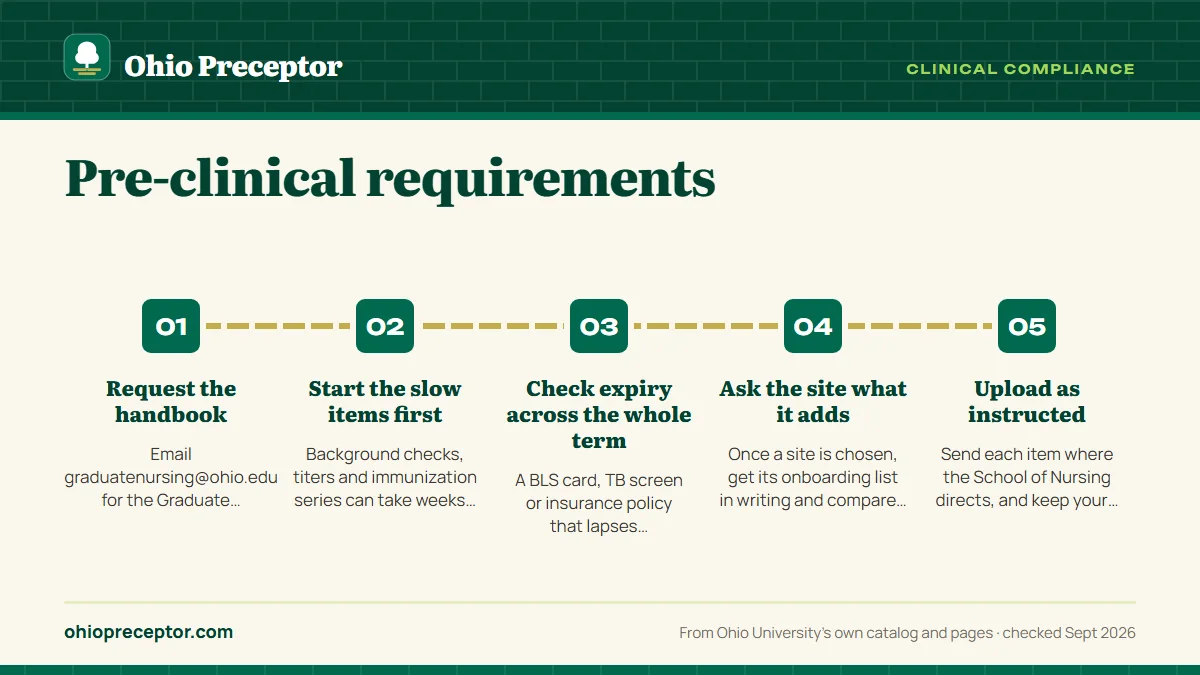
- Request the handbookEmail graduatenursing@ohio.edu for the Graduate Nursing Student Handbook as soon as you are admitted, and list every health status item it names.
- Start the slow items firstBackground checks, titers and immunization series can take weeks. Begin them at least two months before your clinical packet deadline.
- Check expiry across the whole termA BLS card, TB screen or insurance policy that lapses mid-semester is a problem. Each item should run to your last clinical day.
- Ask the site what it addsOnce a site is chosen, get its onboarding list in writing and compare it with Ohio University's.
- Upload as instructedSend each item where the School of Nursing directs, and keep your own copies together in one folder.
The usual miss: a requirement that is current on packet day but expires before the semester ends. Check every date against the final week of the term.
How we keep the preceptor side as ready as yours
Your requirements are yours to complete, and the preceptor and site side has its own checklist: license verified, site onboarding understood, agreement status known. Your placement advisor confirms all three for every preceptor we line up, and tells you up front what the site will ask of you, so both halves are ready on the same day.
With a packet deadline close, that matters most: nothing new surfaces in the final week, and no site requirement arrives after you thought you were done. Faculty approve the placement, and they receive a file that already meets Ohio University's rules. Send your course and city with the form below, or read about affiliation agreements if your site has mentioned one.
Questions Ohio University students ask
Which immunizations does Ohio University require for graduate clinicals?
Ohio University's public pages name "immunization status" and "TB screening" but leave the specific list to the Graduate Nursing Student Handbook, which you request from graduatenursing@ohio.edu. Clinical sites may add their own. An RN-to-BSN onboarding list, for example, names TB, Tdap, MMR, varicella, hepatitis B, COVID and influenza when a site requires them.
Do Ohio University graduate students need Ohio BCI and FBI fingerprinting?
The graduate pages say "State and Federal background checks" without naming a method. The BCI/FBI wording on ohio.edu belongs to the associate degree program. Ask the School of Nursing which checks it accepts for your track, and ask your clinical site too, since a site outside Ohio may want a check covering its own state.
Is a drug screen required for Ohio University MSN clinicals?
A drug screen does not appear on Ohio University's public graduate requirement lists. Sites can still require one: the RN-to-BSN onboarding list includes a urine drug screen when a facility asks. Check the Graduate Nursing Student Handbook and your site's onboarding list, and schedule any screen inside the window the site specifies.
Does my BLS need to come from a particular provider?
Ohio University's public pages say only "Basic Life Support (BLS) Required," without naming a provider or course type. The Graduate Nursing Student Handbook or your clinical site may be more specific, so confirm before you renew, and time the renewal so the card stays valid through your final clinical day.
Do certificate students who are already APRNs still need all of this?
Yes. The certificate pages carry the same pre-clinical wording as the MSN, and the PMHNP certificate page says current APRNs usually enter a clinical course in their first semester. That leaves little time, so gather health, background, BLS and insurance proof while you apply, alongside the preceptor details the School of Nursing asks for.
Related pages
Last checked 2026-09-24
We check these pages against Ohio University's own catalog, program pages and Nursing Knowledge Center. Your syllabus, the Graduate Nursing Student Handbook and your faculty have the final word.
- Ohio University: MSN application process
- Ohio University Graduate Catalog 2026-27: MSN Family Nurse Practitioner
- Ohio University Nursing Knowledge Center: graduate nursing handbook
- Ohio University associate degree in nursing: materials and supplies
- Ohio University RN-to-BSN: NRSE 4595 clinical requirements
Ohio University lets you choose your preceptor. We find the right one.
Tell us your Ohio University program, your community and your next clinical course. We find preceptors who fit the course and prepare what faculty review before they approve them.
- Preceptors matched to the course: primary care for the FNP
NRSE 6840sequence, acute care for AG-ACNP, psychiatric care for PMHNP - Your clinical packet details ready ahead of Ohio University's packet deadline
- Close to home, in Ohio or in any state where Ohio University admits graduate nurses
Start your placement plan
Program, city and clinical start is all we need to begin.