Affiliation agreements for Ohio University clinicals
Ohio University does not require an affiliation agreement for a clinical site, but the facility may, and many hospital systems do. When one is needed, the timing is out of your hands: Ohio University's own pages say no one can promise how long it will take, or that the two sides will agree at all. Here is what is public, which sites and states insist on one, and how to keep an agreement from costing you a semester.
Get your placement plan
Tell us your Ohio University program and where you live. A placement advisor replies with the preceptor and site options that fit your course.
Ohio University's position
The clearest public statement sits on the RN-to-BSN clinical course pages for NRSE 4585, NRSE 4595 and the older NRSE 4600: "Ohio University does not require Affiliation Agreements (AA). However, depending on your precepting site, an AA may be required by the facility."
The same pages put the first step on the student: "Students MUST determine if the facility where precepting hours are to be completed requires an Affiliation Agreement," by asking the site's "education or human resources department." They also name a School of Nursing contact who searches for an agreement already on file, the quickest answer available.
If an agreement exists, you move on to the site's onboarding. If the facility needs one and none exists, it has to be negotiated between Ohio University and the facility, and that is where time disappears.
How long an agreement can take
No one can say in advance. The RN-to-BSN pages give "no guarantee" of timing and no promise of success: nobody can tell "how long the Affiliation Agreement process can take," and an agreement may never be reached "if either party cannot agree to the terms."
The NRSE 4595 page offers one benchmark: "Specialty Select Hospitals: Affiliation Agreement process can take up to 2-3 months to be approved." Among Ohio health systems' own pages, Nationwide Children's says a new agreement "may take up to 6 months to a year."
An archived 2023 RN-to-BSN request form shows how requests moved at that time. They went to the College of Health Sciences and Professions Office of Clinical Education, whose Sr. Director for Clinical Education acted as liaison between the School of Nursing and the facility, and the form warned that the School could not promise how long signing would take.
Graduate students: what is public and what is not
No public graduate page describes the agreement process for MSN, certificate or DNP students. The one trace is a title: a January 2026 archived copy of the graduate forms page lists an "Affiliation Agreement Request Form Graduate." That form, like the rest of the page, now sits behind Ohio University's single sign-on.
Whether the CHSP clinical education office handles graduate agreements the way it handled RN-to-BSN requests is not stated. As soon as a site says it needs an agreement, email graduatenursing@ohio.edu, the inbox the Knowledge Center lists for clinical placements and paperwork, and check the Graduate Nursing Student Handbook for the process.
Hospital systems make the question unavoidable for graduate students. Cleveland Clinic accepts students only "In a program in which a current affiliation agreement exists," and Holzer's archived pages say that without an active Clinical Education Affiliation Agreement "you will NOT be able to participate in a rotation." The hospital system applications guide has their windows.
What Ohio health systems say about agreements
Each row below is that system's own published policy, not Ohio University's. Read it as a guide to which doors are open before you spend weeks on a site.
| System | What its page says |
|---|---|
| Cleveland Clinic | A current affiliation agreement is required; Ohio University appears on the schools listed on its ACEMAPP page |
| OhioHealth | "Unfortunately, OhioHealth is not initiating new affiliation agreements"; it holds agreements with "several schools across Ohio and surrounding states" |
| Holzer | An active Clinical Education Affiliation Agreement on file (archived 2026 pages) |
| Nationwide Children's | A clinical contract "MUST exist"; a new one "may take up to 6 months to a year" |
| University Hospitals | Students should make sure their school has an affiliation agreement with UHHS |
| ProMedica | "It is the role of the School of Nursing" to contact ProMedica for an agreement |
| Premier Health | Without a current contract, "this process may take much longer" (archived 2026 page) |
OhioHealth deserves a second look. With no new agreements being started, a site inside OhioHealth works only if Ohio University already holds one, which the School of Nursing can confirm. For RN-to-BSN students the NRSE 4595 page is blunter still: "OhioHealth- ONLY Employees can use site."
Colorado and other state rules
One state requires an agreement whatever the site. The RN-to-BSN course pages say: "The Colorado Board of Nursing requires ALL students completing precepting hours within the state to have an AA." Ohio University's licensure disclosures add that Colorado expects students to be covered by workers' compensation during clinical experiences.
Colorado appears on the RN-to-BSN program page's state list but not on the 28-state graduate application list, so this mostly touches RN-to-BSN students who live there. The Colorado page has the state detail, and approved states explains the graduate list.
Other rules create similar hurdles. Ohio University's disclosures say West Virginia requires board approval and evidence that the home state permits nursing students to attend out-of-state clinicals. The RN-to-BSN pages add that VA employees must be onboarded as students in the VA, and that University of Michigan Health keeps "non-negotiable deadline dates."
Timing an agreement against your packet deadline
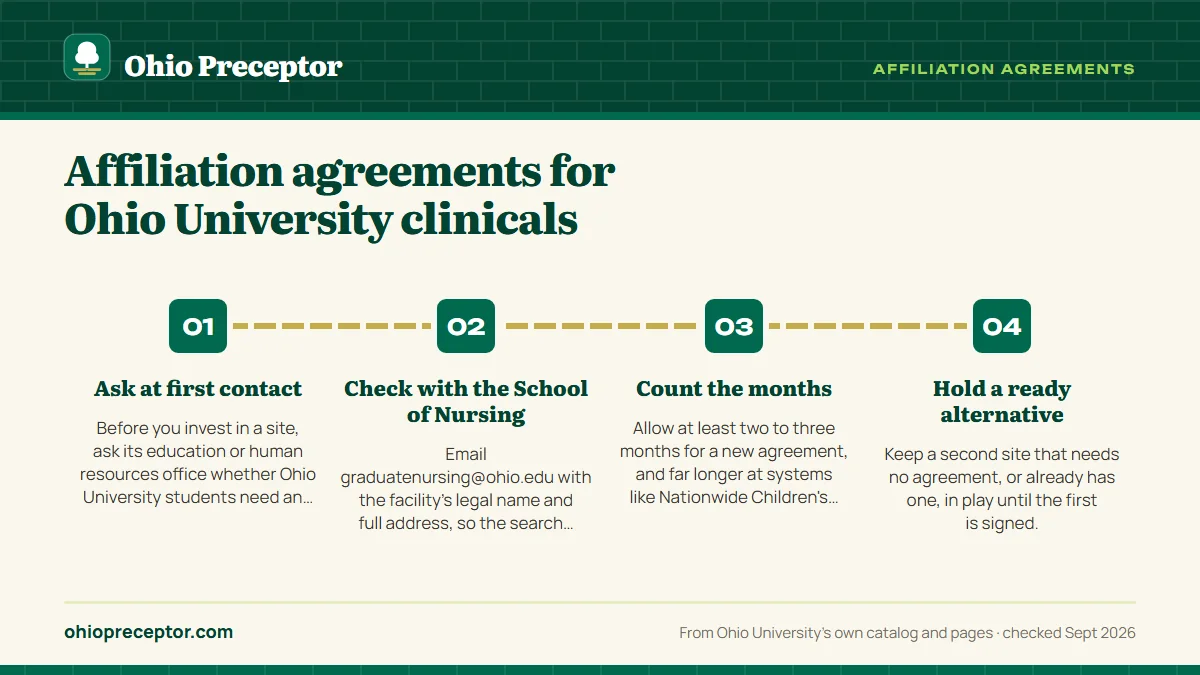
- Ask at first contactBefore you invest in a site, ask its education or human resources office whether Ohio University students need an agreement there and whether one already exists.
- Check with the School of NursingEmail graduatenursing@ohio.edu with the facility's legal name and full address, so the search for an existing agreement is exact.
- Count the monthsAllow at least two to three months for a new agreement, and far longer at systems like Nationwide Children's. If that runs past your clinical packet deadline, the site belongs to a later term.
- Hold a ready alternativeKeep a second site that needs no agreement, or already has one, in play until the first is signed.
The mistake: treating a preceptor's yes as the finish line. If the facility needs an agreement that does not exist yet, that yes can take months to become usable.
How we handle agreements in your search
Your placement advisor asks every prospective site about agreements and onboarding in the first conversation, not after a preceptor agrees. Sites with an agreement already in place, or none required, rise to the top of your list, and any site needing a new one is flagged with a realistic timeline against your packet date.
When an agreement is the right route, we hand you the facility's exact details and contacts for the School of Nursing and keep a ready alternative moving until the signature lands. Ohio University and the facility sign the agreement, and faculty approve the placement; we make sure nothing about the site surprises them. Use the form below to begin, or see how it works for the full sequence.
Questions Ohio University students ask
Does Ohio University have affiliation agreements with Ohio hospitals?
Ohio University does not publish a list. Cleveland Clinic's application materials include Ohio University among eligible schools, and Cleveland Clinic requires a current agreement for that. For any other facility, the School of Nursing can check whether an agreement exists; email graduatenursing@ohio.edu with the facility's name and address.
Who signs an affiliation agreement, the student or the school?
The school and the facility. An archived RN-to-BSN request form routed requests to the College of Health Sciences and Professions Office of Clinical Education, which acted as liaison with the facility, and ProMedica's page says requesting an agreement is the School of Nursing's role. Your part is to find out whether one is needed, supply exact facility details and leave enough time.
Does a private practice need an affiliation agreement?
Only if the practice requires one, since Ohio University does not. Ask the office manager or whoever handles student paperwork, and ask early: a small practice may not have hosted an Ohio University student before, and its answer shapes your whole timeline, from the first call to the packet.
What if the agreement is not signed by my packet deadline?
Ohio University's public pages describe no exception. RN-to-BSN students may not enroll until the agreement and onboarding are approved, and systems such as Holzer refuse rotations without one on file. Contact graduatenursing@ohio.edu and your course faculty before the deadline, and move to a site that is ready if the signature is still pending.
Related pages
Last checked 2026-09-24
We check these pages against Ohio University's own catalog, program pages and Nursing Knowledge Center. Your syllabus, the Graduate Nursing Student Handbook and your faculty have the final word.
Ohio University lets you choose your preceptor. We find the right one.
Tell us your Ohio University program, your community and your next clinical course. We find preceptors who fit the course and prepare what faculty review before they approve them.
- Preceptors matched to the course: primary care for the FNP
NRSE 6840sequence, acute care for AG-ACNP, psychiatric care for PMHNP - Your clinical packet details ready ahead of Ohio University's packet deadline
- Close to home, in Ohio or in any state where Ohio University admits graduate nurses
Start your placement plan
Program, city and clinical start is all we need to begin.