Colorado: on the RN-to-BSN list, off the graduate one
Ohio University's RN-to-BSN names Colorado, but as of September 2026 its online MSN, post-master's certificates and MSN-to-DNP do not accept Colorado residents. Colorado also comes with two clinical conditions Ohio University flags on its own pages: an affiliation agreement for every precepting student, and workers' compensation coverage.
Get your placement plan
Tell us your Ohio University program and where you live. A placement advisor replies with the preceptor and site options that fit your course.
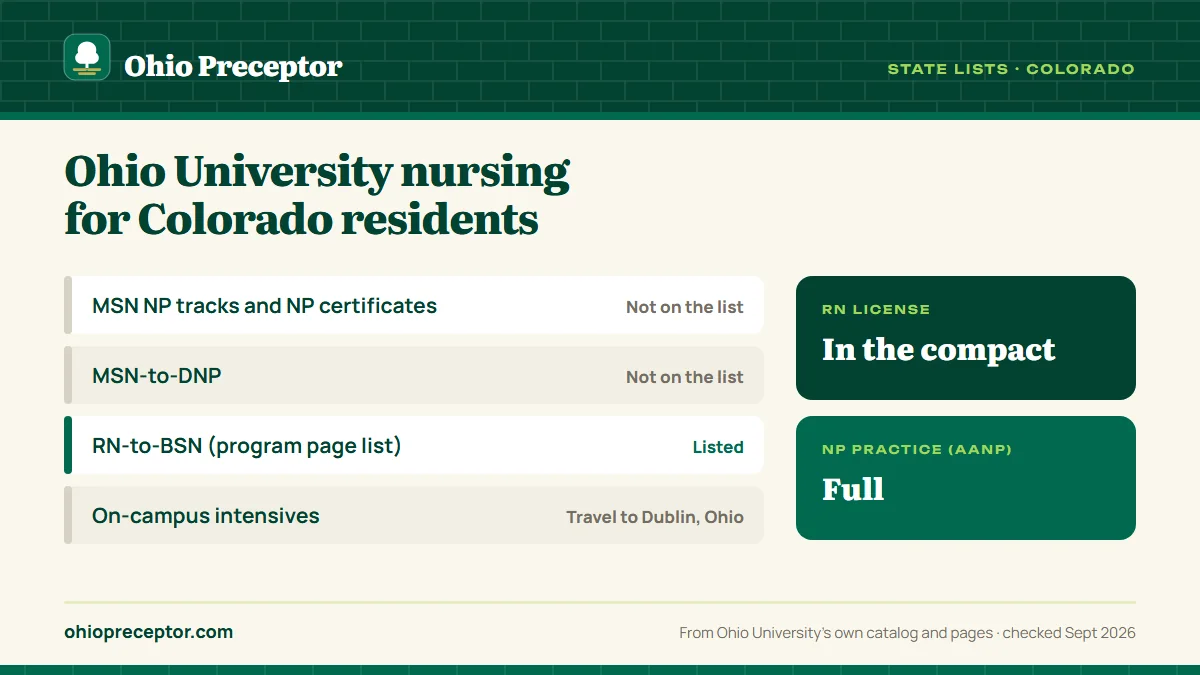
Which Ohio University lists include Colorado
Graduate admission follows the 28-state application list, and Colorado is missing from it. The RN-to-BSN runs on separate lists, and Colorado appears on every version Ohio University publishes, from the 32-state program page down to the 27-state NRSE 4600 page.
| Program | Status for Colorado residents | Delivery | Clinical hours |
|---|---|---|---|
| MSN FNP, PMHNP or AG-ACNP | Not open: off the 28-state list | Online | 750 |
| MSN Nurse Leader or Nurse Educator | Not open | Online | 500 |
| Post-master's certificates, Emergency NP included | Not open; the certificate disclosure also says "No" | Online | 750, or 450 to 500 for Emergency NP |
| MSN-to-DNP | Not open | Online | 1,000 post-baccalaureate |
| RN-to-BSN | On all four state lists | 100% online | 31.5 |
Lists shift, so confirm with Ohio University before you apply. The approved states page sets the graduate list beside the RN-to-BSN versions.
Two Colorado conditions Ohio University flags
The NRSE 4585 and NRSE 4595 course pages carry one line about Colorado by name: "The Colorado Board of Nursing requires ALL students completing precepting hours within the state to have an AA." Ohio University itself does not require affiliation agreements, so in most states it depends on the facility. In Colorado, plan on one at every site.
The second condition sits in the provost's licensure disclosures. The RN-to-BSN entry says Colorado wants students covered by workers' compensation insurance during clinical experiences, and the certificate table repeats the point for students and faculty. Ask the site and Ohio University how that coverage is documented well before your start date.
Readers who check Colorado's regulations will find less. Rule 1.2 of the Board's rules (3 CCR 716-1) deals with pre-licensure programs and has no step for out-of-state RN-BSN or graduate programs, and the Board's website could not be reviewed. Follow Ohio University's instruction as the working rule; timing advice is on the affiliation agreements page.
The usual Colorado slip: securing a preceptor first and asking about the agreement second. Ohio University says no timeline can be promised for a new agreement, so ask on the first call.
Full practice, with a mentorship condition
AANP counts Colorado among the full-practice states, but prescriptive authority carries a condition: each NP attests to 750 hours of experience gained in an agreement with a mentor who is a physician or an APRN. Some recently licensed NPs are still logging those hours when a student asks them to precept.
Colorado also gives a state income tax credit to preceptors who teach unpaid in rural and frontier shortage areas. Since HB22-1005, advanced practice nurses share it with RNs and other licensed outpatient professionals. That bill capped it at 300 preceptors a year, extended it to tax years that begin before 2033, and restricted it to students of accredited Colorado schools, so preceptors of Ohio University students do not appear to be eligible.
Front Range systems and your license
Denver-Aurora-Centennial is the largest metro, about 3.1 million people in 2025 Census estimates, with Colorado Springs, Greeley and Fort Collins-Loveland next. Big systems include UCHealth, Denver Health, HCA HealthONE, the Colorado hospitals of CommonSpirit Health, and Intermountain Health, operator of Denver's Saint Joseph Hospital. Treat them as illustrations of the market, not as sites known to accept Ohio University students.
Compact membership took effect in Colorado on January 19, 2018, which lets a multistate license issued here reach sites in other member states; the APRN Compact is not enacted. For RN-to-BSN clinicals, the preceptor needs an active license in your state and the facility's, as the RN license page explains.
How we help Colorado nurses
For RN-to-BSN students, we locate a Colorado-licensed nurse with a BSN or higher to precept, settle the facility's affiliation agreement and workers' compensation questions at the outset, and assemble what the Preceptor Agreement Form needs well ahead of Ohio University's cutoff. Ohio University graduate students weighing a move to Colorado should talk to the School of Nursing first. Coloradans who want an NP track can look south: New Mexico is on the approved list, and we can start a preceptor search there once your move is settled. Begin with the contact form.
Questions Ohio University students ask
Can a Colorado resident enroll in Ohio University's online PMHNP?
Not as of September 2026. Every Ohio University graduate nursing program looks for residence in an approved state plus a valid, unrestricted RN license, and Colorado is not among the 28. The provost's disclosures mark Colorado "No" for the MSN and the post-master's certificate too. Ask Ohio University directly if a move is part of your plans.
Does every Colorado clinical site need an affiliation agreement?
Ohio University's RN-to-BSN course pages say yes, stating that the Colorado Board of Nursing requires an agreement for all students completing precepting hours in the state. In other states it depends on the facility. Request it early: Ohio University notes the process has no fixed timeline and can stall over terms.
Can my Colorado preceptor claim the state's tax credit?
Probably not. HB22-1005 limited Colorado's rural and frontier preceptor credit to preceptorships for students enrolled at accredited Colorado institutions, so a student in Ohio University's program, based in another state, does not appear to count. Preceptors should check the Colorado Department of Revenue's credit page for current terms.
Which Ohio University program is realistic for a Colorado RN?
The RN-to-BSN, which lists Colorado on every published version of its state list. Coursework is entirely online, and the 31.5 clinical hours in NRSE 4585 and NRSE 4595 take place near home at a site of your choosing. Deadlines and the Preceptor Agreement Form are explained on the RN-to-BSN page.
Related pages
Last checked 2026-09-24
We check these pages against Ohio University's own catalog, program pages and Nursing Knowledge Center. Your syllabus, the Graduate Nursing Student Handbook and your faculty have the final word.
- Ohio University MSN application process: approved RN licensure states
- Colorado State Board of Nursing (Division of Professions and Occupations)
- Ohio University NRSE 4585 requirements: affiliation agreements and Colorado
- Ohio University professional licensure disclosures, health sciences
- Colorado HB22-1005, preceptor tax credit
Ohio University lets you choose your preceptor. We find the right one.
Tell us your Ohio University program, your community and your next clinical course. We find preceptors who fit the course and prepare what faculty review before they approve them.
- Preceptors matched to the course: primary care for the FNP
NRSE 6840sequence, acute care for AG-ACNP, psychiatric care for PMHNP - Your clinical packet details ready ahead of Ohio University's packet deadline
- Close to home, in Ohio or in any state where Ohio University admits graduate nurses
Start your placement plan
Program, city and clinical start is all we need to begin.