Ohio University MSN FNP: the clinical path and your preceptors
Ohio University's online MSN Family Nurse Practitioner track runs 40 credits across 11 courses, and all 750 of its direct care hours happen in primary care, in three 250-hour practicums that follow NRSE 7230. Ohio University lets you choose your own preceptor with faculty approval, so the real job is finding a primary care clinician near home and having everything confirmed before the clinical packet deadline. Below: each clinical course, the OCIs, and when to start asking.
Plan your FNP practicums
Tell us your start term, your city and which practicum comes first. Your placement advisor replies with primary care options that fit Ohio University's FNP courses.
The MSN FNP at a glance
Ohio University's MSN with a Family Nurse Practitioner focus (catalog code MS1224) is an online track run by the School of Nursing within the College of Health Sciences and Professions. The 2026-27 Graduate Catalog sets it at 40 credit hours including 750 practicum hours, and the program's course page describes 11 courses designed for six semesters on a part-time schedule. It closes with a comprehensive program exam.
Admission starts with a BSN (minimum GPA 3.0) plus two years' worth of full-time RN experience gained in the last five years. You must also reside in one of Ohio University's 28 approved states and hold an unencumbered RN license issued there. A one-way video interview for the Program Track Directors completes the file.
Start terms deserve a second look. The catalog lists fall and spring entry, and the FNP page shows the next start as Spring 2027, with applications due 11/02/26 and classes beginning 01/11/27. The MSN comparison table says fall, and the general application page mentions three intakes a year. The FNP page's FAQ even says the program “can be completed in 3 semesters”, which reads like certificate text; the catalog and course page both say six.
The clinical path, course by course
No practicum starts until NRSE 7230 Advanced Health Assessment is done. It is the last course before clinicals and carries the pre-clinical OCI. After it, each practicum requires the one before, and once practicums start, the FNP track FAQ has students taking a single clinical course each semester.
| Course | What the catalog says it covers | Practicum hours | Offered |
|---|---|---|---|
NRSE 7230 Advanced Health Assessment (4 credits) | Last course before clinicals; requires NRSE 7220 and NRSE 7810; pre-clinical OCI | Not part of the 750 | Fall, summer |
NRSE 6840 FNP Practicum I (6 credits) | Comprehensive care of individuals and families across the lifespan in primary care; OCI | 250 | Fall, spring |
NRSE 6841 FNP Practicum II (6 credits) | Individuals and families with complex health conditions, building on Practicum I | 250 | Spring, summer |
NRSE 6842 FNP Practicum III (6 credits) | The FNP as an entry-level clinician managing acute, chronic and well visits | 250 | Fall, summer |
NRSE 7818 Advanced Diagnostics for Clinical Reasoning (2 credits) | Diagnostic reasoning; requires NRSE 7230 | None | Set by your program of study |
That offering pattern allows two unbroken runs: NRSE 6840 in fall, NRSE 6841 in spring and NRSE 6842 in summer, or the same three starting in spring and finishing in fall. Your advisor's program of study decides which one is yours, and Ohio University labels the table tentative. The catalog's “3.5 lecture, 5.0 clinical” line on each practicum is a contact-hour figure; the 250 clock hours per course come from the program pages.
Where 750 hours fit in your week
The catalog sets the floor at 750 direct care hours, all in primary care settings under qualified preceptors. At 250 per practicum across a 15-week course, that averages close to 17 hours of patient care a week, and each course's hours have to be finished inside its own semester. The FNP hours guide breaks the total down further.
The MSN FAQ budgets 18 to 20 weekly hours of coursework in clinical semesters, on top of two or three days on site, while the FNP page's own FAQ puts school work at 20 to 28 hours a week. Either way, the practical test for any preceptor is whether their clinic schedule lines up with the days you can take away from your job.
Losing a preceptor partway through is what puts those hours at risk. A withdrawal from a nursing course has to be made up by repeating it, and Ohio University's pages disagree on repeats: each practicum carries the catalog note “May not be retaken”, whereas the Knowledge Center allows any single course to be repeated once. Your Graduate Nursing Student Handbook, sent by email from graduatenursing@ohio.edu, holds the full grading policy.
Who finds the preceptor, and the settings FNP students use
Ohio University's MSN FAQ starts with the student: students “are permitted to identify their preceptors,” and faculty then approve the choice. The Graduate Clinical Coordinator is a second source of help, and a large system may route you through its own application, often well ahead and sometimes for a fee. Those routes can run side by side.
For settings, the same FAQ names primary care offices and clinics based in hospitals or the community, with faculty approving the preceptor and a clinical supervisor assigned to you. Family practices, community health centers and hospital-owned outpatient clinics all fit. Because Practicum I and III are framed across the lifespan, a practice whose patients range from infants to older adults gives you the broadest caseload.
The catalog asks for “qualified preceptors” without naming professions. For clinicals inside Ohio, ORC 4723.32(F) permits APRN students to practice under an APRN acting for the program in one of three roles: faculty member, teaching assistant or preceptor. Your faculty confirm how that applies to the clinician you have in mind.
When to start the preceptor search
Plan backward from the clinical packet, not from the first day of class. Ohio University's packet deadlines land about seven to nine weeks before each semester opens; the Spring 2027 packet is due 11/09/2026, and the packet deadlines page lists the rest. Your preceptor has to be confirmed, and the paperwork gathered, before that date.
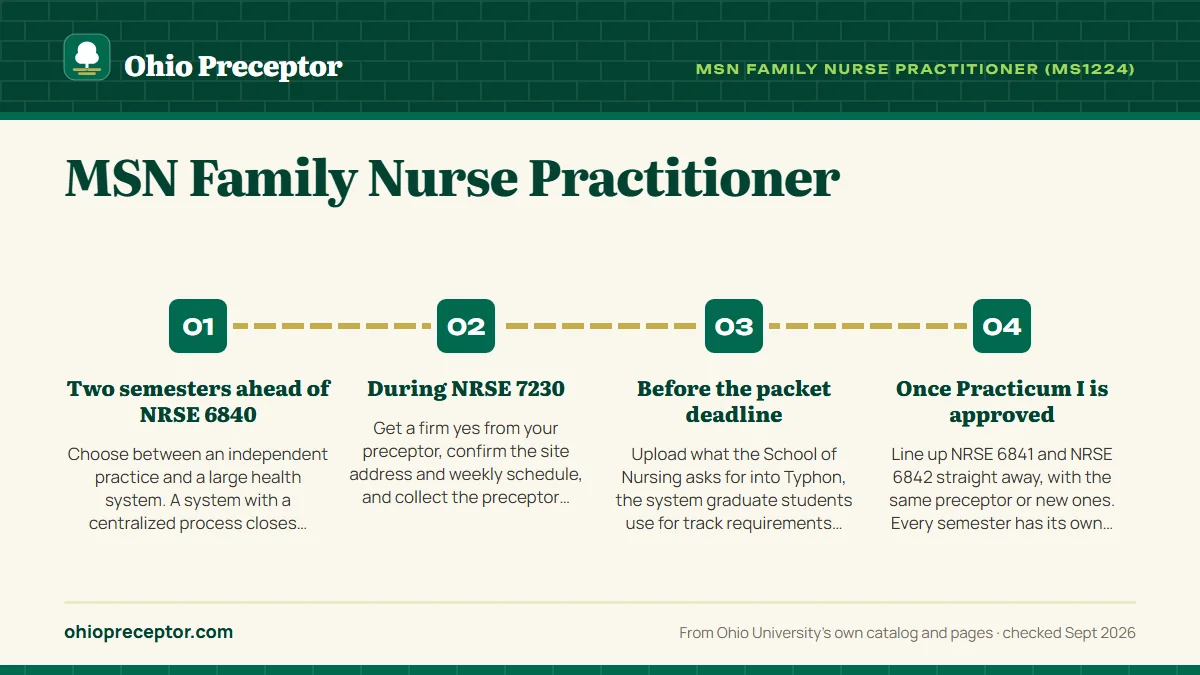
- Two semesters ahead of
NRSE 6840Choose between an independent practice and a large health system. A system with a centralized process closes its window well before the packet is due, and the hospital system applications page tracks the four Ohio facilities Ohio University lists. - During
NRSE 7230Get a firm yes from your preceptor, confirm the site address and weekly schedule, and collect the preceptor forms from the graduate Forms and Resources page or from graduatenursing@ohio.edu. - Before the packet deadlineUpload what the School of Nursing asks for into Typhon, the system graduate students use for track requirements and clinical placement documents. Immunizations, BLS, background checks and malpractice insurance travel with the preceptor paperwork.
- Once Practicum I is approvedLine up
NRSE 6841andNRSE 6842straight away, with the same preceptor or new ones. Every semester has its own packet deadline, one term after the last.
The mistake to avoid: waiting until NRSE 7230 ends before asking anyone. On Ohio University's calendar, the clinical packet for NRSE 6840 falls due while NRSE 7230 is still running.
The FNP on-campus intensives
Ohio University's nursing OCIs meet at 6805 Bobcat Way in Dublin. The Knowledge Center marks two FNP courses: NRSE 7230, with the pre-clinical OCI on 9/18 to 9/19/2026, 6/07 to 6/08 or 6/09 to 6/10/2027, and 09/24 to 09/25/2027; and NRSE 6840, whose OCI falls on 09/21/2026, 02/08/2027 or 9/23/2027 depending on your term.
The count depends on the page. The FNP courses page describes three OCIs, tied to NRSE 7230 and to the first and final clinical courses, while the FAQ on the FNP track page says two. Book clinical days around the posted dates, ask faculty whether a visit attaches to NRSE 6842 for your cohort, and see the on-campus intensives guide for planning clinical weeks around them.
Why Ohio University FNP students choose us
We build the whole FNP clinical plan at once. Your placement advisor starts from your program of study, searches family practices and community clinics within a reasonable drive of home, and checks that each candidate's patient mix suits the lifespan focus of the FNP courses.
Before anything goes to Ohio University, your advisor gathers the preceptor's credentials, current license, practice address and everything else the clinical packet requires. Faculty at Ohio University make the final decision on every preceptor and site; our job is to hand them a file that is complete and rule-ready on the first submission.
We also keep the big systems' application windows on your calendar and stay on call through every semester. Should a preceptor leave partway through a term, the replacement search begins at once so your hours keep moving. Your start term and city are enough to begin; add them to the form below, or see how it works.
Questions Ohio University students ask
Does Ohio University assign preceptors to FNP students?
Ohio University's public pages describe a student-first process rather than assignment. You may put forward your own preceptor for faculty to approve, the Graduate Clinical Coordinator can lend a hand, and some large hospital systems require their own centralized request. No ohio.edu page promises a placement, so FNP students do best with a confirmed preceptor of their own and the other routes as support.
Is malpractice insurance required before FNP clinicals?
Yes. Evidence of malpractice insurance is one of the catalog's pre-clinical requirements, alongside immunizations, BLS and federal and state background checks. The DNP page goes further, asking APRN-track students for a nurse practitioner malpractice policy of their own rather than employer coverage. The Graduate Nursing Student Handbook has the MSN detail. Buy the policy before your first packet deadline.
Can I do Ohio University FNP clinicals outside Ohio?
Yes, provided your home is in one of the approved states; Ohio University describes practicum hours completed locally. Plan on an RN license valid in the state where you train, and expect some states to add rules. Ohio University's licensure notes say Illinois requires both student and preceptor to hold an Illinois RN license, and West Virginia requires board approval. Check your state's rules before you approach a preceptor.
Can one preceptor cover all three FNP practicums?
Nothing public from Ohio University requires a single preceptor or forbids one, and faculty approve the preceptor and site for each course. Staying with one practice keeps onboarding simple, while a move for NRSE 6842 can widen the mix of acute, chronic and well visits the catalog describes for that course. Check your syllabus and ask faculty before planning around either.
What can I add after the MSN FNP?
Two Ohio University programs build on it. The Emergency NP certificate, launched in Fall 2026, asks for FNP licensure and current ACLS and adds emergency department hours; see the Emergency NP certificate guide. The MSN-to-DNP adds a practice doctorate, with prior MSN hours credited through an individual gaps analysis toward its 1,000-hour total.
Related pages
Last checked 2026-09-24
We check these pages against Ohio University's own catalog, program pages and Nursing Knowledge Center. Your syllabus, the Graduate Nursing Student Handbook and your faculty have the final word.
Ohio University lets you choose your preceptor. We find the right one.
Tell us your Ohio University program, your community and your next clinical course. We find preceptors who fit the course and prepare what faculty review before they approve them.
- Preceptors matched to the course: primary care for the FNP
NRSE 6840sequence, acute care for AG-ACNP, psychiatric care for PMHNP - Your clinical packet details ready ahead of Ohio University's packet deadline
- Close to home, in Ohio or in any state where Ohio University admits graduate nurses
Start your placement plan
Program, city and clinical start is all we need to begin.