Ohio University FNP clinical hours: 750 across three practicums
Ohio University's MSN Family Nurse Practitioner requires a minimum of 750 direct care hours, split evenly across NRSE 6840, NRSE 6841 and NRSE 6842 at 250 hours each. All of it happens in primary care, one practicum per semester, so the practical questions are which three semesters and which preceptors.
Get your placement plan
Tell us your Ohio University program and where you live. A placement advisor replies with the preceptor and site options that fit your course.
Where the 750 comes from
The 2026-27 Graduate Catalog says it directly: FNP "clinical practicum experiences occur in primary care settings under supervision of qualified preceptors for a minimum of 750 direct care hours." The program totals 40 credits, and each of the three practicums carries 6 credits and 250 practicum hours. The ohio.edu courses page repeats the 750 and describes a six-semester, part-time design.
Students who read the catalog course by course sometimes get thrown by one line. Each practicum entry shows "3.5 lecture, 5.0 clinical" under Lecture/Lab Hours. Those are catalog contact figures, not the clock hours you log. The 250-hour figure comes from the program page, and that is the number your log is measured against.
| Course | Hours | Requisite | Offered | Catalog focus |
|---|---|---|---|---|
NRSE 6840 FNP Practicum I | 250 | NRSE 7230 | Fall, spring | Comprehensive care for individuals and families from diverse backgrounds; advanced assessment, diagnosis and management across the lifespan |
NRSE 6841 FNP Practicum II | 250 | NRSE 6840 | Spring, summer | Individuals and families with complex health conditions, building on the first course |
NRSE 6842 FNP Practicum III | 250 | NRSE 6841 | Fall, summer | The FNP as an entry-level clinician: acute, chronic and well visits across the lifespan |
Primary care settings, patients of every age
The MSN FAQ places most FNP clinicals in primary-care offices or in clinics run by hospitals and communities, each with a faculty-approved preceptor and a clinical supervisor assigned by Ohio University. All three course descriptions land in the same place: the primary care setting, with individuals and families across the lifespan.
That lifespan language should shape where you train. A practice that sees only adults may cover much of the complex-condition work in NRSE 6841, but the family focus of NRSE 6840 and the well visits named in NRSE 6842 point toward a panel with children as well as older adults. Spreading the three practicums over two or three sites is one way to see every age group; faculty approve each site and each preceptor.
Who qualifies to precept an FNP student, and which licenses matter, is covered on the preceptor requirements page.
One practicum per semester, two routes through
Ohio University's FNP track FAQ limits students to a single clinical course each term once practicums start. Each practicum also lists the one before it as a requisite. Set those two rules against the Knowledge Center's tentative offerings table and two unbroken routes appear.
| Route | First | Second | Third |
|---|---|---|---|
| Fall start | NRSE 6840 in fall | NRSE 6841 in spring | NRSE 6842 in summer |
| Spring start | NRSE 6840 in spring | NRSE 6841 in summer | NRSE 6842 in fall |
Your advisor registers you each term from your program of study, so the route is assigned rather than picked course by course. What the table tells you is the shape of your need: three consecutive semesters, 250 hours each, with no pause between them. The semester calendar has the term dates.
Both routes include a summer practicum. Preceptors asked in April for a May start may already have leave booked, so confirm the summer term early, even if it is your second or third course.
Pacing 250 hours inside one term
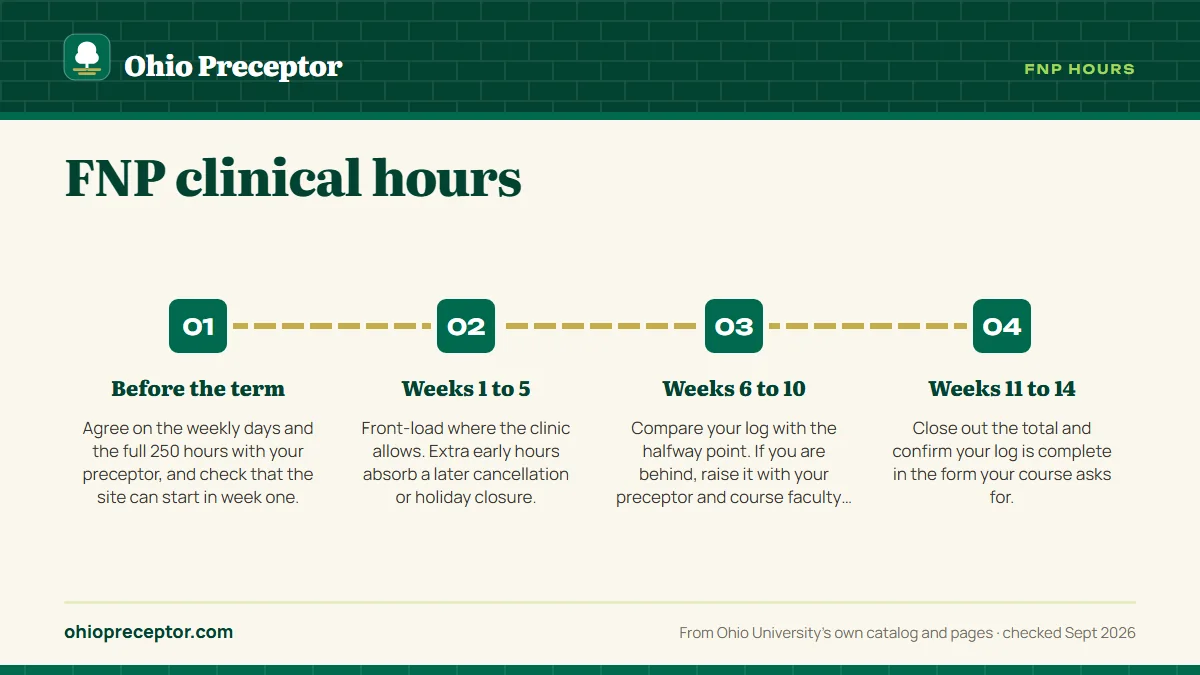
The clinical hours hub explains why Ohio University students should plan to finish by the end of week 14. For an FNP practicum, that means scheduling clinic days from the first week rather than easing in.
- Before the termAgree on the weekly days and the full 250 hours with your preceptor, and check that the site can start in week one.
- Weeks 1 to 5Front-load where the clinic allows. Extra early hours absorb a later cancellation or holiday closure.
- Weeks 6 to 10Compare your log with the halfway point. If you are behind, raise it with your preceptor and course faculty now, while days can still be added.
- Weeks 11 to 14Close out the total and confirm your log is complete in the form your course asks for.
NRSE 6840 also carries an on-campus intensive in Dublin; the next listed date is 02/08/2027. Tell your preceptor about it when you set the schedule so that clinic day is not lost.
Certificate students: the same 750, often sooner
Post-master's FNP certificate students log exactly the same 750 hours in the same three courses; NRSE 7818 brings the certificate to 20 credits. The catalog asks for NRSE 7210, NRSE 7220 and NRSE 7230, or equivalent courses passed at B or better, as prerequisites. A gaps analysis of earlier graduate coursework decides what else you take before clinicals, and Ohio University notes that added courses may lengthen the program. The catalog lists fall as the entry term, while other ohio.edu pages describe more start terms, so your program of study is what fixes the first practicum's semester.
For APRNs, timing moves up. A line on Ohio University's PMHNP certificate page expects current APRNs in an APRN certificate to most likely begin with a clinical course in semester one, which puts the preceptor search before admission rather than after it. The FNP certificate page has the details.
How we set up all three FNP semesters
We treat the FNP practicums as one plan, not three separate scrambles. Your placement advisor looks for primary care preceptors near your home who can commit the full 250 hours in the term you need them, and where the lifespan mix calls for it, lines up the next site while the current practicum is still running.
We collect what faculty check before approval, from the preceptor's license and credentials to the site details the clinical packet requests, and hand it back to you finished, ahead of the clinical packet deadline. Faculty decide; our job is making sure the file they open is correct and whole. If a preceptor leaves mid-term, your advisor moves straight to a replacement. Tell us your first practicum term in the form below.
Questions Ohio University students ask
Can I take two FNP practicums in the same semester?
Ohio University's FNP track FAQ describes one clinical course a term after practicums begin, and each practicum requires the one before it: NRSE 6841 needs NRSE 6840, and NRSE 6842 needs NRSE 6841. Doubling up is not part of the published plan, and your advisor registers you each term from your program of study.
Can one FNP practicum's 250 hours be split between two preceptors?
Nothing on Ohio University's public pages settles this. Every preceptor and site needs faculty approval, so a split means two approvals and two sets of paperwork before the term begins. Ask your course faculty first. If they agree, arrange both preceptors together so the clinical packet goes in complete.
Is the Ohio University FNP 750 or 500 clinical hours?
750. The 2026-27 catalog and the ohio.edu courses page both give the MSN FNP a minimum of 750 direct care hours. The 500-hour figures elsewhere on Ohio University's site belong to other programs: the Nurse Educator and Nurse Leader MSN tracks, and the Emergency NP certificate as listed on its program page.
Are any FNP hours completed before NRSE 6840?
The 750 hours all sit in the three practicums, 250 in each. NRSE 7230, Advanced Health Assessment, comes first and carries a pre-clinical on-campus intensive in Dublin, and it is the course during which your first preceptor should be confirmed. The NRSE 7230 page explains the timing.
Do Ohio University FNP clinical hours have to be in Ohio?
No. Graduate applicants must reside in, and hold RN licensure from, one of Ohio University's 28 approved states, and its certificates page describes practicum hours completed locally. Some states add rules of their own, such as licensing requirements for preceptors or students training there. The clinicals outside Ohio page covers them.
Related pages
Last checked 2026-09-24
We check these pages against Ohio University's own catalog, program pages and Nursing Knowledge Center. Your syllabus, the Graduate Nursing Student Handbook and your faculty have the final word.
Ohio University lets you choose your preceptor. We find the right one.
Tell us your Ohio University program, your community and your next clinical course. We find preceptors who fit the course and prepare what faculty review before they approve them.
- Preceptors matched to the course: primary care for the FNP
NRSE 6840sequence, acute care for AG-ACNP, psychiatric care for PMHNP - Your clinical packet details ready ahead of Ohio University's packet deadline
- Close to home, in Ohio or in any state where Ohio University admits graduate nurses
Start your placement plan
Program, city and clinical start is all we need to begin.