The RN license you need for Ohio University clinicals
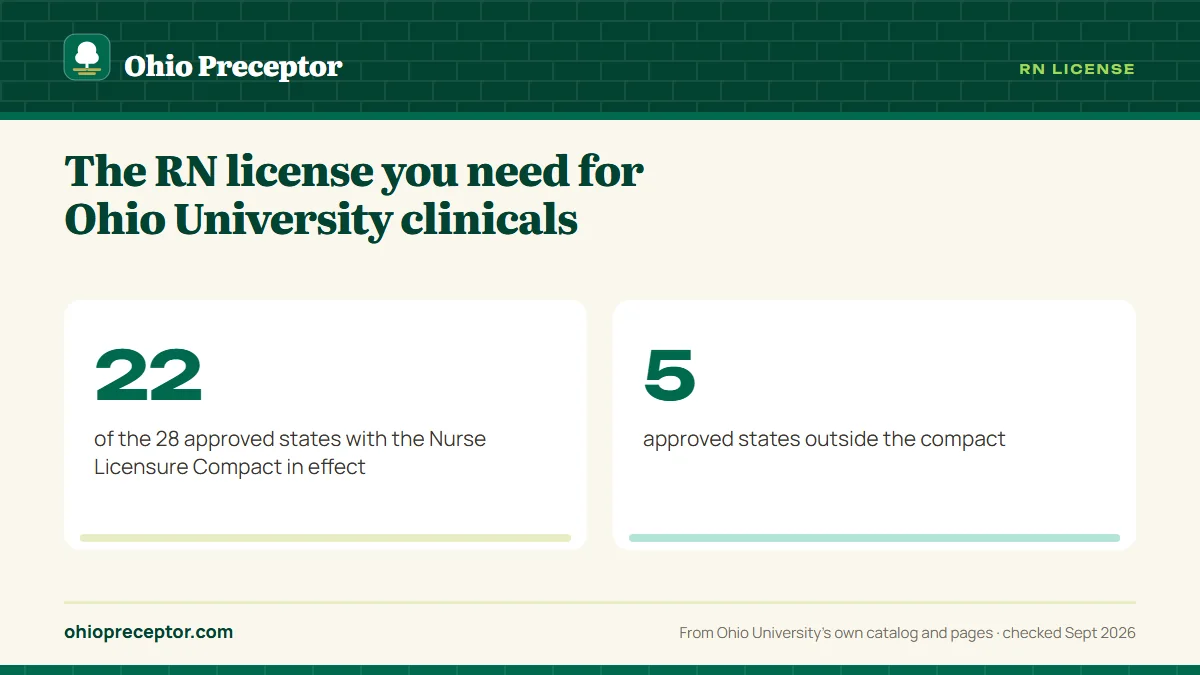
Every Ohio University graduate nursing applicant needs a valid, unrestricted RN license, and during clinicals you practice as a nurse in whatever state your site is in. The Nurse Licensure Compact is in effect in 22 of the 28 approved states, which makes crossing a state line straightforward for many students and harder for a few. Here is how to match your license to your site.
Get your placement plan
Tell us your Ohio University program and where you live. A placement advisor replies with the preceptor and site options that fit your course.
What Ohio University asks for
Admission asks you to show a valid RN license without restrictions in an approved state; the Graduate Catalog's word is "unencumbered." Ohio University does not define either term on its public pages, so if your license carries any board action, raise it with admissions before you apply rather than after.
The Emergency NP certificate goes further, requiring an FNP license or certification with prescriptive authority, plus current ACLS. Everyone else enters as an RN and trains as a student, meeting the pre-clinical requirements on the clinical compliance page before the first practicum.
RN-to-BSN students see their license checked in every clinical course, since the first-week uploads include "Student & Preceptor Nurse License Verification using NURSYS." How graduate licenses are checked during the program is not described publicly; the Graduate Nursing Student Handbook and your faculty set that.
How the Nurse Licensure Compact works for you
Under the compact, as the Ohio Board of Nursing explains it, your home state issues a single multistate license that you can use across every member state. Ohio joined through Senate Bill 3, signed in July 2021, with implementation on January 1, 2023. What decides eligibility is where you live: only a nurse whose home state belongs can hold the multistate version.
| Status | States |
|---|---|
| In effect (22) | Arkansas, Connecticut, Florida, Indiana, Kentucky, Maine, Maryland, Mississippi, Missouri, Montana, New Hampshire, New Jersey, New Mexico, North Carolina, Ohio, Pennsylvania, South Carolina, Texas, Vermont, Virginia, West Virginia, Wisconsin |
| Enacted, not yet in effect (1) | Massachusetts, with implementation targeted for May 2027 |
| Not a member (5) | Alaska, Hawaii, Illinois, Michigan (compact bill pending), Nevada |
The newest members on the list are Pennsylvania (July 7, 2025) and Connecticut (October 1, 2025), so older guides may still show them outside the compact. There is also an APRN Compact, but with five enacting states (Delaware, North Dakota, South Dakota, Utah and Wyoming) against the seven it needs to start, it has no effect on NP students yet.
Matching your license to your clinical site
Start with two questions: which state issued your license, and where is the site?
| You live in | Your site is in | What you need |
|---|---|---|
| A compact state | The same state | Your multistate license |
| A compact state | Another compact state | Your multistate license, plus anything the site or state adds |
| A compact state | A non-compact state such as Illinois or Michigan | A license from the site's state, unless it exempts students |
| A non-compact state such as Michigan | The same state | Your single-state license |
| A non-compact state | Any other state | A license valid in the site's state, unless it exempts students |
Some states excuse nurses licensed elsewhere while they study. Pennsylvania's rule at 49 Pa. Code § 21.118 lifts the need for a Pennsylvania license for program-required clinical work, provided the nurse holds a license from another U.S. jurisdiction, is enrolled in an accredited graduate or BSN program and is not paid for the work. Virginia Code § 54.1-3001 does something similar for RNs from other states in advanced nursing programs, limited to the clinical practice the curriculum calls for. Maryland's statute carves out students of accredited graduate APRN programs practicing within those programs.
Other states pull the other way. Illinois wants an Illinois RN license from both student and preceptor, per Ohio University's disclosure, and West Virginia's nursing education office asks residents for a West Virginia license and everyone else for a multistate one. Hospitals can add a layer: several Ohio systems, among them Cleveland Clinic, University Hospitals and Nationwide Children's, name an active Ohio RN license as a student requirement, so ask whether a multistate license satisfies it. Those systems' processes are on the hospital system applications page, and state approval rules on the clinicals outside Ohio page.
Clinicals in Ohio: the student exemption
Ohio's Nurse Practice Act handles APRN students in ORC 4723.32(F). If you are enrolled in and actively completing an APRN program, you may practice at the APRN level on three conditions: the program prepares you for a board-approved national certification exam or a qualifying graduate degree, the work happens under the program's auspices, and an APRN supervises you in the role of faculty member, teaching assistant or preceptor for the program. Division (F), unlike the pre-licensure exemption, sets no Ohio-location test for the program. Your RN license still has to cover Ohio. The standard care arrangement page explains what the APRN wording means when choosing a preceptor.
Keeping your license in order through the program
A license that lapses or picks up a board action mid-program could put clinicals on hold, so treat renewal dates like course deadlines. Moving needs thought too. Because the multistate license belongs to your primary state of residence, a move to another compact state changes which board issues it, and a move to a non-compact state means licensing there.
Check with the new state's board before you move, and tell graduatenursing@ohio.edu, since residence in an approved state is part of Ohio University's rule; the approved states page covers that side.
The RN license keeps mattering after graduation. The Ohio Board of Nursing requires an active RN license for APRN licensure and accepts either an Ohio single-state license or a multistate license from a compact state, so the license you carry through clinicals is the one your first NP license will rest on if you practice in Ohio.
Why students choose us for license-sensitive placements
License questions are easiest to settle before a preceptor says yes. Your placement advisor checks the preceptor's license and designation for the state where you will train, confirms whether the site or its state asks anything of your own license, and spots an Illinois-style rule before it turns into a surprise at approval time.
We then assemble the preceptor's credentials, license and site details for your clinical packet, so faculty see a placement that already fits the state's rules. The approval decision belongs to Ohio University faculty; the file they open is complete. Tell us where you live, where you would like to train and which course comes next in the form below.
Questions Ohio University students ask
Is Ohio a Nurse Licensure Compact state?
Yes. Ohio Senate Bill 3, signed in July 2021, brought Ohio into the Nurse Licensure Compact, and implementation began on January 1, 2023. An Ohio resident can hold a multistate license, and nurses living in other compact states can practice in Ohio on theirs. The Ohio Board of Nursing tracks nurses working in Ohio on non-Ohio multistate licenses.
I live in Michigan. Can I do clinicals at an Ohio site?
Michigan is not in the compact, so a Michigan license carries no multistate privilege into Ohio. The Ohio Board of Nursing recognizes an Ohio single-state license or a compact multistate license, so plan on holding an Ohio license for an Ohio site, and check whether the hospital lists an active Ohio RN license among its student requirements.
Do I need an APRN license to start clinicals?
Not for the MSN, or for the FNP, PMHNP and AG-ACNP certificates if you are not yet an APRN: you train as a student, and in Ohio the ORC 4723.32(F) exemption covers APRN-level practice under an APRN preceptor. The Emergency NP certificate is the exception, because it admits only licensed Family Nurse Practitioners.
Does my preceptor's license have to be from my state?
For RN-to-BSN students, yes: preceptors must be licensed where the student is and where the facility is. For graduate students Ohio University publishes no general rule, but some states set one, Maryland and Illinois among them. In every case, your preceptor's license has to be valid in the state where the site operates.
Related pages
Last checked 2026-09-24
We check these pages against Ohio University's own catalog, program pages and Nursing Knowledge Center. Your syllabus, the Graduate Nursing Student Handbook and your faculty have the final word.
Ohio University lets you choose your preceptor. We find the right one.
Tell us your Ohio University program, your community and your next clinical course. We find preceptors who fit the course and prepare what faculty review before they approve them.
- Preceptors matched to the course: primary care for the FNP
NRSE 6840sequence, acute care for AG-ACNP, psychiatric care for PMHNP - Your clinical packet details ready ahead of Ohio University's packet deadline
- Close to home, in Ohio or in any state where Ohio University admits graduate nurses
Start your placement plan
Program, city and clinical start is all we need to begin.