The Ohio University DNP 1,000-hour rule
Ohio University's MSN-to-DNP requires 1,000 post-baccalaureate practice hours, of which no fewer than 750 must be direct care with your population and no fewer than 250 must go to a scholarly project. Earlier MSN hours can count, but only after an individual gaps analysis, and Ohio University publishes no fixed number that carries over.
Get your placement plan
Tell us your Ohio University program and where you live. A placement advisor replies with the preceptor and site options that fit your course.
What the catalog actually requires
The 2026-27 Graduate Catalog sets the rule in one sentence: students "complete a total of 1000 practice hours (post-baccalaureate) ... which will include a minimum of 750 direct-care hours with their population and a minimum of 250 hours completing a scholarly project." The same page says MSN holders must complete "a minimum of 36 credit hours and a total of 1000 individualized faculty-supervised practicum hours."
Three words carry most of the meaning. "Post-baccalaureate" means the count starts after your BSN, which is why graduate clinical time from your MSN is in play at all. "Minimum" applies to both parts, so extra project hours cannot stand in for missing direct care, or the reverse. And "individualized" signals that two students in the same cohort can owe quite different totals.
The gaps analysis, and why no fixed number exists
Ohio University decides how much of your earlier time counts through what the DNP FAQ calls a "gaps analysis ... conducted on clinical/practice hours completed in previous graduate coursework to determine additional clinical/practice hours needed." The curriculum page adds that MSN-to-DNP students "may receive credit for some of their clinical hours completed in previous graduate clinical courses as determined on an individual basis."
No ohio.edu page or catalog entry says how many MSN hours usually transfer, so only the School of Nursing can give you your number. What you control is the evidence. The catalog and the apply page both say that upon admission, "students should be prepared to provide documentation of any precepted practicum/clinical hours earned through a graduate nursing program."
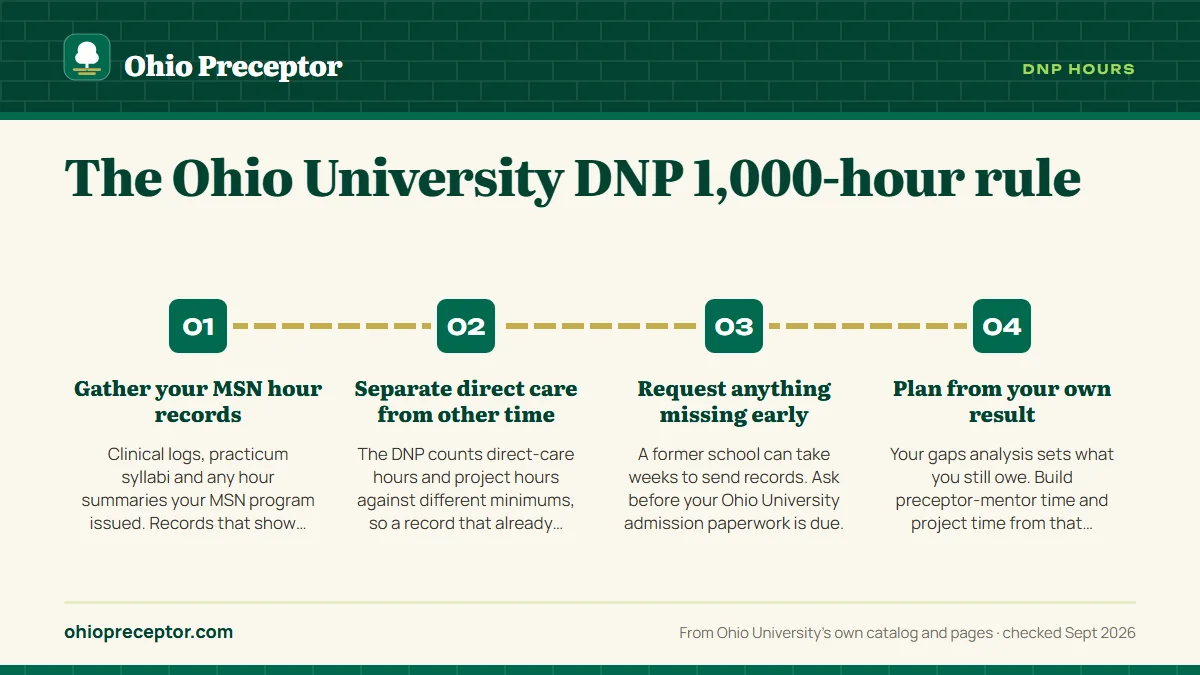
- Gather your MSN hour recordsClinical logs, practicum syllabi and any hour summaries your MSN program issued. Records that show precepted hours course by course are the most useful kind.
- Separate direct care from other timeThe DNP counts direct-care hours and project hours against different minimums, so a record that already splits them is easier to assess.
- Request anything missing earlyA former school can take weeks to send records. Ask before your Ohio University admission paperwork is due.
- Plan from your own resultYour gaps analysis sets what you still owe. Build preceptor-mentor time and project time from that figure, not from a classmate's.
Working out the hours you still owe
Once the gaps analysis comes back, the arithmetic is simple, with one catch. Subtract the credited hours from 1,000 to find your remaining total, then test each minimum on its own: credited direct-care hours plus new direct-care hours must reach 750, and project hours must reach 250 regardless of what else you have banked.
Two students can land in very different places. An experienced NP whose MSN included a long precepted clinical sequence may find much of the direct-care side covered and owe mainly project time. A nurse whose MSN practicum centered on leadership or teaching may carry over fewer direct-care hours and owe far more of them. Either way, whatever remains still needs a faculty-approved setting and a preceptor or mentor.
Ohio University also offers optional certificates inside the DNP, listed at 67 total credits with an AG-ACNP, FNP or PMHNP certificate. How those certificate practicum hours interact with your 1,000 is a question for your gaps analysis, since no public page spells it out.
NRSE 8920 and NRSE 8921: 250 each, or 100 and 150?
The two DNP practicums are where new practice hours are scheduled, and Ohio University lists them two ways. The catalog program page and the DNP curriculum page give NRSE 8920 and NRSE 8921 250 practicum hours each. The MSN-to-DNP sample schedule, marked "Subject to change," shows NRSE 8920 as "DNP Practicum (100 hours)" and NRSE 8921 as "DNP Immersion (150 hours)," with "Total Practicum Hours: 250."
| Source | NRSE 8920 | NRSE 8921 | Both practicums |
|---|---|---|---|
| 2026-27 Graduate Catalog program page | 250 | 250 | 500 |
| DNP curriculum page on ohio.edu | 250 | 250 | 500 |
| MSN-to-DNP sample schedule | 100 | 150 | 250 |
Ohio University describes DNP practice hours as individualized, so ask faculty which figure your preceptor-mentor should plan around, and budget for the larger one until you hear back. Course-level detail, from choosing the project site to the final presentations in Dublin, is on the NRSE 8920 and NRSE 8921 page.
Other DNP rules that touch your hours
- The 14-week cutoff. The sample schedule sets week 14 as the deadline for each practicum's hours. The clinical hours hub sets that beside Ohio University's 15-week course language.
- Malpractice coverage. The DNP apply page requires nurse practitioner malpractice insurance for APRN-track students and says "Insurance provided by the employer is not acceptable." The malpractice insurance page has the details.
- Sequence. The DNP FAQ says nursing courses "must be taken in sequence, and certain courses may only be available during specific semesters," so a delayed practicum can ripple through the rest of the plan.
- Time limit. The Graduate Catalog gives a professional doctorate seven calendar years from its start, while the DNP FAQ says "You can take up to 6 years." Plan to the shorter figure unless the School of Nursing confirms the longer one.
Where we fit in your DNP hours
Under the DNP FAQ, faculty and student choose the preceptor-mentor and clinical setting together, and our work is built to feed that conversation. Once your gaps analysis sets the hours you owe, your placement advisor looks for nearby preceptor-mentors and settings that can carry both the direct-care time and the scholarly project, and brings the options to you with credentials and site details already gathered.
That turns the faculty meeting into a choice between ready candidates instead of a blank page. Faculty make the call on the preceptor-mentor and setting; we see that the materials in front of them are complete and fit Ohio University's rules at first review. Tell us your remaining hours in the form below, and we will map them onto your practicum terms.
Questions Ohio University students ask
Will my 750 MSN FNP hours cover the DNP's direct-care minimum?
They might, but only the gaps analysis decides. Ohio University credits earlier precepted hours "on an individual basis" and publishes no automatic transfer. Arrive at admission with records for each precepted MSN hour. Even with generous credit, the 250-hour scholarly project minimum is counted on its own, so plan for project hours regardless.
Do BSN-to-DNP students follow the same 1,000-hour rule?
BSN-to-DNP nurse practitioner tracks remain in the 2026-27 catalog with 1,000 total hours, 750 of them direct care, yet Ohio University's DNP admissions pages currently offer only the post-MSN route and the BSN-to-DNP Nurse Anesthesia program. Nurse Anesthesia follows a different model, with a minimum of 2,300 direct-care hours.
Can DNP project hours happen at my own workplace?
Ohio University's public pages neither allow nor rule it out. The DNP FAQ ties practice hours to course objectives and says faculty help choose the preceptor-mentor and setting. The project centers on "a transformative change to promote quality healthcare," which needs a real organization, so raise your workplace with faculty early. The workplace page covers the trade-offs.
When does Ohio University complete the DNP gaps analysis?
The public pages tie it to admission: students should be ready to document precepted graduate hours upon admission, and the FAQ describes the gaps analysis as the step that sets the additional hours needed. No exact timing is published, so if your result has not arrived before you start planning practicum terms, ask the School of Nursing at graduatenursing@ohio.edu.
Related pages
Last checked 2026-09-24
We check these pages against Ohio University's own catalog, program pages and Nursing Knowledge Center. Your syllabus, the Graduate Nursing Student Handbook and your faculty have the final word.
Ohio University lets you choose your preceptor. We find the right one.
Tell us your Ohio University program, your community and your next clinical course. We find preceptors who fit the course and prepare what faculty review before they approve them.
- Preceptors matched to the course: primary care for the FNP
NRSE 6840sequence, acute care for AG-ACNP, psychiatric care for PMHNP - Your clinical packet details ready ahead of Ohio University's packet deadline
- Close to home, in Ohio or in any state where Ohio University admits graduate nurses
Start your placement plan
Program, city and clinical start is all we need to begin.