What the best Ohio University placement service does
A placement service earns its fee when it knows Ohio University's clinical process as well as you do: the NRSE sequence, the clinical packet dates, the hospital windows and the approved-state rules. Use the standards below to judge any service, ours included, and take the questions near the end into every conversation.
Get your placement plan
Tell us your Ohio University program and where you live. A placement advisor replies with the preceptor and site options that fit your course.
It starts from your NRSE course
The first question a strong service asks is which course needs the preceptor. Ohio University's NP tracks each run three 250-hour practicums in order: NRSE 6840, NRSE 6841 and NRSE 6842 for FNP; NRSE 6843, NRSE 6844 and NRSE 6845 for AG-ACNP; NRSE 6846, NRSE 6847 and NRSE 6848 for PMHNP. The Emergency NP certificate uses NRSE 6857 to NRSE 6859, and the MSN-to-DNP uses NRSE 8920 and NRSE 8921.
Course order changes the match. A final FNP practicum treats you as an entry-level clinician, so the preceptor's patient mix has to be broad. Offering terms matter as well: Ohio University's tentative course offerings list each AG-ACNP practicum in only one term a year, so missing one can mean waiting a year for it to run again. The course number is the detail that decides everything else in the search.
It works to Ohio University's calendar
Ohio University's graduate clinical packet falls due three times a year, and each date sits seven to nine weeks before the term it covers. On top of that, the Nursing Knowledge Center lists earlier facility application dates for Cleveland Clinic, Holzer, Mount Carmel and OhioHealth, with Holzer's the earliest every term. A capable service plans backward from whichever date comes first for your site. Our packet deadlines page sets out the 2026-27 dates.
It also knows the fixed days in your semester. Several courses carry an on-campus intensive in Dublin, Ohio, including NRSE 6840, NRSE 6843 and NRSE 6848, and clinical days should be planned around those dates rather than discovered clashing with them. The on-campus intensives page lists them.
It respects where you live and where you train
Ohio University admits graduate nursing students who live in, and hold an RN license from, one of its approved states: Ohio and 27 others. A service that searches outside Ohio should know that each state's board sets its own rules for clinicals. Ohio University's licensure disclosures give examples: Illinois requires both the APRN student and the preceptor to hold an Illinois RN license, Maryland requires out-of-state preceptors to be licensed in Maryland, and West Virginia requires its board's approval.
Affiliation agreements belong in the same early check. Ohio University's RN-to-BSN pages note that the university does not require one, a facility may, and Colorado's board requires one for every precepting student in that state. The approved states page lists the full set.
It prepares details faculty can approve
Ohio University faculty approve every preceptor and site, so the most useful thing a service hands you is a complete file. That means every credential, license detail and site fact the clinical packet asks about, lined up in the packet's own order and finished before the deadline rather than during it.
Because the packets, clinical overview sheets and preceptor packet are not public, a good service works from the versions you receive. The School of Nursing sends the clinical overview sheets and preceptor packet on request to graduatenursing@ohio.edu. It should also know which preceptor qualifications are published and which are not: the catalog describes AG-ACNP supervision by acute-care physicians and advanced practice providers, while for the other tracks the rules sit in the preceptor packet, the Graduate Nursing Student Handbook and guidance from your faculty.
It has a plan for a preceptor who leaves
Preceptors change jobs, take leave and cut back hours, while each practicum's hours are planned to fit inside a single semester. Ohio University's Important Dates page also says removing a graduate nursing course puts you out of sequence, needing a new program of study. The service you choose should explain, before you start, what happens if your preceptor steps away in week six.
Look for a concrete answer: who you contact, how quickly a new search begins, and how the replacement's details reach faculty. The strongest answers also account for the calendar, meaning how many weeks remain, how many hours are still owed and which sites can take a student mid-term. Our preceptor dropped out page shows the order of steps we follow.
Questions to ask any placement service
Bring these to every conversation, including ours. Clear, specific answers are the best sign a service understands Ohio University.
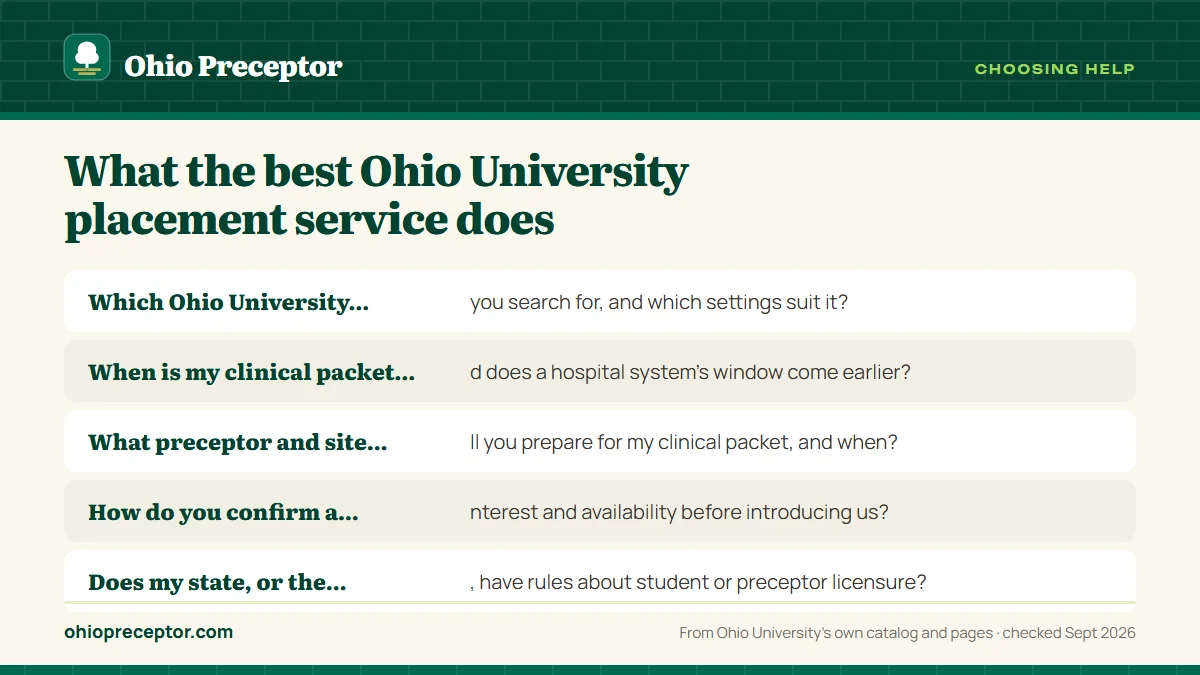
- Which Ohio University course will you search for, and which settings suit it?
- When is my clinical packet due, and does a hospital system's window come earlier?
- What preceptor and site details will you prepare for my clinical packet, and when?
- How do you confirm a preceptor's interest and availability before introducing us?
- Does my state, or the site's state, have rules about student or preceptor licensure?
- Will the site need an affiliation agreement or its own student application?
- What happens if my preceptor leaves partway through the semester?
- What exactly does your quote cover, course by course?
Why Ohio University students choose us
We built our service around Ohio University's process and nothing else. Your placement advisor asks for your NRSE course first, plans from your packet deadline and any hospital window, searches close to home in the settings Ohio University names for your track, and confirms each preceptor before you meet them.
Then we prepare the details faculty review, in packet order, so what reaches them is complete on arrival. We stay on call through the semester and start a replacement search the week a preceptor steps away. Faculty make the final decision; we make it a straightforward one. See how it works or ask for a quote on the cost page.
Questions Ohio University students ask
What should a placement service ask me first?
Your Ohio University program, the NRSE course that needs a preceptor, the term it runs, your city and how many hours you still need. A good service also asks which clinicians you have already approached and whether you work for a hospital system, since both change where the search should start.
Can a placement service decide whether my preceptor is approved?
Approval belongs to Ohio University faculty, for every preceptor and site. A service's job is to make that decision easy: a preceptor who fits the course, a site that suits the track, and details that are complete when they arrive. Ask each service to show you how it prepares for approval.
Does a service need to know my program's clinical hours?
Yes, because hours shape how much time a preceptor must commit. Ohio University's MSN NP tracks carry 750 hours in three 250-hour practicums, the Emergency NP certificate shows 450 in the catalog and 500 on its program page, and the MSN-to-DNP totals 1,000 post-baccalaureate hours with prior hours credited by gaps analysis. See the clinical hours page.
I already have part of my placement arranged. Is a service still useful?
Often, yes. If you have a willing preceptor but no backup, or a site that runs its own application you have not started, a service can prepare the details for your packet, check the site's requirements and line up a second option before the deadline.
How should I compare two quotes?
Compare the scope rather than the headline. Check which courses each quote covers, what preparation for the clinical packet is included, how deadlines and hospital windows are tracked, and what happens if a preceptor leaves. Two quotes that look similar can describe very different amounts of work.
Related pages
Last checked 2026-09-24
We check these pages against Ohio University's own catalog, program pages and Nursing Knowledge Center. Your syllabus, the Graduate Nursing Student Handbook and your faculty have the final word.
Ohio University lets you choose your preceptor. We find the right one.
Tell us your Ohio University program, your community and your next clinical course. We find preceptors who fit the course and prepare what faculty review before they approve them.
- Preceptors matched to the course: primary care for the FNP
NRSE 6840sequence, acute care for AG-ACNP, psychiatric care for PMHNP - Your clinical packet details ready ahead of Ohio University's packet deadline
- Close to home, in Ohio or in any state where Ohio University admits graduate nurses
Start your placement plan
Program, city and clinical start is all we need to begin.