Precepting an Ohio University nursing student
Perhaps an Ohio University nursing student has asked you to take them on, or you are open to the idea. This page sets out what to expect: who the student is, what the course asks of you, who supervises from the university side and what paperwork comes your way. The School of Nursing has no page written for preceptors, so everything here is drawn from Ohio University's program pages and catalog.
Open to precepting?
Tell us your specialty, where you practice and which semesters suit you. A placement advisor replies with the details.
Who the student is
Ohio University's NP students arrive as experienced registered nurses. Applicants to the MSN NP tracks, the NP certificates and the DNP must show an unencumbered RN license in one of Ohio University's approved states and the equivalent of two years of full-time relevant RN experience within the past five years.
Before an MSN NP student's first practicum, they complete NRSE 7230 Advanced Health Assessment, which Ohio University describes as the last course before clinicals, with a one- to two-day skills workshop on campus in Dublin, Ohio. Post-master's certificate students need graduate courses in advanced pathophysiology, pharmacology and health assessment (NRSE 7210, NRSE 7220 and NRSE 7230, or equivalents) with at least a B.
Before any clinical day, Ohio University requires proof of health status and immunizations as the Graduate Nursing Student Handbook sets out, BLS, state and federal background checks and malpractice insurance. Its DNP pages specify nurse practitioner malpractice insurance for NP-track students, not coverage provided by an employer.
The course you would be precepting
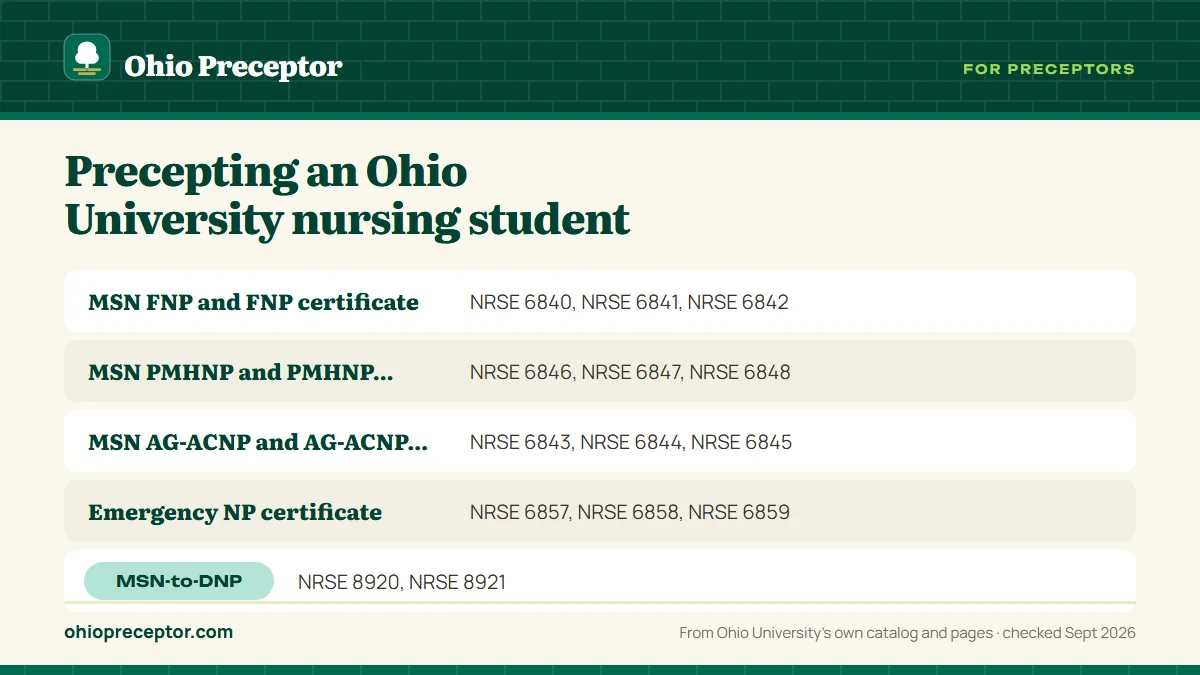
The table shows what Ohio University publishes for each program; where its sources disagree, both figures appear.
| Program | Practicum courses | Hours | Usual setting (Ohio University's wording) |
|---|---|---|---|
| MSN FNP and FNP certificate | NRSE 6840, NRSE 6841, NRSE 6842 | 250 each, 750 total | Primary-care offices or hospital/community-based clinics |
| MSN PMHNP and PMHNP certificate | NRSE 6846, NRSE 6847, NRSE 6848 | 250 each, 750 total | Community or private mental health agencies, correctional facilities, school-based health centers, substance-abuse treatment |
| MSN AG-ACNP and AG-ACNP certificate | NRSE 6843, NRSE 6844, NRSE 6845 | 250 each, 750 total | Critical care units, hospital-based medicine and emergency units |
| Emergency NP certificate | NRSE 6857, NRSE 6858, NRSE 6859 | 450 (catalog) or 500 (program page) | Hospital or emergency care facility |
| MSN-to-DNP | NRSE 8920, NRSE 8921 | 250 each (catalog); 100 and 150 (sample schedule) | Individualized to the program of study, with a preceptor-mentor |
| MSN Nurse Leader | NRSE 6850, NRSE 6851 | 250 each, 500 total | Organizational units of health care organizations |
| MSN Nurse Educator | NRSE 7940, NRSE 7941 | 250 each, 500 total | Academic nursing schools or a professional development unit |
| RN-to-BSN | NRSE 4585, NRSE 4595 | 10.5, then 40 true hours with at least 21 in direct patient contact | Community-based sites, then any site that employs nurses |
What the time commitment looks like
Ohio University's semesters are built on 15-week courses, and each NP practicum is worth 250 hours. Spread evenly, that averages about 17 hours a week. The MSN FAQ describes students spending two to three days a week at their clinical site during clinical courses.
You and the student agree the schedule at the start, and it is worth building in the fixed dates early. Some courses include an on-campus intensive in Dublin: one day for NRSE 6840 and two days each for NRSE 6843 and NRSE 6848. RN-to-BSN courses are much shorter: five weeks each, with the 40 true hours of NRSE 4595 including at least three with the preceptor.
Faculty and the clinical supervisor
Ohio University's MSN FAQ says NP clinicals run with an approved preceptor and an assigned clinical supervisor, and every preceptor and site needs faculty approval. For the DNP, clinical hours are faculty-supervised in collaboration with a preceptor or mentor. The clinical supervisor page explains that role.
Evaluation forms and the format of any faculty site contact are set out in course materials rather than on public pages, so request the syllabus and the clinical overview sheet for the course from the student. For preceptors practicing in Ohio, section 4723.32(F) of the Ohio Revised Code allows an APRN student to practice while supervised by an APRN acting for the program as a faculty member, teaching assistant or preceptor; the standard care arrangement page covers Ohio law.
The paperwork that reaches you
Paperwork comes through the student. The School of Nursing sends graduate students the clinical overview sheets and preceptor packet for their program on request, and faculty review your credentials, license details and site information as part of the student's clinical packet. Because that packet closes roughly two months before the term, the student may ask for your details ahead of the first clinical day.
If you work inside a large health system, your employer may route students through its own application. Ohio University's calendar lists separate student application deadlines for Cleveland Clinic, Holzer, Mount Carmel and OhioHealth. Some facilities also need an affiliation agreement with the school; the affiliation agreements page explains when.
RN-to-BSN preceptors see a shorter version: a Preceptor Agreement Form approved before the student enrolls, and Nursys license verification for student and preceptor. Ohio University asks that the preceptor hold a BSN or higher degree and an active license in the same state as the student and the facility, and not be a close relative.
Before you say yes
- Which course is it, and which semester? The course number tells you the patient mix the student needs.
- Can your patient mix cover what the course describes, for example patients across the lifespan for an FNP practicum?
- How many hours, and on which days? Agree a weekly pattern that fits your clinic.
- Which dates are fixed? Ask about on-campus intensives and semester start and end dates.
- Does your employer run its own student application or require an affiliation agreement?
- Who is the student's clinical supervisor, and how will they be in touch?
- What does the preceptor packet ask you to provide, and by when?
Working with us
We connect clinicians with Ohio University students whose course fits their practice, in the student's own area. When you tell us your specialty, location and the semesters that suit you, your placement advisor introduces students whose course matches your setting, confirms the dates up front and helps the student gather what faculty need from you, so your part of the paperwork stays small.
If a student you precept needs a second preceptor or a replacement, we handle that search too. To register interest, use the form on this page and select "I'm a preceptor (not a student)" in the program field.
Questions Ohio University students ask
Must I be an NP to precept an Ohio University NP student?
Ohio University's public pages set out a credential rule for one track only: the catalog describes AG-ACNP practicums under acute-care physicians and advanced practice providers. For FNP and PMHNP, the rules are in the preceptor packet the School of Nursing provides, and faculty approve every preceptor. See preceptor requirements for what is published.
How many hours a week will the student spend with me?
Plan on roughly two to three clinic days a week, the pattern Ohio University's MSN FAQ gives for clinical courses. Averaged across the term, a 250-hour practicum comes to about 17 hours weekly, and you and the student fix the real schedule together in the first week or before it.
Does Ohio University give preceptors continuing education credit?
Ohio University's public nursing pages describe no preceptor benefits such as continuing education credit, a faculty title or library access, and the university has no preceptor-facing nursing page. If recognition matters to you, ask the School of Nursing at graduatenursing@ohio.edu before agreeing, so you know what to expect.
What happens if I can no longer precept mid-semester?
Tell the student and their clinical supervisor as early as you can, so the hours already completed are documented and a replacement can be approved quickly. The student's course runs on a fixed semester, and dropping a graduate nursing course puts them out of sequence, so notice time makes a real difference. We can start the replacement search for them.
Will I sign an agreement with Ohio University?
For RN-to-BSN students, yes: a Preceptor Agreement Form is approved before the student enrolls. For graduate students, the preceptor packet holds the forms faculty need from you. A facility may separately require an affiliation agreement with the school, so check your employer's policy early.
Related pages
Last checked 2026-09-24
We check these pages against Ohio University's own catalog, program pages and Nursing Knowledge Center. Your syllabus, the Graduate Nursing Student Handbook and your faculty have the final word.
Ohio University lets you choose your preceptor. We find the right one.
Tell us your Ohio University program, your community and your next clinical course. We find preceptors who fit the course and prepare what faculty review before they approve them.
- Preceptors matched to the course: primary care for the FNP
NRSE 6840sequence, acute care for AG-ACNP, psychiatric care for PMHNP - Your clinical packet details ready ahead of Ohio University's packet deadline
- Close to home, in Ohio or in any state where Ohio University admits graduate nurses
Start your placement plan
Program, city and clinical start is all we need to begin.