Ohio University's post-master's AG-ACNP certificate: acute care hours for practicing APRNs
The post-master's Adult-Gerontology Acute Care NP certificate admits in fall only and runs its three hospital practicums, NRSE 6843, NRSE 6844 and NRSE 6845, as a fall, spring and summer sequence. Before any of that, a gaps analysis checks two things the other certificate pages barely mention: whether your earlier courses covered the lifespan, and whether your advanced pharmacology is recent enough. Here is how both checks work and what they mean for your hospital timeline.
Plan your acute care certificate
Tell us your entry year, your current license and the hospitals near you. Your placement advisor replies with an acute care plan timed to Ohio University's fall-only sequence.
Who takes the AG-ACNP certificate
Applicants to the certificate (catalog code CTACNG) bring an MSN, a graduate GPA of 3.20 or higher for unconditional admission, two full-time-equivalent years as an RN within the last five, and an unencumbered RN license in an approved state where they also live. Current degree-seeking students and non-degree students are both eligible.
It suits two kinds of nurse in particular: APRNs certified in another population who work in, or want to move into, hospital medicine and critical care, and MSN-prepared nurses whose earlier coursework needs topping up first. Ohio University's PMHNP certificate page, speaking about APRN certificates in general, says current APRNs will more than likely go straight into a clinical course. The AG-ACNP certificate page leaves that line out, so confirm your own starting point with the School of Nursing.
The lifespan and five-year pharmacology checks
A footnote on the AG-ACNP certificate page sets this certificate apart: “Some states and accrediting bodies require that the courses covered the lifespan and that the Advanced Pharmacology course is no more than five years old.” The same note adds that “Students will receive a gaps analysis of their previous coursework to determine needed additional coursework.”
In practice the gaps analysis looks past course titles. If your earlier pathophysiology, pharmacology or assessment courses were limited to one population, or your advanced pharmacology course is more than five years old, coursework may be added before NRSE 6843. Because Practicum I runs only in fall, that can move your first acute care term to the following fall.
Ohio's licensing law runs a similar clock. The Ohio Board of Nursing's 2025 guide restates ORC 4723.482: a CNP applicant needs an advanced pharmacology course completed no more than five years before the application, of at least 45 contact hours and specific to the nursing specialty, and the Board notes that missing required content may be completed through qualifying continuing education. Your home state board sets its own rule, so check it before you apply.
Prerequisite numbers: the older set
The AG-ACNP certificate is the one NP certificate whose catalog page lists the older prerequisite numbers: NRSE 6210, NRSE 6221 and NRSE 6230, courses that still have entries in the 2026-27 catalog. The FNP and PMHNP certificate catalog pages list NRSE 7210, NRSE 7220 and NRSE 7230 instead, and the web pages for all three certificates show the older set in their admission tables but the newer one in their curricula.
For you, content and age matter more than numbering. Bring the syllabi and completion dates for your advanced pathophysiology, pharmacology and health assessment courses to the gaps analysis, since the pharmacology date is the one the footnote singles out. Missing prerequisites can be taken before admission in non-degree status or inside the certificate.
Fall, spring, summer: the acute care sequence
With the gaps closed, a fall entrant can move through the three practicums in consecutive terms, which is how the catalog's three-semester figure fits. The catalog's certificate page labels all three at 250 hours, where the MSN page leaves NRSE 6845 unlabeled.
| Term | Course | Catalog focus | Hours |
|---|---|---|---|
| Fall | NRSE 6843 AG-ACNP Practicum I (OCI) | Adults and older adults with acute and emergent complex conditions | 250 |
| Spring | NRSE 6844 AG-ACNP Practicum II | Working as an interdisciplinary team member in acute care | 250 |
| Summer | NRSE 6845 AG-ACNP Practicum III | Advanced clinical judgment for adults with complex conditions | 250 |
| Set by your program of study | NRSE 7818 Advanced Diagnostics for Clinical Reasoning | Diagnostic reasoning, 2 credits | None |
Two quirks carry over from the catalog: the NRSE 6845 entry prints NRSE 6847, a PMHNP course, as its requisite, and the certificate page's FAQ calls the program “2 years” while the certificates index says one year. A comprehensive program exam closes the certificate. The MSN AG-ACNP guide covers the same courses from the degree side.
Acute care sites for working APRNs
Clinical settings match the MSN track's: intensive and critical care, hospital medicine and emergency units, where the catalog expects acute care physicians and advanced practice providers to supervise you, alongside a clinical supervisor from Ohio University. The certificates index promises local practicum hours in a setting you prefer.
Your own employer's hospital can be a strong starting point, and some systems say so on their own pages. Holzer ranks its employees first for advanced practice student rotations, and Premier Health's archived page gives current employees priority for placement. Other systems are stricter: OhioHealth works only with schools it already has agreements with and wants a new application every semester.
If you plan to train where you already work, keep student shifts clearly apart from paid ones in your records, and ask faculty early how they view a preceptor from your own unit.
Hospital windows close before the application does
Put the Fall 2027 dates in order. Ohio University's posted facility deadlines for that fall run from 4/1/2027 to 6/1/2027, and the certificate application closes 07/05/27, so a direct-entry applicant aiming at a large system meets its window before the admission decision. The hospital system applications guide sets out every system's dates, and the School of Nursing can tell you how early a certificate applicant may file.
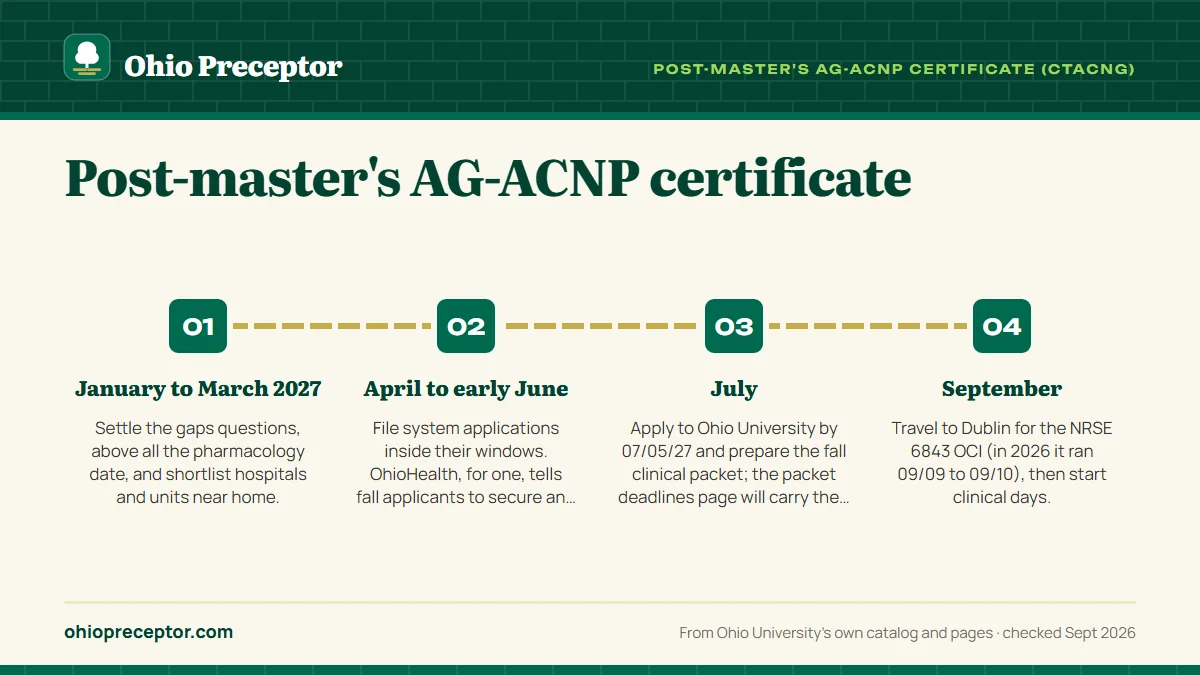
- January to March 2027Settle the gaps questions, above all the pharmacology date, and shortlist hospitals and units near home.
- April to early JuneFile system applications inside their windows. OhioHealth, for one, tells fall applicants to secure an agreeing preceptor before applying.
- JulyApply to Ohio University by 07/05/27 and prepare the fall clinical packet; the packet deadlines page will carry the Fall 2027 date.
- SeptemberTravel to Dublin for the
NRSE 6843OCI (in 2026 it ran 09/09 to 09/10), then start clinical days.
The acute care certificate trap: leaving hospital applications until after admission. For a Fall 2027 NRSE 6843, every Ohio facility deadline Ohio University posts falls before the certificate application closes, so the preceptor search belongs in winter.
Why acute care APRNs choose us
Your placement advisor starts with the calendar: the gaps analysis, the fall-only NRSE 6843 and each hospital's window. We then work every route at once, from your employer's student process to direct outreach to hospitalists, critical care physicians and acute care NPs wherever a system permits it.
We collect the preceptor's credentials and license, the unit details and every form in Ohio University's preceptor packet. Ohio University faculty approve every preceptor and site, and they review a complete file the first time.
Three practicums in three straight terms leave no slack, so the spring and summer preceptors are in motion before fall ends, and a replacement search starts at once if a unit's staffing changes. The form at the end of the page starts the conversation, and how it works covers each step.
Questions Ohio University students ask
Does the AG-ACNP certificate admit in spring?
The catalog lists “Fall only”, and the certificate page shows Fall 2027 as the next start, with applications due 07/05/27 and classes from 08/23/27. Because NRSE 6843 runs only in fall, a spring entry would leave you waiting for the first practicum anyway. Get the School of Nursing to confirm your term before a preceptor sets aside time for you.
My pharmacology course is more than five years old. What happens?
Ohio University's AG-ACNP certificate page says some states and accrediting bodies require advanced pharmacology no more than five years old, and that a gaps analysis determines needed coursework. Expect it to flag an older course. Any added course lengthens the program and can push NRSE 6843 to the following fall, so ask the School of Nursing about the course date early, well ahead of the application deadline.
Should I choose the AG-ACNP or the Emergency NP certificate?
They serve different goals. The AG-ACNP certificate prepares you for adults and older adults across critical care, hospital medicine and emergency units, with 750 hours. The Emergency NP certificate requires existing FNP licensure and current ACLS, centers on emergency care across the lifespan, and lists 450 hours in the catalog versus 500 on its web page. See the Emergency NP guide.
Can all three practicums be at the same hospital?
Ohio University's public pages set no rule against it, and faculty approve each preceptor and site course by course. Hospital systems add their own conditions; OhioHealth, for example, asks for a new student application every semester. Plan each term's application separately even if you hope to stay on one unit all year.
How many OCIs are in the AG-ACNP certificate?
Two, according to the certificate FAQs. On the Knowledge Center's table, NRSE 6843 is the AG-ACNP course with an OCI, held early in the fall term at Ohio University's Dublin center. A student whose gaps analysis adds NRSE 7230 also attends that course's pre-clinical OCI, so check with faculty which trips your own schedule includes.
Related pages
Last checked 2026-09-24
We check these pages against Ohio University's own catalog, program pages and Nursing Knowledge Center. Your syllabus, the Graduate Nursing Student Handbook and your faculty have the final word.
Ohio University lets you choose your preceptor. We find the right one.
Tell us your Ohio University program, your community and your next clinical course. We find preceptors who fit the course and prepare what faculty review before they approve them.
- Preceptors matched to the course: primary care for the FNP
NRSE 6840sequence, acute care for AG-ACNP, psychiatric care for PMHNP - Your clinical packet details ready ahead of Ohio University's packet deadline
- Close to home, in Ohio or in any state where Ohio University admits graduate nurses
Start your placement plan
Program, city and clinical start is all we need to begin.