Ohio University AG-ACNP clinical hours in acute care
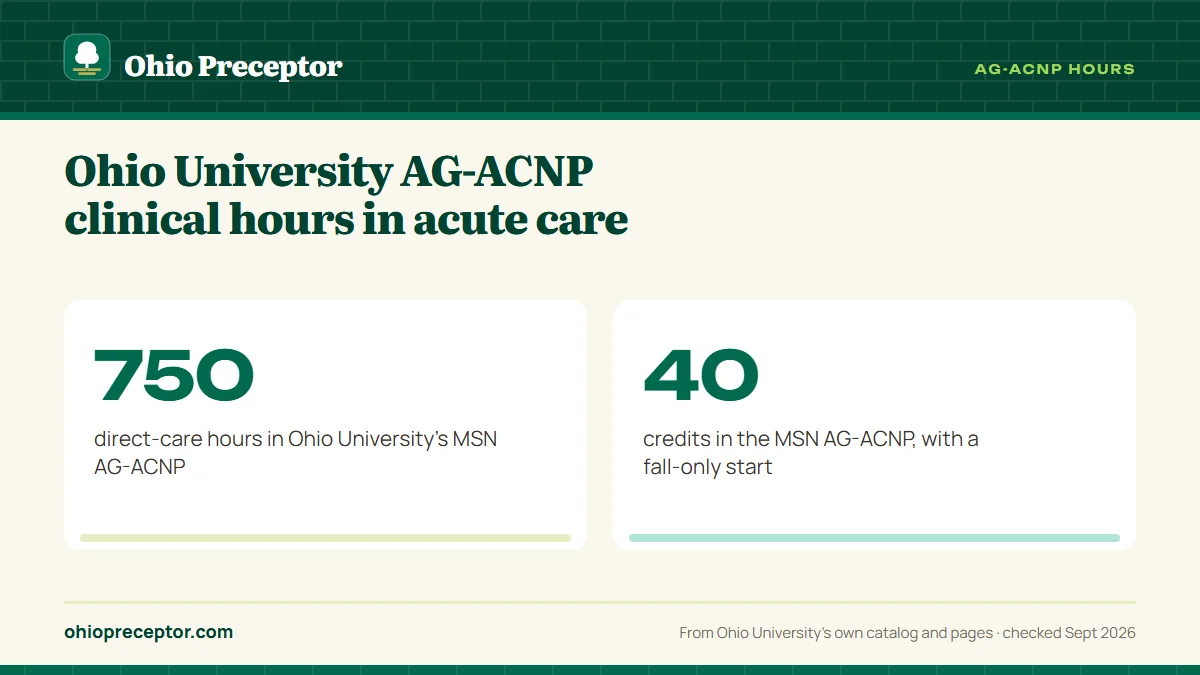
Ohio University's MSN Adult-Gerontology Acute Care NP requires a minimum of 750 direct-care hours in acute care, spread across NRSE 6843, NRSE 6844 and NRSE 6845. Each practicum appears in only one term a year, in a fixed fall, spring, summer order, which leaves very little room for a placement to slip.
Get your placement plan
Tell us your Ohio University program and where you live. A placement advisor replies with the preceptor and site options that fit your course.
Acute care hours under acute care clinicians
The catalog puts it this way: AG-ACNP practicum experiences take place "in acute-care settings," supervised by "acute-care physicians and advanced practice providers," for at least 750 direct-care hours. Of Ohio University's three MSN NP tracks, it is the only one whose catalog text names physicians as well as advanced practice providers as supervisors.
Typical settings, per the MSN FAQ, are critical care, hospital medicine and emergency units, each placement pairing a faculty-approved preceptor with a school-assigned clinical supervisor. The course descriptions line up behind that list. NRSE 6843 covers acute and emergent complex conditions in adults and older adults, NRSE 6844 places you on the interdisciplinary team in acute care, and NRSE 6845 asks for advanced clinical judgment with adults who have complex conditions.
Where these descriptions name a population, it is adults and older adults, as the track's title suggests, rather than the across-the-lifespan wording of the FNP and PMHNP courses. Pediatric acute care is not what these practicums are built around.
Three practicums, three fixed terms
Every FNP and PMHNP practicum is scheduled twice a year. The AG-ACNP practicums each sit in a single column of the tentative offerings table, so a missed or withdrawn course has no second chance until that same term comes around a year later. The table does not say so in words; it follows from reading it.
The track also admits in fall only, according to the catalog, and the next start shown on ohio.edu is Fall 2027. Put a fall-only start together with once-a-year practicums and, in practice, your three clinical terms are set from the day you enroll. That predictability is useful: you know now which fall, spring and summer need acute care preceptors.
| Course | Hours listed | Requisite in the catalog | Offered | On-campus intensive |
|---|---|---|---|---|
NRSE 6843 Practicum I | 250 | NRSE 7230 | Fall only | Yes: 09/09 and 09/10/2026 in Dublin |
NRSE 6844 Practicum II | 250 | NRSE 6843 | Spring only | Not marked |
NRSE 6845 Practicum III | 250 on the certificate page; no label on the MSN page | NRSE 6847, a PMHNP course | Summer only | Not marked |
The NRSE 6845 listing conflict
Ohio University's own pages disagree about the third AG-ACNP practicum in three ways. Knowing them now saves a confused email later.
- The web course list leaves it out. The ohio.edu AG-ACNP courses page lists
NRSE 6843andNRSE 6844but notNRSE 6845, while still describing "11 courses for 40 total credits." The ten courses it shows add up to 34 credits, exactly one 6-credit practicum short. - The MSN catalog page drops the hours label.
NRSE 6843andNRSE 6844carry "(250 practicum hours)" andNRSE 6845carries nothing. The AG-ACNP certificate catalog page labels all three at 250. - The catalog requisite points to another track. The
NRSE 6845course entry reads "Requisites: NRSE 6847," the second PMHNP practicum, rather thanNRSE 6844.
The 750-hour total only adds up with NRSE 6845 at 250, and the catalog program page, the certificate page and the Knowledge Center offerings table all include the course. Plan for three 250-hour practicums. If a registration hold or degree audit ever reflects the odd requisite, raise it with your advisor or the School of Nursing at graduatenursing@ohio.edu right away. The NRSE 6845 page follows the course in more detail.
Do not read the missing web listing as a sign that NRSE 6845 is optional. The catalog, the certificate page and the offerings table all include it, and the 750 hours depend on it.
Acute care sites and hospital application windows
Critical care units and hospital medicine services sit inside hospital systems, and the MSN FAQ cautions that larger systems may run a centralized preceptor-assignment process students must use, with requests often due well ahead and fees possible. For Ohio facilities, the Nursing Knowledge Center posts application deadlines for Cleveland Clinic, Holzer, Mount Carmel and OhioHealth that close months before each term.
For AG-ACNP students the effect is concrete. The fall 2026 deadlines ran from 4/1/2026 to 6/1/2026, so an NRSE 6843 request was due while students were still in coursework. The spring and summer windows for NRSE 6844 and NRSE 6845 then close during, or just after, the practicum before them. Plan all three terms at once. Every posted date sits on the hospital system applications page.
Certificate students and the lifespan footnote
The post-master's AG-ACNP certificate carries the same three practicums and 750 hours, plus NRSE 7818, in 20 credits, with a fall-only start. Its page also flags a rule some states and accreditors apply to earlier coursework, covering lifespan content and the age of your Advanced Pharmacology course, and a gaps analysis settles what you must add.
Extra courses can push the first practicum back a year, given the fall-only NRSE 6843, so confirm your practicum term before you commit a preceptor. Certificate students who are current APRNs may reach NRSE 6843 in their first fall, so for them the acute care search starts before admission. See the AG-ACNP certificate page.
How we plan acute care hours for AG-ACNP students
Acute care placements reward early, organized work. We map your three practicum terms, identify which hospital systems near you run centralized applications and when their windows close, and search for acute care physicians or advanced practice providers whose units suit each course's focus.
Your placement advisor confirms hours and schedules with each preceptor and collects the credentials, license and unit details that faculty review and the clinical packet requires. Approval rests with Ohio University faculty, and we make sure the file they receive has every piece in place and meets the rules on first read. Because a lost AG-ACNP term can cost a year, your advisor keeps watch through each semester and moves on a replacement immediately if a preceptor drops. Use the form below and start with your NRSE 6843 term.
Questions Ohio University students ask
Can AG-ACNP hours be done in an emergency department?
Yes, with faculty approval. Ohio University's MSN FAQ lists emergency units among the usual AG-ACNP settings, next to critical care units and hospital-based medicine. Keep the patient focus on adults and older adults with acute and complex conditions, which is what all three practicum descriptions cover.
What happens if I miss NRSE 6844 in the spring?
The tentative offerings table lists NRSE 6844 in spring only, so the next chance is the following spring, and your program of study would have to change. Removing a course, per the Knowledge Center, puts you out of sequence with a new program of study to request; the out-of-sequence page shows what that does to your timeline.
Can a physician precept me for AG-ACNP hours?
The catalog says AG-ACNP practicum experiences happen "under supervision of acute-care physicians and advanced practice providers," and faculty approve every preceptor. State law adds its own wording for APRN students, and rules differ from state to state. The preceptor requirements page and the standard care arrangement page cover the details.
Does the Ohio University AG-ACNP start in spring?
No. Both the MSN track and the post-master's certificate admit in fall only, according to the catalog. Ohio University's site shows Fall 2027 next: application deadline 07/05/27, first classes 08/23/27. That fixed start is one reason the practicum terms are so predictable.
Related pages
Last checked 2026-09-24
We check these pages against Ohio University's own catalog, program pages and Nursing Knowledge Center. Your syllabus, the Graduate Nursing Student Handbook and your faculty have the final word.
- Ohio University Graduate Catalog 2026-27: MSN Adult-Gerontology Acute Care NP
- Ohio University: MSN AG-ACNP courses
- Ohio University Graduate Catalog: NRSE 6845 AG-ACNP Practicum III
- Ohio University Graduate Catalog 2026-27: Post-Graduate AG-ACNP Certificate
- Ohio University Nursing Knowledge Center: important dates
Ohio University lets you choose your preceptor. We find the right one.
Tell us your Ohio University program, your community and your next clinical course. We find preceptors who fit the course and prepare what faculty review before they approve them.
- Preceptors matched to the course: primary care for the FNP
NRSE 6840sequence, acute care for AG-ACNP, psychiatric care for PMHNP - Your clinical packet details ready ahead of Ohio University's packet deadline
- Close to home, in Ohio or in any state where Ohio University admits graduate nurses
Start your placement plan
Program, city and clinical start is all we need to begin.