NRSE 6843: starting acute care clinicals
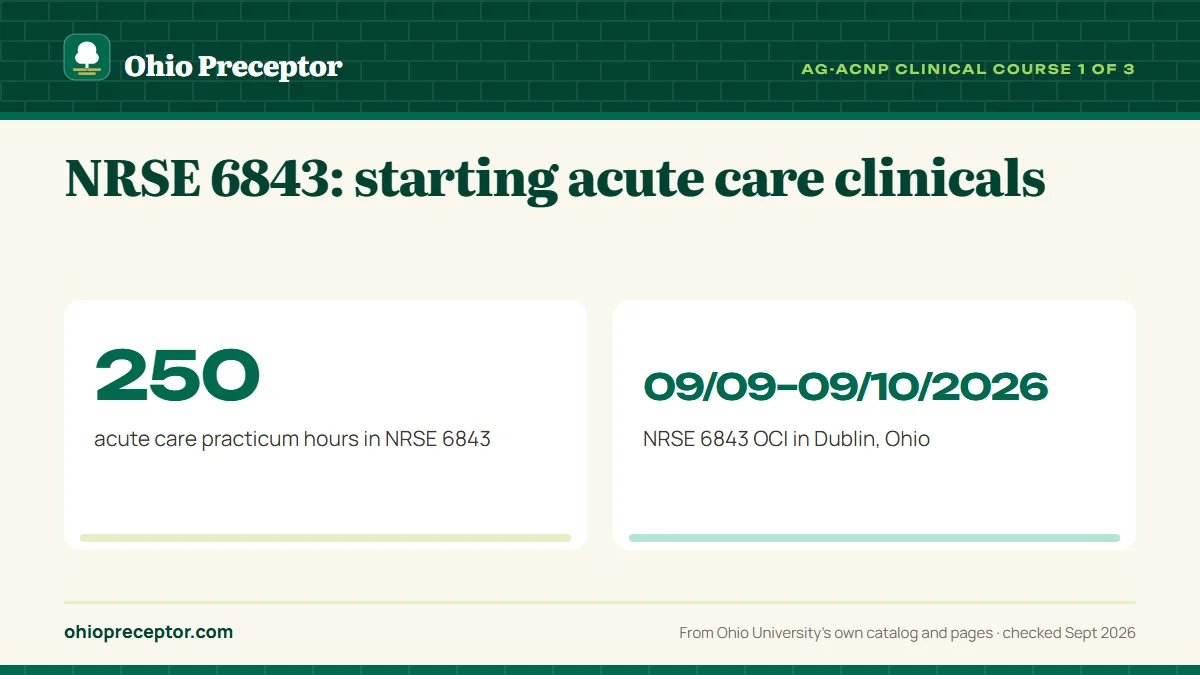
NRSE 6843, Adult Gerontology Acute Care Nurse Practitioner Practicum I, runs once a year, in fall, and opens the AG-ACNP clinical sequence with 250 hours of hospital-based acute care. It follows NRSE 7230, includes an on-campus intensive, and often depends on a hospital's own student application as much as on Ohio University's packet. Planning for it starts months before the term.
Get your placement plan
Tell us your Ohio University program and where you live. A placement advisor replies with the preceptor and site options that fit your course.
Why a fall-only course changes the planning
The Knowledge Center's tentative offerings put the AG-ACNP practicums in a fixed line: NRSE 6843 in fall, NRSE 6844 in spring and NRSE 6845 in summer. The catalog also lists fall as the only entry term for the MSN AG-ACNP. Read together, a missed fall start means 6843 does not come around again until the next fall. The page does not say this in words; it follows from the table.
FNP and PMHNP students get a first practicum twice a year. AG-ACNP students get one chance per academic year, so a placement that falls through in July has no spring section to slide into. Our out of sequence page covers what Ohio University says happens when a course leaves your plan.
Acute and emergent: the course in the catalog's words
The description gives the role as providing "comprehensive healthcare for adult individuals from diverse backgrounds in the acute care setting." The course stresses advanced assessment, diagnosis and clinical management of "acute and emergent complex conditions," and the focus extends to risk assessment, health promotion and prevention for acute conditions in adults and older adults.
The catalog lists 6 credits, split as 3.5 lecture and 5.0 clinical, with NRSE 7230 as the only requisite. The hours come from the AG-ACNP program page, which labels 6843 at 250 practicum hours inside a program minimum of 750 direct-care hours. Pre-clinical requirements apply before the first shift: immunizations and BLS per the Graduate Handbook, federal and state background checks, and malpractice insurance, set out on our clinical compliance page.
Units that fit, and who supervises there
Ohio University's MSN FAQ says AG-ACNP clinicals usually take place in "critical care units, hospital-based medicine and emergency units." As on every track, an assigned clinical supervisor works alongside the approved preceptor. The AG-ACNP catalog page describes the supervision as coming from "acute-care physicians and advanced practice providers."
For a first acute care course, a hospitalist service or intensive care team where you can follow a group of admitted adults from assessment through daily management is a strong fit, and an emergency unit adds the emergent side the description names. Faculty approve the preceptor and the unit; the preceptor requirements page covers who qualifies.
Hospital systems add a layer of their own. OhioHealth's student application FAQ, for example, asks students to apply for a fall rotation only if a preceptor has already agreed to it, which for a fall-only course means the preceptor conversation comes first.
Working back from a fall 2027 section
For students entering 6843 in fall 2027, these are the dated items Ohio University and its registrar have posted so far.
| Date | What happens |
|---|---|
| 4/1/2027 to 6/1/2027 | Ohio facility application deadlines for fall 2027, Holzer first and OhioHealth last |
| 6/07–6/08 or 6/09–6/10/2027 | Summer offering of the NRSE 7230 pre-clinical OCI in Dublin |
| Not posted yet | Fall 2027 clinical packet deadline (fall 2026's was 07/06/2026) |
| 08/23/2027 | Fall 2027 term opens (tentative calendar) |
Ohio University notes that facility dates are "subject to change at facilities discretion." How each system runs its process is on our hospital system applications page.
Hospital windows close before Ohio University's packet date. For fall 2026, Holzer's closed on 4/1/2026, more than three months ahead of the 07/06/2026 packet deadline; a search that starts at packet time misses it.
The September intensive in Dublin
NRSE 6843 is one of the courses the tentative table flags as "On-Campus OCI Required In Course." Its 2026-27 session ran 09/09–09/10/2026 at 6805 Bobcat Way, Dublin, early in the fall term. The fall 2027 date is not posted yet; OCI dates, per the Knowledge Center, go up no less than three months before the visit. Tell a new unit early that you will be away for those days, since unit schedules are usually built well in advance.
The AG-ACNP track FAQ counts two intensives in all, and the tentative table marks this one and the NRSE 7230 pre-clinical visit. Neither NRSE 6844 nor NRSE 6845 carries a mark, so this is the last scheduled trip to Dublin in the clinical sequence as the table stands.
From 7230 into acute care, and on to 6844
NRSE 7230 brings the health assessment foundation, and the catalog lists it as the only gate. NRSE 6844, which requires 6843, follows in spring and turns the focus to working as an interdisciplinary team member in acute care. Staying on the same unit into spring can spare you a second orientation, though some systems want a new application every term; OhioHealth's FAQ says so for its own sites.
The catalog's "May not be retaken" line sits beside the Knowledge Center's repeat-once rule. For a fall-only course, a repeat also means waiting for the next fall on the tentative table. Failing or repeating a clinical course explains the conflict. A brief handoff from your fall preceptor to your spring one, even a short email, helps the new unit pitch the team role at the right level.
Why acute care students bring 6843 to us
Acute care placements run on hospital calendars, and that is where our preparation shows. We track the large Ohio systems' application windows alongside Ohio University's packet date, search for a hospitalist, critical care or emergency preceptor close to home, and assemble the credentials, license and unit details faculty need to see.
Because 6843 comes once a year, we start early and keep a second option in view in case a unit's capacity changes. If a large system's window has already closed, we turn to hospitals and units with their own routes that still fit the course. Faculty hold the approval; your placement advisor makes sure the file in front of them is complete, accurate and on time. Tell us your fall term through the form below.
Questions Ohio University students ask
Can I take NRSE 6843 in spring?
No. The Knowledge Center's offering table, marked tentative, shows NRSE 6843 in fall only, with 6844 in spring and 6845 in summer. The MSN AG-ACNP catalog entry also names fall as the only term of entry. Your advisor builds your program of study around that single fall offering, so confirm your year with them.
Does the AG-ACNP certificate use NRSE 6843?
Yes. The post-master's AG-ACNP certificate lists NRSE 6843, NRSE 6844 and NRSE 6845 at 250 hours each plus NRSE 7818, for 20 credits. Its catalog prerequisites use older course numbers (NRSE 6210, 6221 and 6230), and a gaps analysis may add coursework before clinicals; the AG-ACNP certificate page covers both.
Do I need an Ohio RN license for a hospital placement in Ohio?
Ohio accepts an Ohio single-state or multistate compact RN license for practice, but several hospital systems ask for more. Cleveland Clinic, University Hospitals and Nationwide Children's list an active Ohio RN license as a student requirement on their own pages. Check the system's requirement before you apply; our RN license page has the detail.
Can an emergency department host my 6843 hours?
Ohio University's MSN FAQ names emergency units among the usual AG-ACNP settings, together with critical care units and hospital-based medicine. The course description's focus on acute and emergent conditions in adults and older adults fits emergency work well. Faculty still approve the specific preceptor and department, so confirm the fit with them before the packet date.
How much time does 6843 take each week?
Plan on two or three site days a week plus 18-20 hours of coursework, the load Ohio University's MSN FAQ gives for clinical courses. In acute care, where shifts often run long, that can mean fewer but longer days. Agree the pattern with your preceptor early and check it against your syllabus.
Related pages
Last checked 2026-09-24
We check these pages against Ohio University's own catalog, program pages and Nursing Knowledge Center. Your syllabus, the Graduate Nursing Student Handbook and your faculty have the final word.
Ohio University lets you choose your preceptor. We find the right one.
Tell us your Ohio University program, your community and your next clinical course. We find preceptors who fit the course and prepare what faculty review before they approve them.
- Preceptors matched to the course: primary care for the FNP
NRSE 6840sequence, acute care for AG-ACNP, psychiatric care for PMHNP - Your clinical packet details ready ahead of Ohio University's packet deadline
- Close to home, in Ohio or in any state where Ohio University admits graduate nurses
Start your placement plan
Program, city and clinical start is all we need to begin.