Failing or repeating an Ohio University clinical course
Ohio University lets a graduate nursing student repeat any single course once, treats a WF as a failed attempt, and dismisses a student on the third failed attempt across the whole program. A line in the Graduate Catalog seems to rule out retaking practicum courses at all. Here is how the rules fit together, what they mean inside a practicum, and how to set up a second attempt that goes well.
Get your placement plan
Tell us your Ohio University program and where you live. A placement advisor replies with the preceptor and site options that fit your course.
The School of Nursing's rules, in its own words
The Knowledge Center's Important Dates page sums up the grading policy from the Graduate Student Handbook. These are its sentences, quoted exactly:
- "withdrawing from a Nursing course will mean that the course must be repeated."
- "Any single course may only be repeated once."
- "A grade of WF (withdrawn failing) is considered a failed attempt at a course, so the student must retake the course and be successful to remain eligible to continue in the program."
- "A student is permitted to have a total of two failed attempts over the course of their program and remain eligible to continue. Upon a student's third failed attempt, they will be dismissed."
- "Retaking a graduate course does not remove the WP/WF on your academic record."
Read together, the two-attempt allowance covers your whole program, not each course. A student who stumbles in NRSE 6841 and later in NRSE 6842 has used both, and a third failed attempt anywhere ends the program. The full policy is in the handbook.
What counts as an attempt
Timing decides how a problem shows up on your record. Here is how the public rules line up, using the School of Nursing's week-based deadlines; the calendar dates for each term are on the semester calendar page.
| What happens | On your record | Failed attempt? | Repeat needed? |
|---|---|---|---|
| Drop by 5PM Friday of week 2 | Nothing; drops in that window stay off the record | No | The course moves, and you need a new program of study |
| Withdraw passing (WP) by 5PM Friday of week 10 | WP stays; no effect on GPA | Not named as one | Yes; withdrawal means the course is repeated |
| Withdraw failing (WF) by 5PM Friday of week 10 | WF stays; no effect on GPA | Yes | Yes, and you must pass it |
| Final grade below the course minimum | Grade stays on the transcript and in the GPA | Yes | Yes, and you must pass it |
| Incomplete (I), with the instructor's permission | Turns into an F if the work is not finished in time | Not stated | Finish the work by the deadline instead |
The catalog's Incomplete deadline is the first two weeks of your next semester of enrollment or two years from the term the I was given, whichever comes first. What Ohio University's public pages leave open is whether a practicum you never started, because no preceptor was approved in time, counts as an attempt. If that risk is real for you, ask the School of Nursing before the term; the out-of-sequence page covers the scheduling side.
The catalog's "May not be retaken" line
The 2026-27 Graduate Catalog entry for each nurse practitioner, Emergency NP, Nurse Leader and DNP practicum, NRSE 6840 for example, carries the note "Repeat/Retake Information: May not be retaken." Taken literally, that clashes with the Knowledge Center's one-repeat rule. The Nurse Educator practicums, NRSE 7940 and NRSE 7941, are the exception: "May be repeated for a maximum of 8.0 hours."
The catalog's own academic policies hint at how the two might fit. They say that when a graduate student "must take a class again to achieve a sufficient grade," the earlier grade stays on the transcript and in the GPA, and that "Non-repeatable graduate courses will earn credit only once." On that reading, the practicum note limits earning credit twice rather than banning a second attempt after a failure. That is an interpretation, though, and Ohio University does not state it.
Plan around neither reading. Ask graduatenursing@ohio.edu for the handbook's grading policy, and if a repeat is coming, ask the School of Nursing in writing how the rule applies to your course.
Grades that count: the catalog floor and the handbook minimum
The Graduate College sets the outer rules. "Conferral of a graduate degree or certificate requires an accumulative graduate GPA of at least a 3.0," and the GPA "cannot be 'rounded up'." No course graded below C (2.0) can satisfy a graduate requirement, and graduate courses cannot be taken pass/fail. The catalog labels a B- "Minimally Acceptable" and a C- "Not Acceptable," and it lets programs set higher minimums.
The clinical-course minimum lives in the Graduate Nursing Student Handbook rather than on any public page. The only nursing minimum published openly is the B required in NRSE 7210, NRSE 7220 and NRSE 7230, or equivalents, for certificate admission.
GPA brings its own risk. Below 3.0, a student goes on academic probation for one semester and is dismissed if the GPA is still under 3.0 when that semester ends; students with fewer than 6 graded credits are not placed on probation. Because a retake leaves the first grade in the GPA, a failed practicum keeps weighing on it even after you pass the second time.
If a practicum goes wrong mid-term
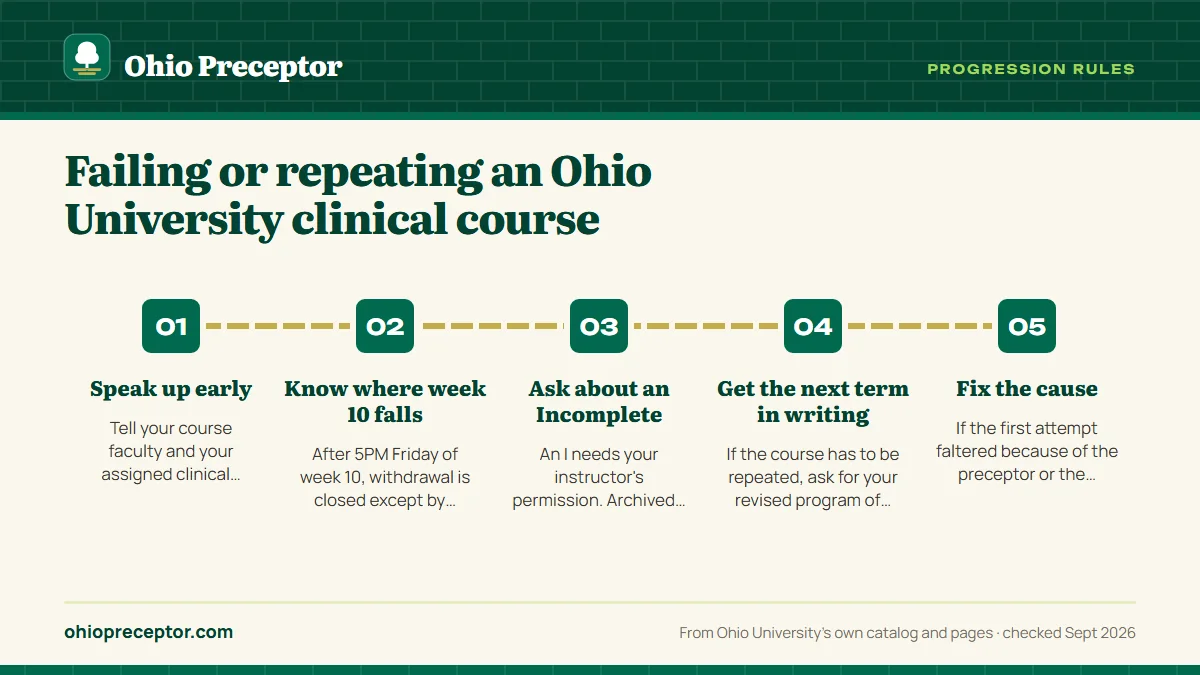
- Speak up earlyTell your course faculty and your assigned clinical supervisor as soon as hours slip or feedback turns negative, not in the final weeks.
- Know where week 10 fallsAfter 5PM Friday of week 10, withdrawal is closed except by petition; before it, a WF still counts as a failed attempt. Decide with both facts in view.
- Ask about an IncompleteAn I needs your instructor's permission. Archived forms lists also show a Graduate Clinical Hour Completion/Extension form, so ask faculty whether it fits your situation.
- Get the next term in writingIf the course has to be repeated, ask for your revised program of study so you know which term the repeat lands in.
- Fix the causeIf the first attempt faltered because of the preceptor or the setting, secure a better fit for the repeat well before its clinical packet deadline. The behind on clinical hours page helps if hours were the problem.
The costly move is withdrawing late in the hope of protecting your record. After the drop deadline, any withdrawal still means repeating the course, and a WF uses up one of your two failed attempts.
Appeals and where to get help
If you believe a final grade is wrong, Ohio University's Grade Appeals process runs from the instructor to the department chair or school director, then the dean, then a five-member faculty committee. The catalog's window is short: no later than 15 business days from the start of the fall or spring semester right after the grade was assigned. The Office of the Ombudsperson can guide you through an appeal or toward an informal resolution.
Dismissal from a program can be appealed as well, through the department chairperson to the associate dean of the college. For other course concerns, the Dean of Students' Student Complaint Directory sends graduate students to the department chair or school director first, then the college dean. Each route takes time, so act while the course is still running.
Setting up the repeat to succeed
A repeat is a fresh start, and the preceptor is the piece you can change most. If the first attempt suffered because a preceptor left mid-term, the site did not match the course, or the weekly days never added up to 250 hours, a new placement can put each of those right.
That is where Ohio University students bring us in. Your placement advisor sources a preceptor and site suited to the repeated course, confirms the full hour commitment and weekly schedule for that term, and assembles the credentials, license and site details faculty review, so the repeat's packet goes in complete and early. Approval stays with Ohio University faculty. Should a preceptor step away mid-term, we reopen the search immediately; the preceptor dropped out page explains how. Tell us about your repeat in the form below.
Questions Ohio University students ask
Can I be dismissed for failing one clinical course?
Not under the published rule on a first failure: two failed attempts are allowed across the program, and dismissal comes on the third. The same page limits each course to one repeat, though, so failing the repeat of that same course leaves no further attempt under the rule. Ask the School of Nursing what follows in that case.
Does a WP count against me?
A WP is not named as a failed attempt, and the catalog says WP, WF and WN grades do not affect your GPA. It still stays on your record after you retake the course, and because you withdrew, the course must be repeated. It also takes you out of sequence, which means a new program of study.
What grade do I need to pass an Ohio University practicum?
The clinical-course minimum is set in the Graduate Nursing Student Handbook, which you request from graduatenursing@ohio.edu; it is not published. The Graduate Catalog's floor is C (2.0) for any course counting toward a degree, a B- is labeled "Minimally Acceptable," and graduation needs a 3.0 cumulative GPA.
Will a passing grade on the repeat replace my first grade?
No. The Graduate Catalog says the earlier grade stays on the transcript and in the GPA calculation when a graduate class is taken again, and the School of Nursing adds that retaking a course leaves a WP or WF in place. Both attempts remain visible, which is why the first one is worth protecting.
Can I use the same preceptor for the repeat?
Ohio University's public pages do not address it. Faculty approve every preceptor and site, so the choice runs through them either way. If the relationship or setting contributed to the first result, a different preceptor may serve you better; if the problem lay elsewhere, ask faculty whether keeping the same preceptor is acceptable.
Related pages
Last checked 2026-09-24
We check these pages against Ohio University's own catalog, program pages and Nursing Knowledge Center. Your syllabus, the Graduate Nursing Student Handbook and your faculty have the final word.
- Ohio University Nursing Knowledge Center: important dates
- Ohio University Graduate Catalog 2026-27: academic policies
- Ohio University Graduate Catalog: NRSE 6840 FNP Practicum I
- Ohio University Graduate Catalog: NRSE 7940 Nurse Educator Practicum I
- Ohio University Nursing Knowledge Center: Graduate Nursing Handbook
Ohio University lets you choose your preceptor. We find the right one.
Tell us your Ohio University program, your community and your next clinical course. We find preceptors who fit the course and prepare what faculty review before they approve them.
- Preceptors matched to the course: primary care for the FNP
NRSE 6840sequence, acute care for AG-ACNP, psychiatric care for PMHNP - Your clinical packet details ready ahead of Ohio University's packet deadline
- Close to home, in Ohio or in any state where Ohio University admits graduate nurses
Start your placement plan
Program, city and clinical start is all we need to begin.