Behind on clinical hours in an Ohio University practicum
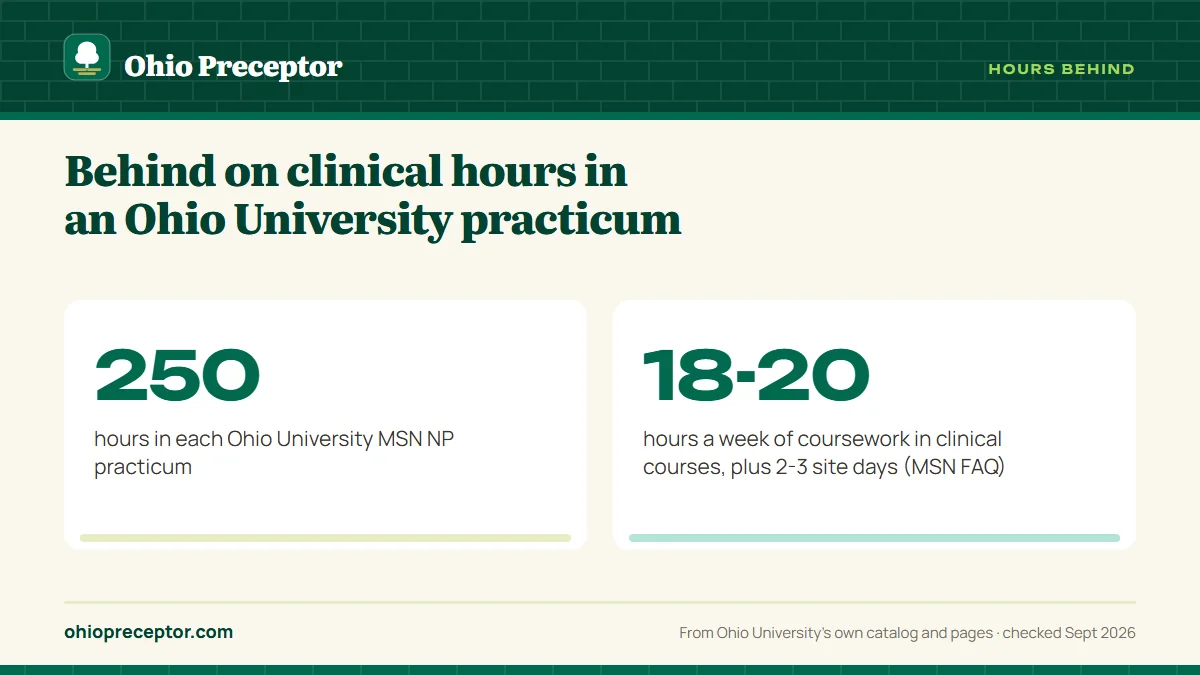
Each MSN NP practicum at Ohio University carries 250 hours, and the published rule is that all of them are finished by the end of the semester. If you are behind, the answer is usually more days with your current preceptor, a second approved preceptor, or both. Here is how to measure the gap and close it.
Get your placement plan
Tell us your Ohio University program and where you live. A placement advisor replies with the preceptor and site options that fit your course.
The rule: every hour inside the semester
Ohio University's MSN-to-DNP sample calendar states that all clinical and practicum hours for each clinical or practicum course must be completed by the end of the 14-week semester. That page is written for the DNP, and your own syllabus is the final word for your course, so ask faculty if it says anything different.
Note the week count. Ohio University's program pages describe 15-week courses, while this calendar and the graduate catalog's drop rule refer to a 14-week semester. The dates themselves are fixed: Fall 2026 runs 08/24 to 12/12/2026, Spring 2027 runs 01/11 to 05/01/2027 and Summer 2027 runs 05/10 to 08/14/2027. Plan to the dates your course gives you, not to a week count.
What the hours look like per week
Ohio University's MSN FAQ estimates about 18 to 20 hours a week of work through the clinical courses plus two to three days at your clinical site. The table shows the arithmetic for common situations; it is simple division, not an Ohio University figure.
| Hours still needed | Weeks left | Hours per week |
|---|---|---|
| 250 | 15 | about 16.7 |
| 250 | 14 | about 17.9 |
| 150 | 8 | about 18.8 |
| 120 | 5 | 24 |
| 100 | 3 | about 33.3 |
Other programs carry different loads per course. Emergency NP courses list 150 hours each, with NRSE 6859 at 200 on the web page, and the DNP practicums show 250 each in the catalog but 100 and 150 on the sample schedule. The clinical hours page sets out those conflicts.
Spot the gap before week 10
Ohio University's deadline to withdraw from an individual class falls in the tenth week (Fall 2026: October 30; Spring 2027: March 26; full Summer 2027: July 16). After that, the School of Nursing allows only a late-drop petition in the most extreme circumstances. So the time to measure your pace is well before then: compare hours logged against weeks elapsed every two weeks, and act the first time you slip below the line.
Typical causes are fixable once named: a preceptor who can offer only one day a week, a site with limited patient volume in your population focus, a clash with your work schedule, or clinical days lost around an on-campus intensive in Dublin. The fix follows from the cause, so name it before you choose one.
Options when you are short
- Add days with your current preceptor. The simplest fix when they have capacity; confirm the new schedule with faculty.
- Add a second preceptor. Another approved clinician, at the same site or a different one, can carry part of the remaining hours. Each preceptor needs faculty approval, and some sites limit this: Nationwide Children's, for example, allows graduate students one preceptor per term.
- Ask about an Incomplete. It needs the instructor's permission, and the graduate catalog puts a firm clock on the unfinished work.
- Withdraw only as a last resort. It means repeating the course, a WF counts as a failed attempt, and you go out of sequence.
Talk to faculty before choosing, and bring numbers: hours done, hours left, weeks left and your plan. If the gap comes from losing your preceptor altogether, the preceptor dropped out page covers that case.
The assumption that hurts: that leftover hours roll into next term. The published rule puts every practicum hour inside the semester.
How we add a second preceptor
A second preceptor is often the quickest way back on pace, and adding one is routine work for us. Your placement advisor looks for a clinician in your population focus near you with open days in the weeks you need, confirms that availability in writing, and gathers their credentials, license and site details for faculty review. If your current site has another qualified clinician, we start there, since faculty already know the site.
Ohio University students choose us because we plan around the hours, not only the name: the schedule we bring back is built to finish your practicum inside the semester. Send your hours logged, weeks left and course number through the form below, or read how it works.
Questions Ohio University students ask
Can unfinished clinical hours carry into next semester?
Not under the published rule on Ohio University's MSN-to-DNP calendar, which puts all practicum hours for a course inside the semester. The graduate catalog's route for unfinished work is an Incomplete, which needs the instructor's permission and has its own completion deadline. Raise it with faculty early rather than assuming hours will roll over.
How many clinical hours a week should I plan for?
Divide your remaining hours by the weeks left in the term. A full 250-hour practicum works out to roughly 17 to 18 hours a week across a 14- or 15-week term. Ohio University's MSN FAQ frames the overall commitment as about 18 to 20 hours of coursework weekly plus two to three days at your clinical site.
Can I have two preceptors in one practicum?
Ohio University's public pages state no limit, so your faculty decide. Each preceptor must be approved, and sites may set their own rules, such as Nationwide Children's one-preceptor-per-term policy for graduate students. Tell faculty how the hours will split between the two before the second preceptor starts.
Does falling behind on hours mean I fail the course?
Ohio University's public pages do not say. The grading policy, including the minimum passing grade for graduate clinical courses, sits in the Graduate Nursing Student Handbook rather than on public pages. Request the handbook from graduatenursing@ohio.edu, read your syllabus, and agree a written catch-up plan with faculty before the gap grows.
Related pages
Last checked 2026-09-24
We check these pages against Ohio University's own catalog, program pages and Nursing Knowledge Center. Your syllabus, the Graduate Nursing Student Handbook and your faculty have the final word.
Ohio University lets you choose your preceptor. We find the right one.
Tell us your Ohio University program, your community and your next clinical course. We find preceptors who fit the course and prepare what faculty review before they approve them.
- Preceptors matched to the course: primary care for the FNP
NRSE 6840sequence, acute care for AG-ACNP, psychiatric care for PMHNP - Your clinical packet details ready ahead of Ohio University's packet deadline
- Close to home, in Ohio or in any state where Ohio University admits graduate nurses
Start your placement plan
Program, city and clinical start is all we need to begin.