Out of sequence: dropping or delaying an Ohio University clinical course
At Ohio University, a graduate nursing student who removes a nursing course from the schedule goes out of sequence and must request a new program of study. Because clinical courses chain together and several run once a year, one dropped practicum can reshape the rest of the program. Here is what the status means, how students land in it, and how to get your next practicum back on track.
Get your placement plan
Tell us your Ohio University program and where you live. A placement advisor replies with the preceptor and site options that fit your course.
What "out of sequence" means
Ohio University gives each graduate nursing cohort "a program of study with an established completion timeline and availability of courses." Your advisor registers you from that plan every semester. The Important Dates page spells out what happens when you step off it: "Students removing a graduate nursing course from their schedule will be going out of sequence and will need to request a new program of study."
The DNP FAQ gives the reason the plan is so fixed: courses are taken in order, and some are offered only in particular semesters. The practicums are also chained by requisite, NRSE 6844 behind NRSE 6843 and NRSE 6845 after that, so a gap in one course pushes back every clinical course after it.
The request process has left only traces in public. Ohio University's 2024 graduate Forms page listed an "Out of Sequence Request Form"; the title was gone from the 2025 and 2026 versions, and the page now requires university sign-in. Ask your advisor or graduatenursing@ohio.edu for the current route instead of hunting for an old form.
How a clinical course falls out of sequence
The usual routes, from the Important Dates page and the Graduate Catalog
- Dropping before the term: a drop in Student Center before classes begin leaves nothing on the DARS, but the course still leaves your plan.
- Dropping in the first two weeks, before 5PM Friday of week 2: the course stays off your record, and you are still out of sequence.
- Withdrawing by 5PM Friday of week 10: a WP or WF goes on the record, you will take the course again, and a WF uses one of your two allowed failures.
- Failing the course: a repeat, with the attempt counted against the program-wide limit.
- Taking a leave of absence: up to one year, declared to your program before the term it begins.
One route has no public rule at all: a practicum that cannot start because no preceptor was approved in time. Ohio University does not say whether that counts as an attempt. What the calendar does make clear is that the clinical packet deadline falls weeks before the term, so a missing preceptor becomes a scheduling problem early. The grade side of withdrawals and failures is on the repeat rules page; this page deals with the timeline.
Once-a-year courses and the wait they create
How long you wait depends on when your course runs next. The Knowledge Center's tentative offerings table, reproduced on the semester calendar page, lists each AG-ACNP practicum in a single term: fall for NRSE 6843, spring for NRSE 6844, summer for NRSE 6845. The Emergency NP courses keep the same fall, spring, summer order, and the Nurse Leader and Nurse Educator practicums each appear once, in fall or spring.
Read plainly, a missed AG-ACNP or ENP practicum returns twelve months later. FNP, PMHNP and DNP practicums appear in two terms each, so the wait is often one semester, though not always: NRSE 6842 is not offered in spring and NRSE 6848 is not offered in summer, which can stretch a gap to two terms. These are readings of a tentative table, not stated rules, so the new program of study you receive is the final word.
Time limits and enrollment status
Being out of sequence does not remove you from the program, but the clock keeps running. The Graduate Catalog gives master's students six calendar years, extendable to seven only for programs over 40 credit hours; the MSN nurse practitioner tracks are 40 credits, and the MSN FAQ says you have up to six years. DNP students have seven calendar years. A dean may grant a one-time, one-semester extension, and beyond that a student must apply for readmission, which may bring extra practicum hours. Each birth or adoption adds an automatic one-semester extension.
Two catalog rules matter before you skip a term. A leave of absence "does not automatically extend the time limit for completion of a degree" and has to be declared before the term it covers. And the catalog shifts a student who skips enrollment for more than one semester into inactive status, with re-enrollment required to return. How the School of Nursing applies that rule to online MSN and DNP students is not stated, so ask your advisor before planning a gap. The delayed graduation page looks at what lost time means for your finish date.
Requesting a new program of study
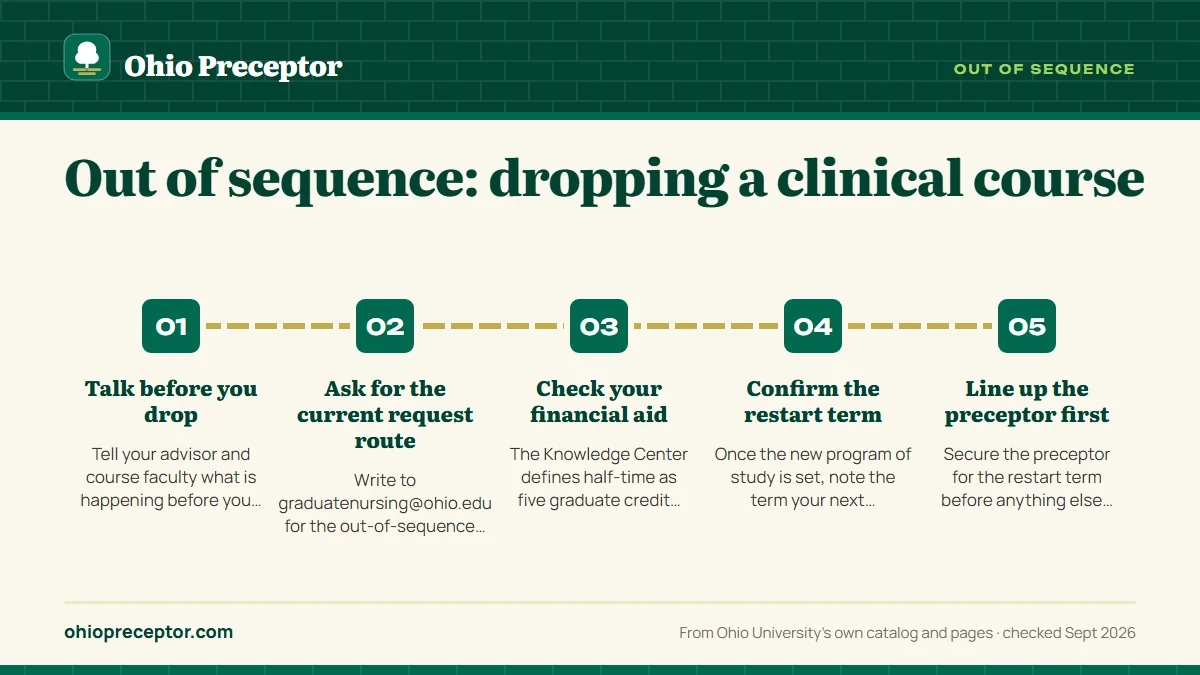
- Talk before you dropTell your advisor and course faculty what is happening before you remove the course, and check that term's drop and withdrawal dates.
- Ask for the current request routeWrite to graduatenursing@ohio.edu for the out-of-sequence process in use now, since the old form title has left the public record.
- Check your financial aidThe Knowledge Center defines half-time as five graduate credit hours, which it says takes at least two courses a semester. Ask Student Financial Aid and Scholarships how a lighter term affects you.
- Confirm the restart termOnce the new program of study is set, note the term your next practicum runs and that term's clinical packet deadline.
- Line up the preceptor firstSecure the preceptor for the restart term before anything else, so the new plan does not slip a second time.
Staying in sequence in the first place
The surest protection is a preceptor confirmed early. Each term's clinical packet is due well before classes begin, and the four Ohio hospital systems on Ohio University's list close their windows earlier still, Holzer about four and a half months before the term starts. See the packet deadline dates and the hospital application windows for each term.
Beyond timing, a few habits keep a practicum on its track: a preceptor who has agreed to the full 250 hours and a weekly pattern you can both keep, a second option held in reserve while a hospital system decides, and on-campus intensive dates built into the schedule from the start.
The trap is waiting on a single hospital application with no fallback. If the answer comes after the packet deadline, the course slips a term, or for once-a-year courses, a full year.
How we get you back in sequence
Ohio University students come to us at both ends of this problem: to avoid it, and to recover from it. For a restart, your placement advisor works from your new program of study, begins the search as soon as the restart term is known, and confirms a preceptor who commits to the full hours for that term.
We then prepare the credentials, license and site details faculty review, check any hospital window against the packet deadline, and keep a replacement search ready if plans change. For once-a-year courses we begin the moment you know you are out of sequence, because the lead time is longest. Every preceptor and site still needs Ohio University faculty approval, and the file faculty review arrives whole. If the restart term is close, start with need a preceptor fast, or use the form below.
Questions Ohio University students ask
Does going out of sequence mean I am dismissed?
No. The published consequence of removing a nursing course is a revised plan, not removal from the program. Dismissal follows other events: a third failed attempt, or a GPA still below 3.0 at the end of a probation semester. The repeat rules page linked above covers both.
Is a new program of study the same as readmission?
No. A new program of study reorders your remaining courses while you stay enrolled. Readmission is the step the Graduate Catalog applies when a student runs past the time limit after any extension, and re-enrollment applies to a student moved to inactive status. Readmission can come with extra requirements, including additional practicum hours.
If I can't find a preceptor, can I start the practicum late and catch up?
Ohio University's public pages give no late-start rule. Practicum hours belong to their semester, and the DNP sample schedule requires all hours by the end of the term. A Graduate Clinical Hour Completion/Extension form appears in archived forms lists, but its terms are not public. Ask faculty early; the behind on clinical hours page has options.
Can I drop a non-clinical nursing course without going out of sequence?
The Important Dates wording covers every graduate nursing course, not just practicums. Non-clinical courses such as NRSE 7230 also gate the clinical sequence, so ask your advisor how a change would move your first practicum before you make it.
Related pages
Last checked 2026-09-24
We check these pages against Ohio University's own catalog, program pages and Nursing Knowledge Center. Your syllabus, the Graduate Nursing Student Handbook and your faculty have the final word.
Ohio University lets you choose your preceptor. We find the right one.
Tell us your Ohio University program, your community and your next clinical course. We find preceptors who fit the course and prepare what faculty review before they approve them.
- Preceptors matched to the course: primary care for the FNP
NRSE 6840sequence, acute care for AG-ACNP, psychiatric care for PMHNP - Your clinical packet details ready ahead of Ohio University's packet deadline
- Close to home, in Ohio or in any state where Ohio University admits graduate nurses
Start your placement plan
Program, city and clinical start is all we need to begin.