Kansas nurses and Ohio University: what is open, what is not
As of September 2026, Kansas is not among the 28 states whose residents Ohio University admits to its online MSN, certificates and MSN-to-DNP. The RN-to-BSN lists Kansas on every version. Kansas regulators review out-of-state APRN programs when a graduate applies for a Kansas license, so their checklist is worth reading early.
Get your placement plan
Tell us your Ohio University program and where you live. A placement advisor replies with the preceptor and site options that fit your course.
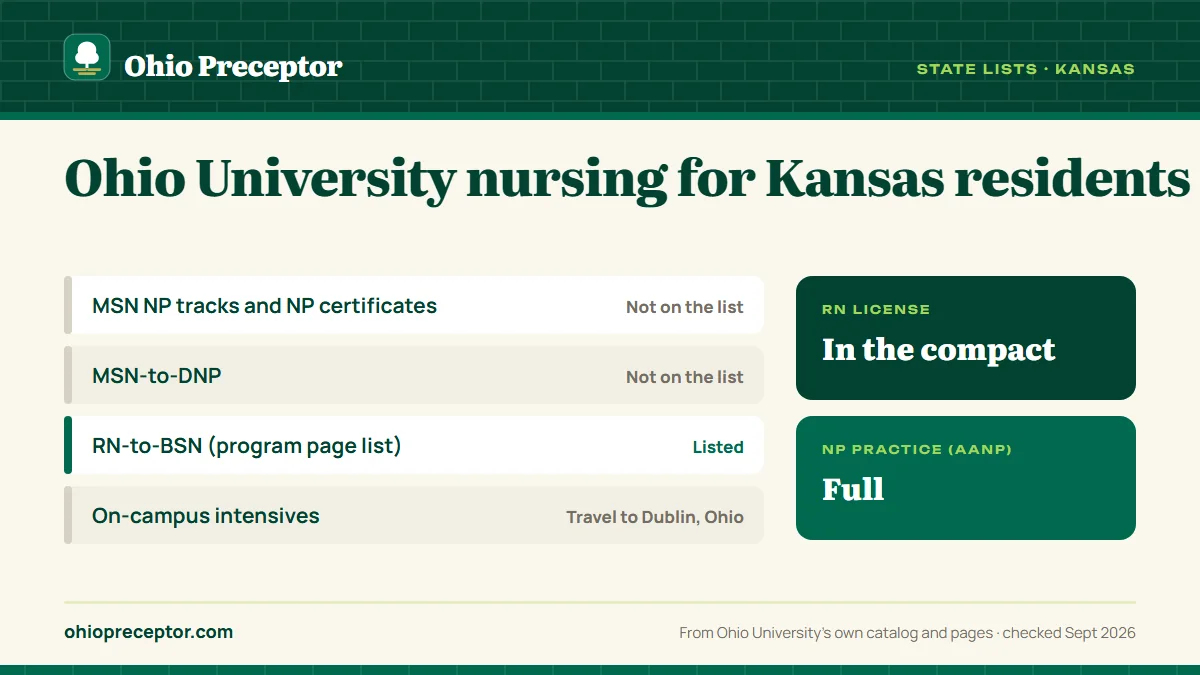
Kansas residents and each Ohio University program
| Program | Kansas residents | Delivery | Clinical hours |
|---|---|---|---|
| MSN FNP, PMHNP or AG-ACNP (40 credits) | Not eligible: Kansas is off the list | Online, with 1-2 day intensives in Dublin, Ohio | 750 |
| Post-master's certificates (20 credits) | Not eligible | Online, with intensives | 750; Emergency NP 450 or 500 |
| MSN-to-DNP | Not eligible | Online, with intensives | 1,000 post-baccalaureate |
| Nurse Leader or Nurse Educator MSN | Not eligible | Online | 500 |
| RN-to-BSN | Listed on all four versions | 100% online, no campus visits | 31.5 |
The provost's MSN licensure disclosure marks Kansas "No" as well. State lists get revised, so verify Kansas's status with Ohio University before applying; the approved states page sets every version side by side.
KSBN reviews programs at licensure, not before
Kansas lets an online APRN program from another state enroll Kansas residents without first registering with its Board of Nursing. The Board's scrutiny arrives at the end instead, once one of the program's graduates files for Kansas APRN licensure. KSBN's published material likewise sets out no placement-approval step for RN-BSN programs based outside Kansas.
On the clinical floor, the rules get concrete. An APRN student in Kansas works on an RN license the state recognizes, Kansas single-state or multistate, with the status of a student of advanced practice nursing. KSBN wants the preceptor oriented, bound by a signed agreement and holding a Kansas APRN license that matches the student's role, and anyone giving APRN students clinical supervision likewise needs Kansas APRN licensure. Online instructors, by contrast, can teach Kansas students without a Kansas license, and faculty site visits are optional; a faculty member who comes does so as a visitor.
The checklist KSBN applies to graduates
Once a graduate from another state's program applies to KSBN for APRN licensure, the Board wants proof of national accreditation and a program of 45 or more credit hours, including a minimum of 3 credits apiece in the three advanced core subjects: pharmacology, health assessment and pathophysiology. Clinical time in the role and specialty is counted too. Students who entered their program before March 1, 2025 need 500 such hours; for later admissions the bar rises to 750.
Now compare Ohio University's numbers. Its MSN NP tracks list 750 clinical hours within 40 credits, and its post-master's certificates list the same 750 hours within 20 credits, taken after an earlier graduate degree. KSBN decides how those credits add up, so an Ohio University student or graduate who expects to hold a Kansas APRN license should ask KSBN directly.
Where Kansas plans go wrong: assuming the clinical hours settle licensure. The credit-hour total is a separate line on KSBN's checklist.
Kansas City, Wichita and the systems in between
Census estimates for 2025 count about 938,000 Kansans in their state's part of the Kansas City metro and about 664,000 in metro Wichita, with Topeka and Manhattan trailing. Systems in the state include Stormont Vail Health, The University of Kansas Health System, Ascension Via Christi and Wesley Healthcare, HCA's Wichita hospital group. They illustrate the market and carry no known arrangement with Ohio University. AANP rates Kansas as full practice.
Compact membership began in Kansas on July 1, 2019, while APRN Compact legislation has not passed. Across the state line, Missouri is on Ohio University's approved list, belongs to the compact, and per Ohio University's disclosure wants clinical faculty licensed in Missouri.
Why Kansas nurses choose us
Kansas RNs enrolled in Ohio University's RN-to-BSN hand the search to a placement advisor: a Kansas-licensed preceptor with at least a BSN, a community site that sees patients of all ages for NRSE 4585, a site where the NRSE 4595 project can run, and Preceptor Agreement details finished ahead of the cutoff. Kansans relocating to Missouri or another approved state can start the NP preceptor search for their new home now. Ohio University graduate students eyeing a move to Kansas should ask the School of Nursing first. The RN license page and our contact page are the next stops.
Questions Ohio University students ask
Can I enroll in Ohio University's online FNP from Wichita or Topeka?
Not while you live in Kansas. The approved-state rule on Ohio University's application page, as of September 2026, calls for residence in a listed state and an unrestricted RN license, and Kansas is not listed. The rule covers every graduate nursing program, including the certificates and MSN-to-DNP. Confirm with Ohio University before planning a move to an approved state.
Does Kansas need to approve Ohio University before I do clinicals there?
No Board approval is needed up front. KSBN explains that APRN programs based in other states may enroll Kansas residents online and are examined only at the licensure stage, and its documents set no placement approval for RN-to-BSN clinicals either. Individual facilities may still insist on affiliation agreements of their own.
Who can precept an APRN student in Kansas?
Under KSBN's guidance, the preceptor needs Kansas APRN licensure in the student's role, an orientation and a signed agreement, and anyone supervising APRN students clinically also needs Kansas APRN licensure. You, the student, practice on a Kansas single-state or multistate RN license that Kansas recognizes.
Is the RN-to-BSN open to Kansas nurses?
Kansas makes every RN-to-BSN list Ohio University prints, the 32-state program page and the three trimmed course-page versions alike. Clinical time totals 31.5 hours, done close to home, and the rest of the program is online. See the RN-to-BSN page for deadlines and forms.
Related pages
Last checked 2026-09-24
We check these pages against Ohio University's own catalog, program pages and Nursing Knowledge Center. Your syllabus, the Graduate Nursing Student Handbook and your faculty have the final word.
Ohio University lets you choose your preceptor. We find the right one.
Tell us your Ohio University program, your community and your next clinical course. We find preceptors who fit the course and prepare what faculty review before they approve them.
- Preceptors matched to the course: primary care for the FNP
NRSE 6840sequence, acute care for AG-ACNP, psychiatric care for PMHNP - Your clinical packet details ready ahead of Ohio University's packet deadline
- Close to home, in Ohio or in any state where Ohio University admits graduate nurses
Start your placement plan
Program, city and clinical start is all we need to begin.