California and Ohio University's nursing programs
As of September 2026, California is not one of the states Ohio University accepts for its online MSN, post-master's certificates or MSN-to-DNP, though it sat on an earlier version of that list. The RN-to-BSN still names California, and the state's Board of Registered Nursing must approve any out-of-state NP program in advance before its students train in California.
Get your placement plan
Tell us your Ohio University program and where you live. A placement advisor replies with the preceptor and site options that fit your course.
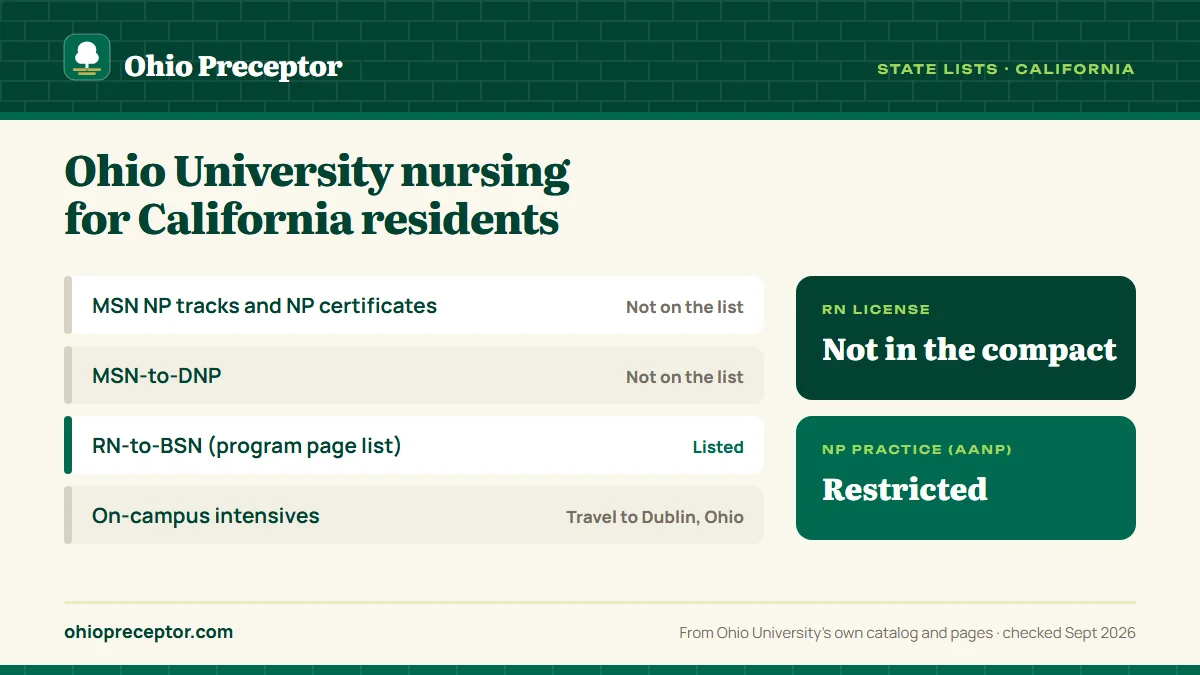
California was on the list once
A July 2019 story from Ohio University's College of Health Sciences and Professions announced the MSN and DNP opening to 22 new states, joining a starting group of six: California, Indiana, Kentucky, Michigan, Ohio and West Virginia. Today's application page names 28 approved states. California is gone from it and Maryland has been added, yet some older school-directory profiles still print the six-state group.
| Program | California residents | Format | Clinical hours |
|---|---|---|---|
| MSN FNP, PMHNP or AG-ACNP, and the matching post-master's certificates | Residence rule not met | Online with short campus intensives | 750 |
| Emergency NP certificate | Residence rule not met | Online | 450 (catalog) or 500 (program page) |
| MSN-to-DNP | Residence rule not met | Online | 1,000 post-baccalaureate |
| MSN Nurse Leader or Nurse Educator | Residence rule not met | Online | 500 |
| RN-to-BSN | Named on all four state lists | 100% online, no campus travel | 31.5 |
The provost's MSN licensure disclosure marks California "No" too. The approved states page has the full list and the spots where Ohio University's pages disagree; check with Ohio University before an application or a move.
The Board of Registered Nursing's step for outside NP programs
California writes this into regulation. Its rule, 16 CCR § 1486, says an NP program based in another state must win the Board of Registered Nursing's approval in advance of placing students in California clinical settings. The first filing is the Board's Verification of Clinical Practice Experience form, and a vote at a Board meeting follows.
What § 1486 expects once a program is approved
- Each preceptor practices under a current California license in their own profession and is qualified for the student's NP category.
- The program orients every preceptor, faculty review each one at least once every two years, and an NP Program Preceptor form is kept on file.
- A written agreement among the agency, the preceptor and the program defines the preceptor's role.
- The curriculum teaches California NP law, including standardized procedures, and students hold an active California RN license.
Approval happens at the program level, so a student cannot file it alone; speak with Ohio University before counting on NP clinical time in California.
Licensing: California sits outside the compact
California is not a Nurse Licensure Compact member, and compact tracking shows no pending bill. A multistate license from Ohio or another member state does not reach California, and § 1486(d) makes a California RN license a condition of out-of-state NP clinicals here. Nor has California enacted the APRN Compact.
RN-to-BSN students face a lighter rule set: the BRN site shows no separate approval process for out-of-state RN-BSN programs. Ohio University's own requirement is that the preceptor's license match both your state and the facility's; the RN license page explains the compact in detail.
Practice rules and where California NP students look
California is a restricted-practice state in AANP's ratings. Some settings and procedures require NPs to keep a standardized protocol agreement, subject to exemptions the Board lists, which shapes who can precept. No state preceptor incentive is on record.
Kaiser Permanente, headquartered in Oakland, runs Northern and Southern California regions. Sutter Health covers Northern and Central California, and University of California Health links UC Davis, UCSF, UCLA, UCI, UC Riverside and UC San Diego. Cedars-Sinai in Los Angeles and Stanford Health Care finish the list. These are places NP students look, not systems known to take Ohio University students. Ohio University's college keeps an employer partnership page for Sutter Health, but such partnerships are employee tuition discounts, not clinical-placement agreements.
Who this page helps, and how we fit
California RNs in Ohio University's RN-to-BSN need a preceptor with a BSN or higher, licensed in California, at a community site for NRSE 4585 and at a site that can host the NRSE 4595 capstone. Ohio University graduate students considering a move west should raise it with the School of Nursing (graduatenursing@ohio.edu) first. Californians relocating to an approved neighbor such as Nevada can start the search for their new home early.
For each of them, your placement advisor does the legwork: a preceptor who fits the course and the state's license rules, a site with its agreement and onboarding needs confirmed, and the details faculty review before approving. Send your course and start term through the contact page.
Questions Ohio University students ask
Can I apply to Ohio University's online FNP while living in California?
Not under the current rules. Ohio University's MSN application page, checked in September 2026, wants applicants to live in one of its 28 approved states and document a valid, unrestricted RN license there; California does not make that list. Every graduate nursing option shares the requirement, the certificates and MSN-to-DNP included.
Why did California drop off Ohio University's list?
Ohio University has not said. The record shows only the sequence: California was in the original group named in the July 2019 college story and is absent from today's 28-state list. For an answer about your own situation, email the School of Nursing at graduatenursing@ohio.edu.
Can California RNs take Ohio University's RN-to-BSN?
By Ohio University's published lists, yes: California is named on the program page and on all three shorter versions, down to the NRSE 4600 course page. The 31.5 clinical hours happen near home, at a site you pick. Courses, the Preceptor Agreement Form and deadlines are on the RN-to-BSN page.
Would a multistate license cover clinicals in California?
No. California has no compact membership, so a multistate license issued in Ohio or another member state stops at the California line. Its rule for out-of-state NP programs also requires an active California RN license for clinicals there, on top of the program's own Board approval.
Related pages
Last checked 2026-09-24
We check these pages against Ohio University's own catalog, program pages and Nursing Knowledge Center. Your syllabus, the Graduate Nursing Student Handbook and your faculty have the final word.
Ohio University lets you choose your preceptor. We find the right one.
Tell us your Ohio University program, your community and your next clinical course. We find preceptors who fit the course and prepare what faculty review before they approve them.
- Preceptors matched to the course: primary care for the FNP
NRSE 6840sequence, acute care for AG-ACNP, psychiatric care for PMHNP - Your clinical packet details ready ahead of Ohio University's packet deadline
- Close to home, in Ohio or in any state where Ohio University admits graduate nurses
Start your placement plan
Program, city and clinical start is all we need to begin.