South Carolina and Ohio University's online NP programs
Yes, South Carolina is on the list: as of September 2026 it is one of 28 states whose residents may apply to Ohio University's online graduate nursing programs. What follows is South Carolina's own detail, starting with a preceptor tax credit that sounds like a recruiting tool but stops at the state line.
Get your placement plan
Tell us your Ohio University program and where you live. A placement advisor replies with the preceptor and site options that fit your course.
Which Ohio University programs South Carolinians can join
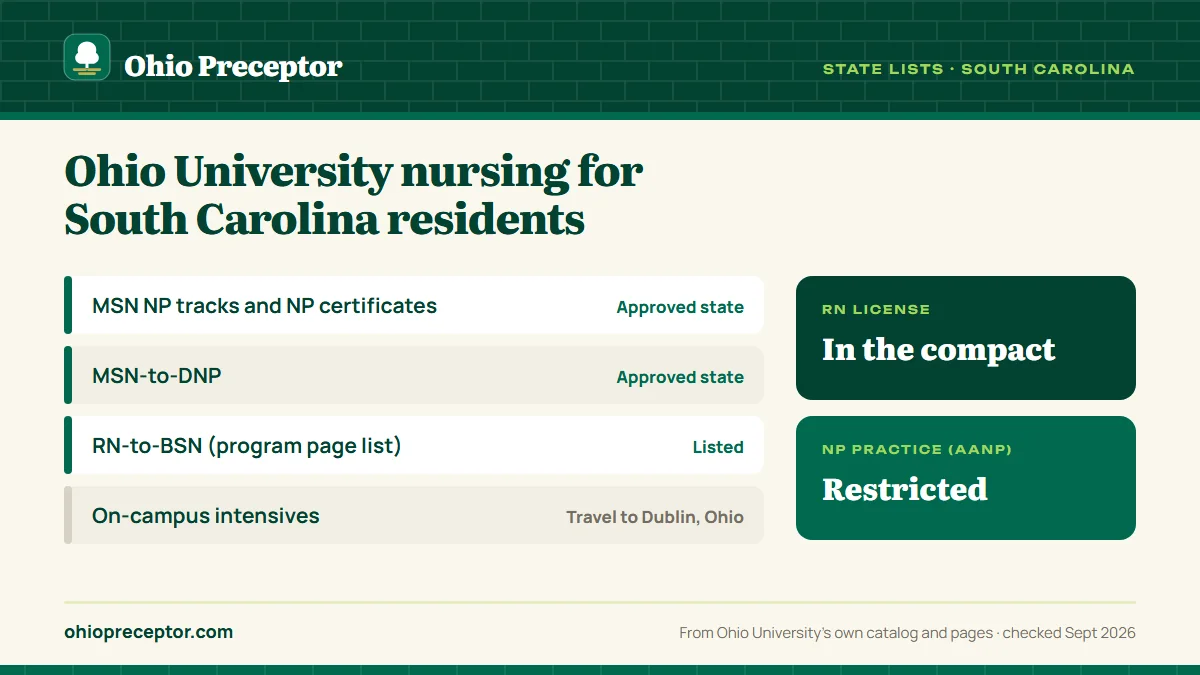
Living in South Carolina with a valid, unrestricted RN license satisfies Ohio University's graduate rule for each online track below, and the state also shows up on all four RN-to-BSN lists. Ohio University revises these lists, so confirm with the School of Nursing before you apply or relocate. The approved states page holds the whole comparison.
| Program | South Carolina residents | How it runs | Clinical hours |
|---|---|---|---|
| FNP, PMHNP or AG-ACNP (MSN or post-master's certificate) | May apply | Online, short campus intensives | 750 |
| Emergency NP certificate | May apply with FNP licensure and ACLS | Online, two intensives | 450 or 500 (Ohio University sources differ) |
| MSN-to-DNP | May apply | Online, intensives | 1,000 post-baccalaureate |
| Nurse Leader or Nurse Educator MSN | May apply | Online | 500 |
| RN-to-BSN | Listed on all four versions | Fully online | 31.5 |
The preceptor tax credit, and why it skips Ohio University students
Under S.C. Code 12-6-3800, a physician, APRN or PA who precepts without pay can reduce state income tax rotation by rotation, with a deduction available beyond the credited ones. The fine print is strict: rotations of 160 hours or longer, at least two in a year, Medicaid participation with 100-plus patients across Medicaid and Medicare together, and students who attend a public or independent college in South Carolina.
That last condition excludes you, so a preceptor who hosts an Ohio University student claims nothing for it. Mention this early; a preceptor who hears it later may feel misled. Even the end date is disputed: a 2024 amendment (Act No. 217) runs the credit to tax year 2029, yet the state revenue department's older ruling, #20-2, still shows repeal on January 1, 2026.
Practice agreements shape the preceptor pool
In AANP's scheme South Carolina counts as restricted. Delegated acts require a written practice agreement with a physician, and prescribing controlled substances comes with supply limits. An NP who precepts you in South Carolina therefore practices under a physician's agreement, and that relationship is part of the site you will train in.
Setting matters as much as credentials. Ohio University's MSN FAQ places FNP hours in primary-care offices or hospital and community-based clinics, and PMHNP hours in settings such as community mental health agencies, correctional facilities or substance-abuse treatment programs. The credential rules for each track are in the preceptor packet; see preceptor requirements.
Greenville, Charleston, Columbia and the Charlotte fringe
Greenville-Anderson-Greer is South Carolina's largest metro at roughly 1.01 million people. Charleston-North Charleston and Columbia each sit just under 900,000, and the Charlotte metro takes in about 454,000 South Carolina residents. Systems NP students look at include Lexington Health (Lexington Medical Center), McLeod Health, Prisma Health, MUSC Health and Roper St. Francis Healthcare.
Treat these as examples, not partners. A system that runs a central student process expects you to use it, often months ahead of the term, as Ohio University's MSN FAQ cautions. Students in the Charlotte area may also find a site in North Carolina.
Licensing and South Carolina's rule for programs based elsewhere
The present version of the compact has run in South Carolina since January 19, 2018; a multistate license with South Carolina as your home state is valid in the other member states as well. Regulation 91-6 governs nursing programs based in other states, requiring Board approval, on-site faculty holding a South Carolina or compact license, and a written clinical agreement. It is aimed at programs preparing students for first licensure; RN-to-BSN and APRN programs fall outside its text. A facility may still want its own contract; see affiliation agreements.
Where we come in
We handle the South Carolina specifics that can derail a first conversation with a preceptor, from the tax credit's in-state limit to a system's application window. Your placement advisor searches your area for a practice suited to your Ohio University course, checks the license, and prepares what your clinical packet needs. Ohio University faculty make the approval call, and what reaches them from us is complete and correct at first reading.
Questions Ohio University students ask
Can I study Ohio University's online PMHNP from South Carolina?
As of September 2026, yes: South Carolina residents with a valid, unrestricted RN license meet the residence rule. PMHNP clinicals total 750 hours across NRSE 6846, NRSE 6847 and NRSE 6848, typically in private or community mental health agencies, school-based health centers or substance-abuse treatment facilities near home. The PMHNP program page shows the sequence.
I live near Charlotte. Can I train at a North Carolina site?
Ohio University's pages do not limit graduate clinicals to your home state, so faculty decide site by site. North Carolina belongs to the compact, which lets a South Carolina multistate license cover you there, and North Carolina's board stays out of graduate programs. Read clinicals outside Ohio before you commit.
Who finds my preceptor, me or Ohio University?
Both, in a sense. Ohio University's MSN FAQ lets students identify preceptors for faculty to approve, and names the Graduate Clinical Coordinator as an alternative source of help. Large systems may require their own application. In South Carolina, as anywhere, starting your own search early gives you the widest choice before the clinical packet deadline.
Is Ohio University's RN-to-BSN available to South Carolina nurses?
South Carolina makes every one of the four RN-to-BSN state lists. The program's clinical time, 31.5 hours in total, is split between two five-week courses, NRSE 4585 and NRSE 4595, with a preceptor you secure yourself. The preceptor needs a BSN or higher and an active license in your state and the facility's state, which for most readers means South Carolina. Details are on the RN-to-BSN page.
Related pages
Last checked 2026-09-24
We check these pages against Ohio University's own catalog, program pages and Nursing Knowledge Center. Your syllabus, the Graduate Nursing Student Handbook and your faculty have the final word.
Ohio University lets you choose your preceptor. We find the right one.
Tell us your Ohio University program, your community and your next clinical course. We find preceptors who fit the course and prepare what faculty review before they approve them.
- Preceptors matched to the course: primary care for the FNP
NRSE 6840sequence, acute care for AG-ACNP, psychiatric care for PMHNP - Your clinical packet details ready ahead of Ohio University's packet deadline
- Close to home, in Ohio or in any state where Ohio University admits graduate nurses
Start your placement plan
Program, city and clinical start is all we need to begin.